Guidelines for Developing Educational Institutions into Happy Organizations: Case study Ngaengkwang School, Sikhio District, Surin Province
Article Sidebar
Main Article Content
Abstract
The purposes of this research were: (1) to investigate the current state, the desirable state, and the priority needs for becoming a happy organization in educational institutions; and (2) to explore guidelines for developing educational institutions into happy organizations. This study employed a mixed-method research design. The participants consisted of 50 school administrators and teachers selected through purposive sampling. In addition, the proposed guidelines for developing educational institutions into happy organizations were evaluated by five experts from Vanichanukul School, Sirinthara Suksa School, and Anuban Onsiri School. Data were collected through interviews with school administrators and representative teachers selected by purposive sampling. The research instrument was an evaluation form assessing the appropriateness and feasibility of the proposed guidelines for developing educational institutions into happy organizations. The data were analyzed using descriptive statistics, including the mean, standard deviation, and the Priority Needs Index (PNI).
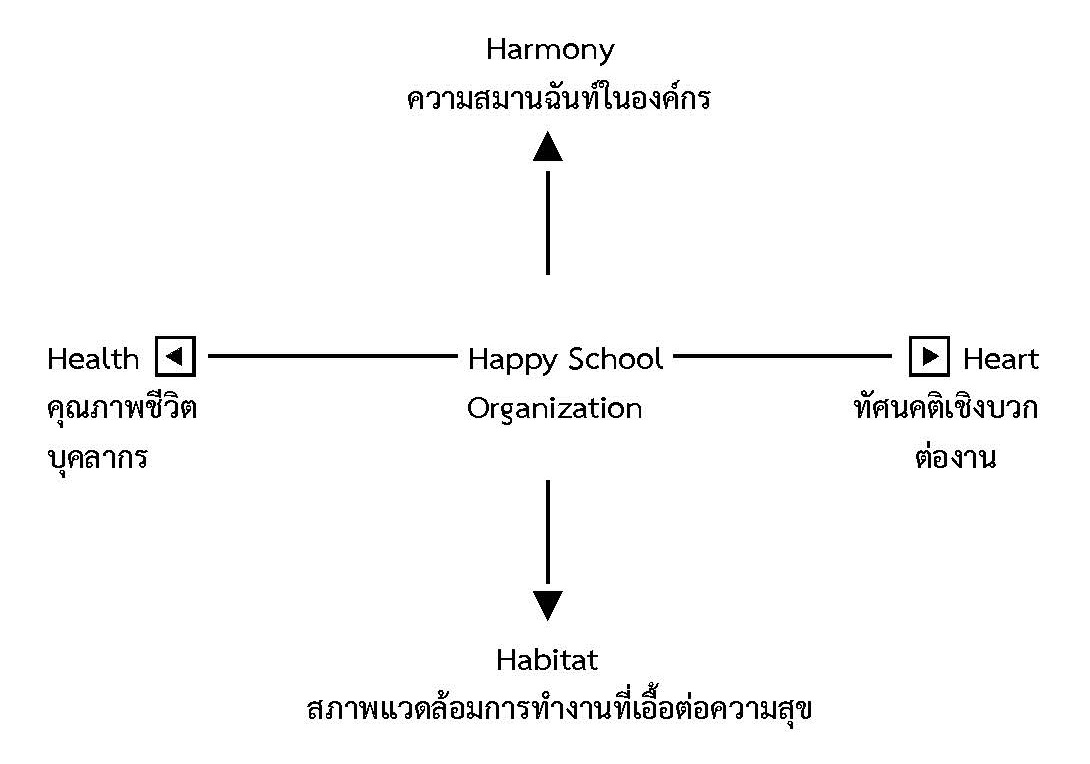
The findings revealed that:- 1. School administrators and teachers at Ngaeng Kwang School, Sikhoraphum District, Surin Province, generally expressed a high level of opinion regarding the current state of a happy organization in schools (X= 4.46). The desired state of a happy organization in schools was rated highest overall (X= 4.81). The essential needs for a happy organization in schools, ranked from highest to lowest, were: 1) Employee happiness (X= 4.88), 2) Positive attitude towards work (X= 4.81), 3) Pleasant work environment (X= 4.77), and 4) Organizational harmony (X= 4.76). 2. The guidelines for developing Ngangkwang School into a happy organization consisted of four aspects: 1) organizational harmony, 2) positive attitudes toward work, 3) a pleasant working environment, and 4) happiness of personnel. A total of 27 development guidelines were proposed. Overall, these guidelines were evaluated as having the highest level of appropriateness and the highest level of feasibility. The knowledge generated from this study can be applied as a guideline for the sustainable development of educational institutions into happy organizations.
Downloads
Article Details

This work is licensed under a Creative Commons Attribution-NonCommercial-NoDerivatives 4.0 International License.
References
กมลทิพย์ ใจเที่ยง. (2562). การบริหารองค์กรแห่งความสุขในสถานศึกษาประถมศึกษา. วารสารศึกษาศาสตร์ มหาวิทยาลัยศิลปากร, 18(2): 74-93.
กมลทิพย์ สงค์ดำ. (2555). องค์ประกอบขององค์กร. . [ออนไลน์]. แหล่งที่มา: https://www.gotoknow.org/posts/337752. [1 พฤษภาคม 2568].
กอปรลาภ อภัยภักดิ์. (2563). บรรยากาศองค์กรแห่งความสุข: คนเบิกบาน งานสำเร็จ. วารสาร มจร มนุษยศาสตร์ปริทรรศน์, 6(1): 315-331.
จันทร์ทร ปานคล้า. (2557). การปฏิบัติตามจรรยาบรรณวิชาชีพของผู้บริหารสถานศึกษากับองค์กรแห่งความสุขในสถานศึกษา สังกัดกรุงเทพมหานคร. วิทยานิพนธ์ปริญญาศึกษาศาสตรมหาบัณฑิต, สาขาวิชาการบริหารการศึกษา, บัณฑิตวิทยาลัย, มหาวิทยาลัยศิลปากร.
ชาญวิทย์ วสันต์ธนารัตน์. (2559). มาสร้างองค์กรแห่งความสุขกันเถอะ (ฉบับปรับปรุง 2559). กรุงเทพฯ: แอทโฟร์พริ้นท์.
เด่นชัย อาทิตย์เจริญชัย. (2558). องค์กรแห่งความสุขของสถานศึกษาศรีบุณยานนท์. วิทยานิพนธ์ศึกษาศาสตรมหาบัณฑิต, สาขาวิชาการบริหารการศึกษา, บัณฑิตวิทยาลัย, มหาวิทยาลัยศิลปากร.
ทิพวัลย์ รามรง. (2557). สารสาระองค์กรแห่งความสุข เล่ม 1. กรุงเทพฯ: พี.เอ.
ธิดารักษ์ ลือชา และกฤษฎากรณ์ ยูงทอง. (2560). ความสุขในการทำงาน: ความหมายและการวัด. วารสารราชภัฏเพชรบูรณ์สาร, 19(2): 9-18.
นันท์สินี ทวิสุวรรณ. (2562). สุขภาวะองค์กรของสถานศึกษาบ้านเขาอ่างแก้ว. วิทยานิพนธ์ปริญญา ศึกษาศาสตรมหาบัณฑิต, สาขาวิชาการบริหารการศึกษา, บัณฑิตวิทยาลัย, มหาวิทยาลัย ศิลปากร.
พุธรัตน์ เจริญสุข. (2559). ข้อปัญหาของการจัดการศึกษาในระบบไทย. [ออนไลน์]. แหล่งที่มา: http://legal.sru.ac.th/5-issues-of-education-management-in-the-thai-system. [2 พฤษภาคม 2568].
ลิลิต วรวุฒิสุนทร. (2558). ปัญหาอมตะครูไทย เร่งแก้ก่อนการศึกษาดำดิ่ง. [ออนไลน์]. แหล่งที่มา: https://www.posttoday.com/politic/report/341473. [1 พฤษภาคม 2568].
สมพงษ์ จิตระดับ. (2558). วอนเห็นใจครูทำงานไม่มีความสุข. [ออนไลน์]. แหล่งที่มา: https://www.kroobannok.com/73674. [5 พฤษภาคม 2568].
สำนักงานเขตพื้นที่การศึกษาประถมศึกษามหาสารคาม เขต 3. (2564). กิจกรรมส่งเสริมสุขภาพอนามัยเพื่อองค์กรแห่งความสุข (Happy Workplace). [ออนไลน์]. แหล่งที่มา: http://www.mkarea3.go.th/mk3/?p=28944. [5 พฤษภาคม 2568].
สำนักงานปลัดกระทรวงศึกษาธิการ. (2563). แผนสร้างความผูกพันและความพึงพอใจในบุคลากรใน สังกัดสำนักงานปลัดกระทรวงศึกษาธิการ. [ออนไลน์]. แหล่งที่มา: http://www.bga.moe.go.th/2018/wp-content/uploads/2020/05/. [5 พฤษภาคม 2568].
อนุพงศ์ รอดบุญปาน และนุชนรา รัตนศิระประภา. (2562). องค์กรแห่งความสุขของสถานศึกษาอนุบาลกุยบุรี (วัดวังยาว). วารสารการบริหารการศึกษา มหาวิทยาลัยศิลปากร, 10(2): 245-257.
Ben-Shahar T. (2007). Happier: Learn the secrets to daily Joy and lasting fulfillment. New York: McGraw-Hill.
