The Ram Ma Muat Ritual of the Thai-Khmer Ethnic Group: Toward Creative Cultural Tourism in Buriram Province
Article Sidebar
Main Article Content
Abstract
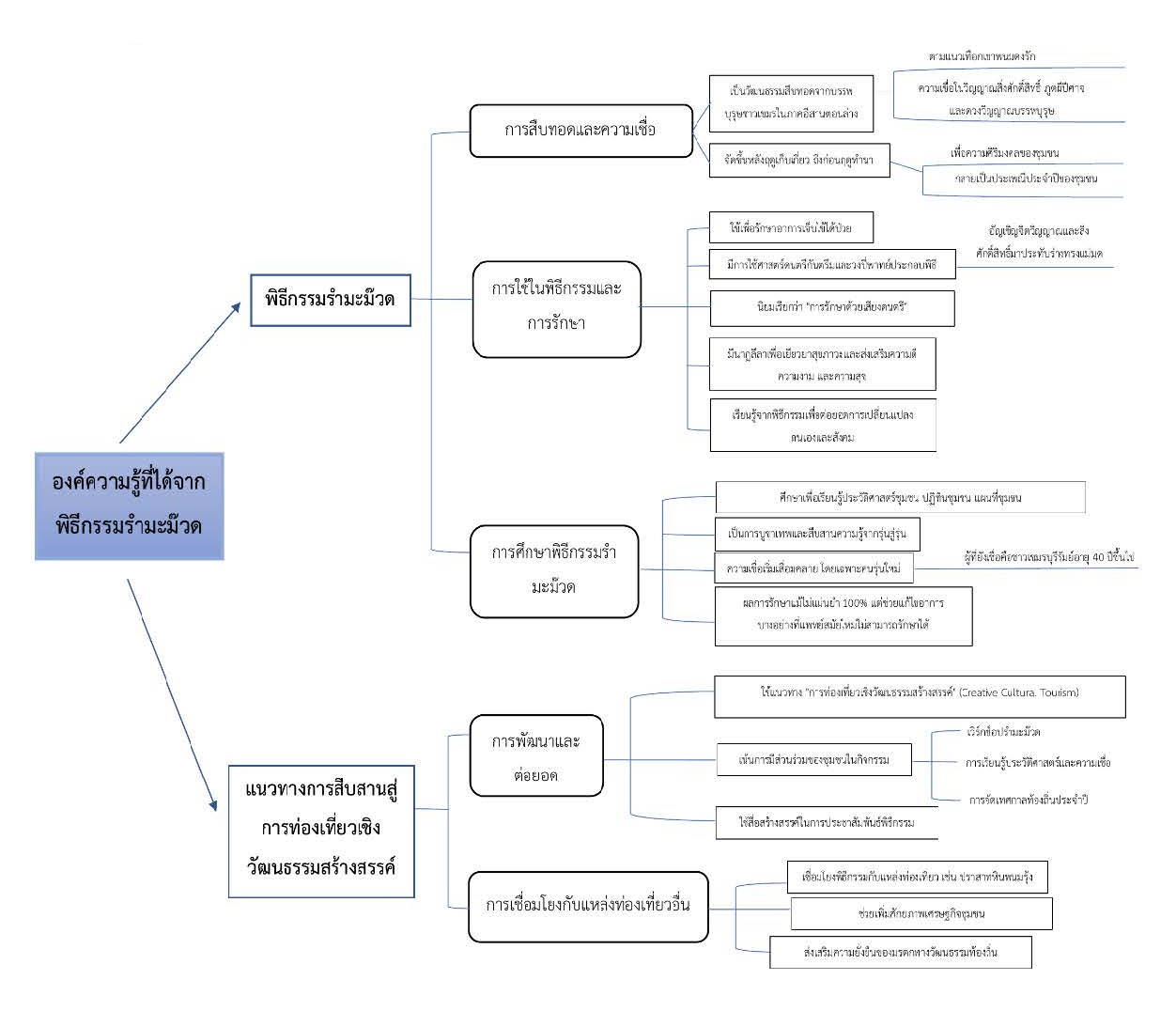
This article aims to Study. 1) study the Ram Ma Muat ritual of the Thai-Khmer ethnic group in Buriram Province and 2) study the guidelines for continuing the Ram Ma Muat ritual of the Thai-Khmer ethnic group for creative cultural tourism. This research used a qualitative research and participatory action research (PAR) design with a target group of 15 people, using purposive sampling. Data was collected through in-depth interviews, participatory observation of the Ram Ma Muat ritual, and group discussions with Ram Ma Muat ritual practitioners, local sages, healers, monks, community leaders, and cultural agencies in the area.
The research results were found as follows:- 1) The Ram Ma Muat ritual is a traditional ceremony rooted in the spiritual beliefs of the Thai-Khmer ethnic community, reflecting their cultural identity, way of life, and social values that have been transmitted across generations; and (2) the preservation and enhancement of the Ram Ma Muat ritual as a form of creative cultural tourism can be achieved through the application of community participation, creative media, and experiential tourism activities. These approaches foster mutual understanding and shared appreciation between tourists and the local culture of Buriram Province. Furthermore, a cultural tourism route was developed through Sakae Sam Community, connecting significant historical attractions associated with the Khmer civilization. This tourism route is expected to contribute to the sustainable conservation and development of the region's cultural heritage resources.
Downloads
Article Details

This work is licensed under a Creative Commons Attribution-NonCommercial-NoDerivatives 4.0 International License.
References
กาญจนา แก้วเทพ. (2549). ศาสตร์แห่งสื่อและวัฒนธรรมศึกษา. พิมพ์ครั้งที่ 2. กรุงเทพฯ: เอดิสัน เพรส โพรดักส์.
เครือจิต ศรีบุญนาค. (2534). การฟ้อนรำของชาวไทยเขมรในเขตอำเภอเมือง จังหวัดสุรินทร์. ปริญญานิพนธ์ศิลปศาสตรมหาบัณฑิต, มหาวิทยาลัยศรีนครินทรวิโรฒ มหาสารคาม.
พิมวลี ดีสม และสวภา เวชสุรักษ์. (2553). นาฏกรรมในพิธีกรรมปัญโจลมะม็วด จังหวัดสุรินทร์. วารสารวไลยอลงกรณ์ปริทัศน์, 10(1: 41–55.
ภิญโญ จิตต์ธรรม. (2522). ความเชื่อ. กรุงเทพฯ: มงคลการพิมพ์.
ยุพดี จรัณยานนท์. (2522). การศึกษานิทานชาวบ้านตำบลจอมพระ อำเภอจอมพระ จังหวัดสุรินทร์.ปริญญานิพนธ์การศึกษามหาบัณฑิต, มหาวิทยาลัยศรีนครินทรวิโรฒ ประสานมิตร.
สุวิไล เปรมศรีรัตน์, สุขุมาวดี ขำหิรัญ. (2527). ชื่อหมู่บ้านของอำเภอเมืองสุรินทร์. นครปฐม: สถาบันวิจัยภาษาและวัฒนธรรมเพื่อพัฒนาชนบท มหาวิทยาลัยมหิดล
สำนักงานจังหวัดสุรินทร์. (2534). บรรยายสรุปจังหวัดสุรินทร์. สุรินทร์: สำนักงานจังหวัดสุรินทร์.
สำนักงานจังหวัดสุรินทร์. (2526). ประวัติมหาดไทยส่วนภูมิภาค จังหวัดสุรินทร์. สุรินทร์: สำนักงานจังหวัดสุรินทร์.
หม่อมเจ้าพูนพิศมัย ดิศกุล. (2518). ประเพณีพิธีไทย. กรุงเทพฯ: เสริมวิทย์บรรณาการ.
Bourdieu, P. (1986). The forms of capital. In J. Richardson (Ed.), Handbook of theory and research for the sociology of education (pp. 241–258). Greenwood.
Csordas, T.J. (1994). The sacred self: A cultural phenomenology of charismatic healing. University of California Press.
Greenwood, D.J. (1989). Culture by the pound: An anthropological perspective on tourism as cultural commoditization. In V.L. Smith (Ed.), Hosts and guests: The anthropology of tourism. (2nd ed., pp. 171–185). University of Pennsylvania Press.
Kapferer, B. (1997). The feast of the sorcerer: Practices of consciousness and power. University of Chicago Press.
Lewis, I.M. (2003). Ecstatic religion: A study of shamanism and spirit possession. 3rd ed. Routledge.
Miton, H., & DeDeo, S. (2022). The cultural transmission of tacit knowledge. arXiv.
Ogge, S. (2024). Threats to the transmission of living heritage among children and youth: Social media use, reflections and suggestions from a decade of capacity-building. In Handbook on Intangible Cultural Practices as Global Strategies for the Future. Springer.
Richards, G. (2011). Creativity and tourism: The state of the art. Annals of Tourism Research, 38(4): 1225–1253.
Richards, G., & Raymond, C. (2000). Creative tourism. ATLAS News, 23: 16–20.
Rouget, G. (1985). Music and trance: A theory of the relations between music and possession. University of Chicago Press.
Singer, M. (1972). When a great tradition modernizes. Chicago: University of Chicago Press.
UNESCO. (2003). Convention for the safeguarding of the intangible cultural heritage. UNESCO.
UNESCO. (2006). Towards sustainable strategies for creative tourism: Discussion report of the planning meeting for the 2008 International Conference on Creative Tourism. Santa Fe, New Mexico, U.S.A.
UNESCO. (2022). Capacity-building programme on safeguarding intangible cultural heritage in Thailand. UNESCO Bangkok.
UNESCO. (2023). การเสริมสร้างศักยภาพเพื่อส่งเสริมและรักษามรดกภูมิปัญญาทางวัฒนธรรมในประเทศไทย. UNESCO Bangkok.
UNWTO. (2018). Tourism and culture synergies. UNWTO, Madrid, DOI: https://doi.org/10.18111/9789284418978
