
Thai Higher Education in Transition: The Adaptation of Digital Universities in the Age of Artificial Intelligence
Article Sidebar
Main Article Content
Abstract
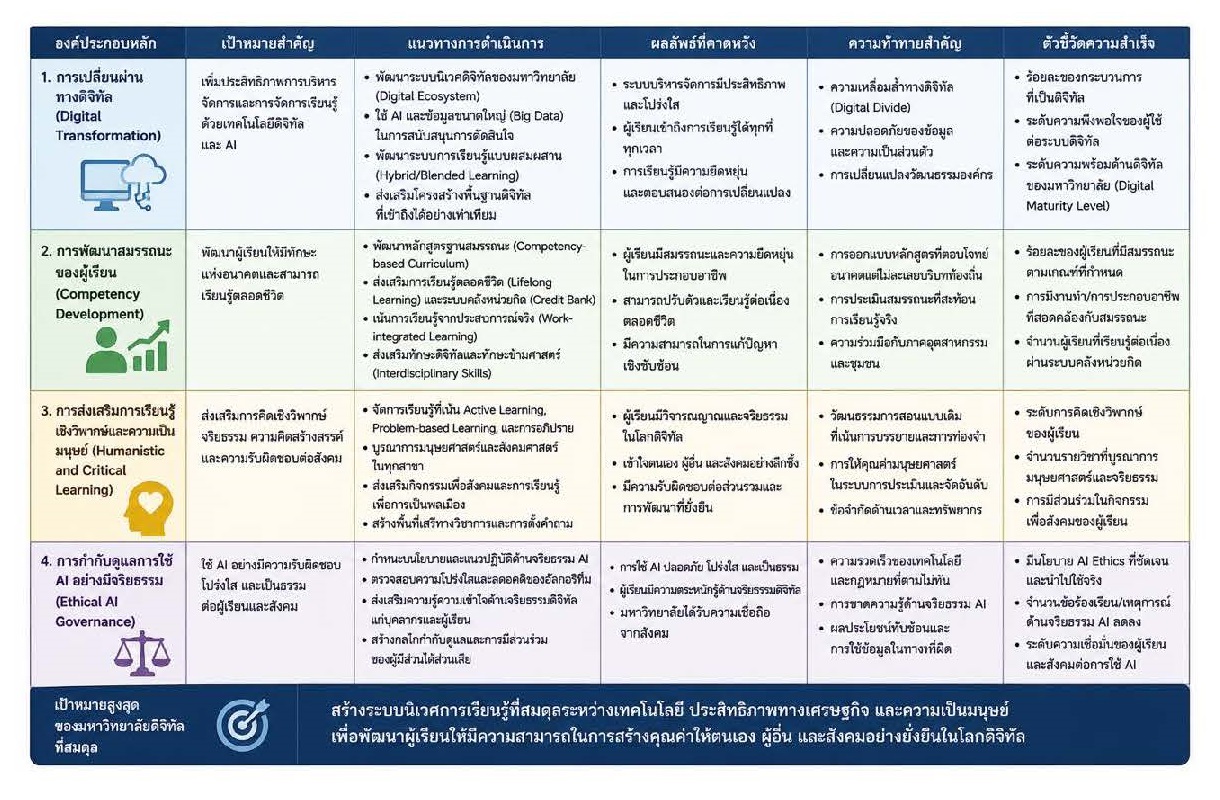
This article examines the transition of Thai higher education and the adaptation of digital universities in response to the transformative influence of Artificial Intelligence (AI). It explores the implications of this transition for the roles of higher education institutions in human capital development, knowledge production, and the promotion of lifelong learning. The study employed Critical Document Analysis in conjunction with Narrative Synthesis to examine academic literature, empirical studies, policy documents, and reports from relevant national and international organizations. This methodological approach facilitated a comprehensive synthesis of emerging trends, challenges, and future directions in Thai higher education within the digital era. The findings indicate that Thai higher education institutions have increasingly adapted by implementing Competency-Based Education (CBE), adopting Outcome-Based Education (OBE), developing Credit Bank systems, promoting lifelong learning, and integrating digital technologies and artificial intelligence into teaching and learning processes. These initiatives are intended to respond to the growing demands of the knowledge-based economy and the rapidly evolving labor market. Furthermore, data from the Higher Education Curriculum Online Information System (CHECO) demonstrate a continuous increase in the number of revised and accredited academic programs, particularly in the fields of digital technology, innovation, and artificial intelligence. Nevertheless, the synthesis of recent research suggests that the current transformation has primarily emphasized structural and technological changes, while comparatively less attention has been devoted to the transformation of pedagogical practices and the cultivation of essential competencies, including critical thinking, analytical reasoning, and the humanistic dimensions of higher education. The study concludes that the future development of Thai higher education should pursue a balanced approach that integrates technological advancement with the fundamental mission of universities to cultivate human potential, advance knowledge, and contribute to sustainable social development. It further proposes that digital transformation should be supported by a learning ecosystem that integrates digital technologies with competency-based learning, critical thinking, and lifelong learning, thereby enabling Thai higher education institutions to respond effectively and sustainably to the challenges of the AI era.
Downloads
Article Details

This work is licensed under a Creative Commons Attribution-NonCommercial-NoDerivatives 4.0 International License.
References
กระทรวงการอุดมศึกษา วิทยาศาสตร์ วิจัยและนวัตกรรม. (2566). แผนด้านอุดมศึกษาเพื่อผลิตและพัฒนากำลังคนของประเทศ พ.ศ. 2564-2570 (ฉบับปรับปรุง พ.ศ. 2566-2570). กรุงเทพฯ: กระทรวงการอุดมศึกษา วิทยาศาสตร์ วิจัยและนวัตกรรม.
กระทรวงดิจิทัลเพื่อเศรษฐกิจและสังคม. (2561). นโยบายประเทศไทย 4.0 กับการพัฒนาเศรษฐกิจดิจิทัล. กรุงเทพฯ: กระทรวงดิจิทัลเพื่อเศรษฐกิจและสังคม.
มหาวิทยาลัยเทคโนโลยีสุรนารี. (2568). รายงานการอนุมัติหลักสูตรและ/หรือปรับปรุงหลักสูตร ประจำปี พ.ศ. 2568. กรุงเทพฯ: มหาวิทยาลัยเทคโนโลยีสุรนารี.
Altbach, P.G., & Salmi, J. (Eds.). (2011). The road to academic excellence: The making of world-class research universities. World Bank.
Bearman, M., Ryan, J., & Ajjawi, R. (2023). Discourses of artificial intelligence in higher education: A critical literature review. Higher Education, 86(2): 369-385. https://doi.org/10.1007/s10734-022-00937-5
Bender, E.M., Gebru, T., McMillan-Major, A., & Shmitchell, S. (2021). On the dangers of stochastic parrots: Can language models be too big?. Proceedings of the 2021 ACM Conference on Fairness, Accountability, and Transparency, 610-623. https://doi.org/10.1145/3442188.3445922
Bond, M., Khosravi, H., De Laat, M., & Bergdahl, N. (2024). A meta systematic review of artificial intelligence in higher education: A call for increased ethics, collaboration, and rigour. International Journal of Educational Technology in Higher Education, 21, Article 4. https://doi.org/10.1186/s41239-024-00461-9
Castells, M. (1996). The rise of the network society. Blackwell Publishers.
Crawford, K. (2021). Atlas of AI: Power, politics, and the planetary costs of artificial intelligence. Yale University Press.
Freire, P. (1970). Pedagogy of the oppressed. Continuum.
Marginson, S. (2016). The dream is over: The crisis of Clark Kerr's California idea of higher education. University of California Press.
Nussbaum, M.C. (2010). Not for profit: Why democracy needs the humanities. Princeton University Press.
Selwyn, N. (2019). Should robots replace teachers? AI and the future of education. Polity Press.
Siemens, G. (2005). Connectivism: A learning theory for the digital age. International Journal of Instructional Technology and Distance Learning, 2(1): 3-10.
UNESCO. (2022). Reimagining our futures together: A new social contract for education. UNESCO Publishing.
World Economic Forum. (2023). The future of jobs report 2023. World Economic Forum.
