Management Guidelines for the Student Support System based on The Tri-Sikkha Principles of Ban Wang Phak Waen School under Surat Thani Primary Educational Service Area Office 2
Article Sidebar
Main Article Content
Abstract
This research article aims to Study: 1) investigate the conditions of student support system administration based on the Tri-Sikkha principles at Ban Wang Phak Waen School; 2) develop guidelines for administering the student support system based on the Tri-Sikkha principles; and 3) evaluate the proposed guidelines. The study employed a mixed-methods research design. Data were collected through in-depth interviews with 15 stakeholders and 5 key informants, while the proposed guidelines were evaluated by 15 experts. The data were analyzed using inductive and content analysis.
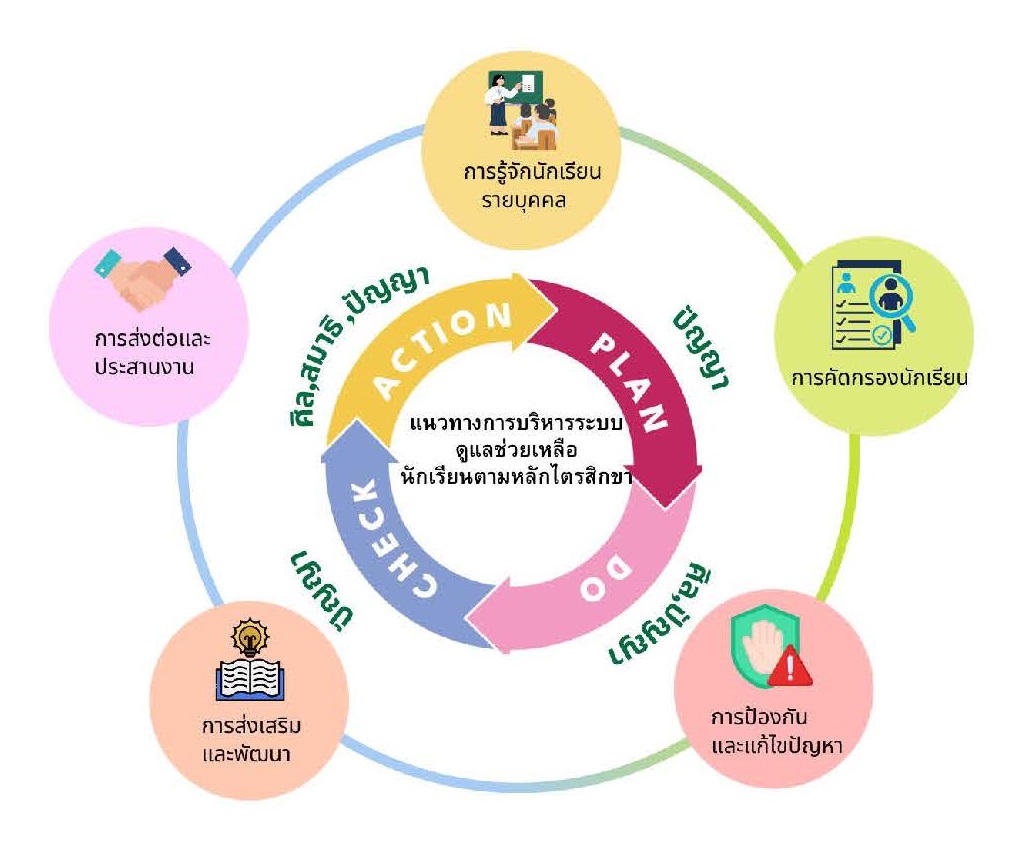
The research results were found as follows:- 1) Although the school implemented all five components of the student support system according to the established framework, the administration still encountered problems related to a lack of systematic management and continuity. In particular, student data collection remained document-based and lacked technological integration, limiting effective student analysis and follow-up. In addition, teachers’ workloads and unstructured coordination prevented the system from fully addressing individual student needs. 2) The guidelines for administering the student support system based on the Tri-Sikkha principles consisted of five main processes: individual student identification, student screening, student promotion and development, prevention and problem-solving, and student referral. The administration effectively integrated the Tri-Sikkha principles throughout the process. Panya-Sikkha (wisdom training) was applied in planning, goal setting, and the design of data collection tools. Sila-Sikkha (moral training) and Samadhi-Sikkha (mental training) were applied during implementation to ensure ethical and attentive practices. Panya-Sikkha was also applied in monitoring, comparison, and evaluation, while all three principles were integrated into the improvement of individual student support plans. 3) The evaluation of the proposed guidelines by experts indicated that the guidelines were highly appropriate, feasible, and beneficial overall. The highest mean score was appropriateness (X = 4.84), followed by usefulness (X= 4.74) and feasibility (X= 4.57). These findings demonstrate that the proposed guidelines are systematic, practical, and applicable to educational institutions.
Downloads
Article Details

This work is licensed under a Creative Commons Attribution-NonCommercial-NoDerivatives 4.0 International License.
References
กระทรวงศึกษาธิการ. (2542). พระราชบัญญัติการศึกษาแห่งชาติ พ.ศ. 2542. กรุงเทพฯ: คุรุสภา.
พระธรรมปิฎก (ป.อ. ปยุตฺโต). (2546). พุทธธรรม. พิมพ์ครั้งที่ 11. กรุงเทพฯ: มหาจุฬาลงกรณราชวิทยาลัย.
โรงเรียนบ้านวังผักแว่น. (2566). รายงานการปฏิบัติงานประจำปีการศึกษา 2566. สุราษฎร์ธานี: โรงเรียนบ้านวังผักแว่น. (อัดสำเนา).
วิไลวรรณ สุทธิพงษ์. (2562). แนวทางการพัฒนาระบบดูแลช่วยเหลือนักเรียน. กรุงเทพฯ: สำนักพิมพ์ราชมงคล.
สำนักงานคณะกรรมการการศึกษาขั้นพื้นฐาน. (2559). การศึกษาสภาพการจัดระบบการดูแลช่วยเหลือนักเรียนในสถานศึกษาขั้นพื้นฐาน. กรุงเทพฯ: โรงพิมพ์ชุมนุมสหกรณ์การเกษตรแห่งประเทศไทย.
สำนักงานคณะกรรมการการศึกษาขั้นพื้นฐาน. (2561). แนวทางการดำเนินงานระบบการดูแลช่วยเหลือนักเรียนในสถานศึกษา. กรุงเทพฯ: โรงพิมพ์ชุมนุมสหกรณ์การเกษตรแห่งประเทศไทย.
สำนักงานคณะกรรมการการศึกษาขั้นพื้นฐาน. (2564). คู่มือการดำเนินงานระบบการดูแลช่วยเหลือนักเรียน.กรุงเทพฯ: กระทรวงศึกษาธิการ.
สำนักงานคณะกรรมการการศึกษาขั้นพื้นฐาน. (2565). คู่มือการใช้ระบบสารสนเทศการดูแลช่วยเหลือนักเรียน (OBEC CARE). กรุงเทพฯ: สำนักงานคณะกรรมการการศึกษาขั้นพื้นฐาน.
