
Guidelines for the Development of Human Rights Principles for People in the Area Nong Bua Lamphu Province
Article Sidebar
Main Article Content
Abstract
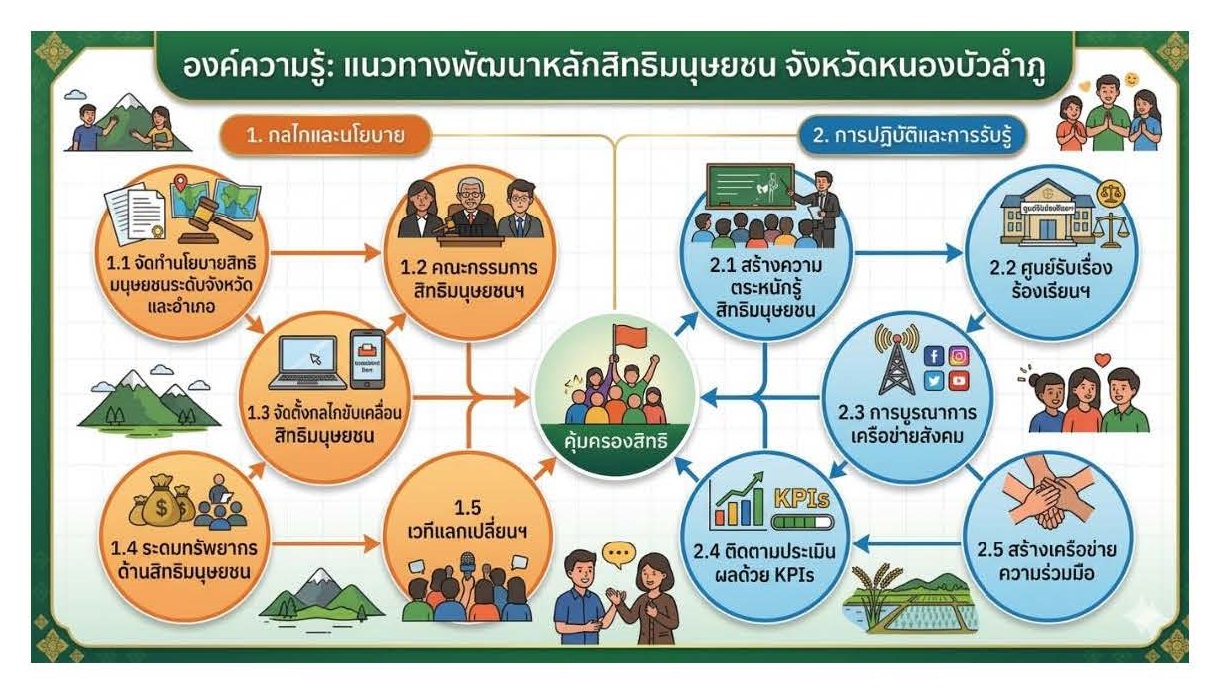
This research aimed to study (1) public opinions on human rights principles, (2) compare public opinions on human rights principles classified by gender, age, education level, occupation, and average monthly income, (3) problems related to human rights principles among the public, and (4) guidelines for developing human rights principles for the public. The sample group consisted of 400 people aged 18 years and above, determined using Yamane’s formula. Key informants included representatives from the government sector, civil society, and the academic sector, totaling 15 persons, selected through purposive sampling. The research instruments used for data collection were questionnaires and interviews. The statistics used for data analysis included frequency, percentage, mean, and standard deviation, while hypothesis testing was conducted using t-test and F-test. 1. The results of the study revealed that the overall public opinion on human rights principles in Nong Bua Lamphu Province was at a high level (X= 3.80). The aspect with the highest mean was public participation (X= 3.85), followed by networks and cooperation (X= 3.84), and policy and support mechanisms (X= 3.68). The comparison of public opinions classified by gender, age, education level, occupation, and average monthly income showed that there were no significant differences in opinions on human rights principles among people in Nong Bua Lamphu Province. 2. Regarding human rights problems, it was found that rural populations face poverty, unstable income, and debt, which limit their access to basic necessities and public services. Access to healthcare and education remains insufficient, particularly in remote areas. Some children drop out of the education system early and enter the workforce. In addition, issues of inequality, injustice, drug problems, violence, and unequal access to rights among vulnerable groups were also identified. 3. For development guidelines and solutions, it is recommended that the grassroots economy be strengthened, local occupations be promoted, income increased, and poverty sustainably reduced. Public health and education systems should be improved to ensure equal access for all, while children, youth, and workers should be protected with fairness. Public participation should be promoted, drug problems should be addressed, environmental issues should be managed, and the justice system should be developed to be transparent and accessible.
Downloads
Article Details

This work is licensed under a Creative Commons Attribution-NonCommercial-NoDerivatives 4.0 International License.
References
ภัคพงศ์ ปัญธิญา. (2565). ทัศนคติ การรับรู้ และการตระหนักถึงสิทธิมนุษยชนและการเรียกร้องสิทธิความเท่าเทียมทางเพศของกลุ่มคนที่มีความหลากหลายทางเพศในประเทศไทย. วิทยานิพนธ์ปริญญามหาบัณฑิต, มหาวิทยาลัยธรรมศาสตร์.
พงษ์เทพ สันติกุล และคณะ. (2562). รูปแบบการจัดการความรู้ของผู้บริหารคณะสงฆ์สำหรับการสอนธรรมศึกษา ในสถานศึกษา. วารสารบัณฑิตศึกษาปริทรรศน์ มหาวิทยาลัยมหาจุฬาลงกรณราชวิทยาลัย, 15(2): 22-36.
ไพรัช ธีระชัยมหิทธิ์. (2568). ปัญหาสิทธิมนุษยชน ของบุคคลที่มีสัญชาติไทยตามมาตรา 23 แห่งพระราชบัญญัติสัญชาติ พ.ศ. 2508 (แก้ไขฉบับที่ 4 พ.ศ. 2551). วารสารกฎหมาย การเมือง และสังคมศาสตร์ มหาวิทยาลัยราชภัฏเชียงราย, 9(2): 49-67.
รัฐธรรมนูญแห่งราชอาณาจักรไทย พุทธศักราช 2560. (2560, 6 เมษายน). ราชกิจจานุเบกษา. เล่ม 134 ตอนที่ 40 ก. หน้า 1-90.
อุดมศักดิ์ สินธิพงษ์. (2561). กฎหมายเกี่ยวกับสิ่งแวดล้อม. พิมพ์ครั้งที่ 5. กรุงเทพฯ: วิญญูชน.
Bagozzi, R.P. (1981). Attitudes, intentions, and behavior: A test of some key hypotheses. Journal of Personality and Social Psychology, 41(4): 607–627.
Chambers, R. (1994). The origins and practice of participatory rural appraisal. World Development, 22(7): 953-969. doi.org.
Durkheim, É. (1997). The division of labour in society (W. D. Halls, Trans.). Free Press. (Original work published 1893).
Locke, J. (1975). An essay concerning human understanding (P.H. Nidditch, Ed.). Clarendon Press. (Original work published 1689).
Mannheim, K. (1954). Ideology and utopia: An introduction to the sociology of knowledge (L. Wirth & E. Shils, Trans.). Harcourt, Brace & World. (Original work published 1936).
Sen, A. (1999). Development as freedom. Oxford University Press.
Wraight, S.P., & Ramos, M.E. (2008). Application of the entomopathogenic fungus Beauveria bassiana against the melon aphid Aphis gossypii on greenhouse cucumber. Biocontrol Science and Technology, 18(1): 1-15. doi.org.
United Nations. (1948). Universal declaration of human rights. un.org
