DEMOCRACY AND POLITICAL INSTABILITY: A COMPARATIVE STUDY OF THAILAND AND NEPAL
Keywords:
Democracy, Political Instability, Political Institutions, Conflict Management, Thailand, NepalAbstract
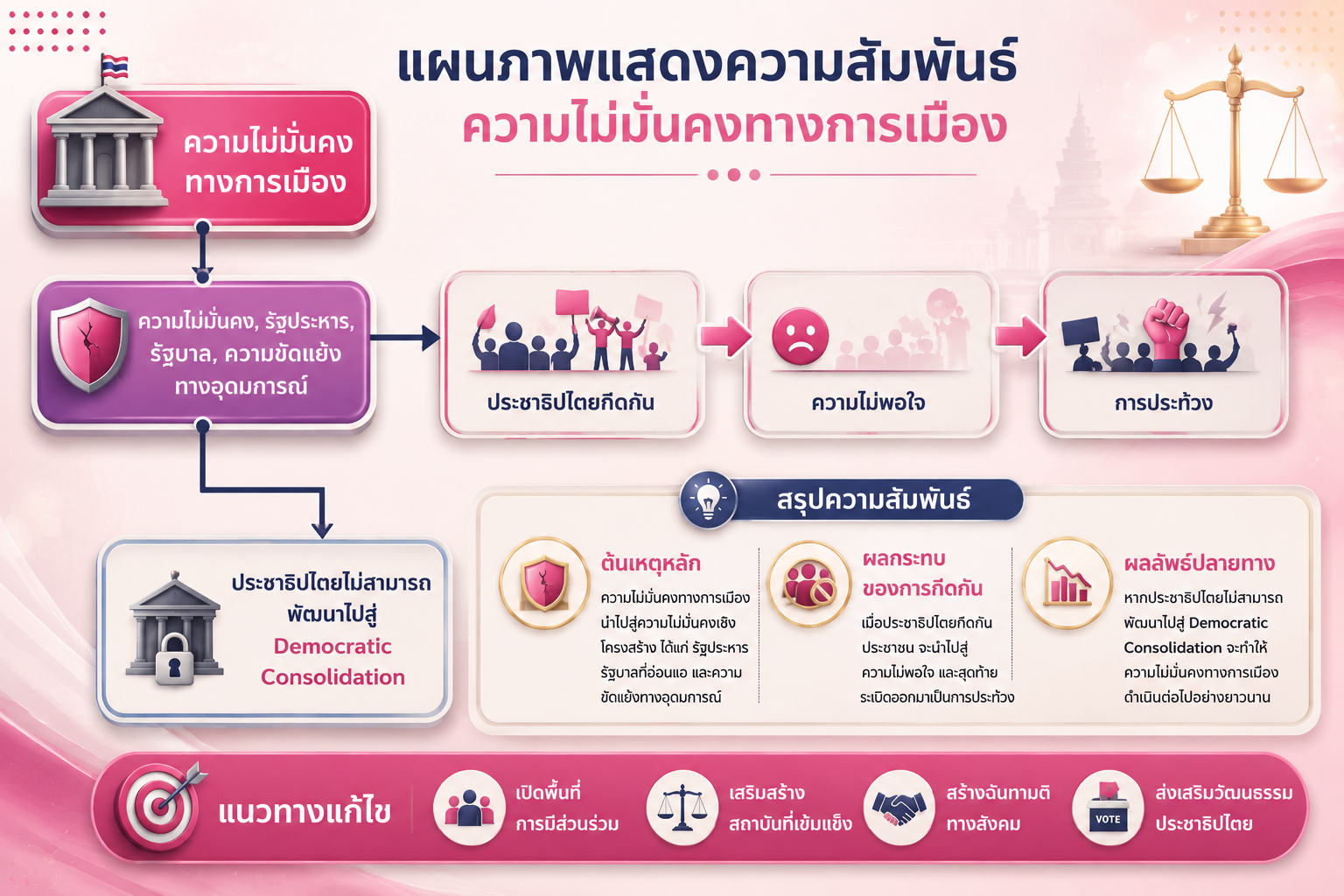
The purpose of this article is to examines the relationship between democracy and political instability through a comparative analysis of political developments in Thailand and Nepal. It focuses on democracy, institutional capacity, and mechanisms for managing political conflict. The study employs a comparative analysis of democratic development, constitutional arrangements, patterns of political competition, and mechanisms for conflict management in the two countries. The findings suggest that political instability is not a direct consequence of democracy or the expansion of political participation. Rather, it is associated with the capacity of political institutions to accommodate participation, political competition, and societal differences. The case of Thailand illustrates a recurring pattern of political instability in which conflicts among political actors may lead to political crises, interventions outside electoral processes, constitutional changes, and subsequent returns to electoral competition. Nepal, by contrast, followed a different trajectory. Conflicts concerning political representation and the distribution of power developed into armed conflict before being brought back into the political process through the peace process, the establishment of a republic, and the adoption of the 2015 Constitution. The article argues that democratic stability depends not merely on the existence of elections but also on the capacity of political institutions to manage political competition and conflict within commonly accepted rules. Comparing Thailand and Nepal therefore demonstrates that, despite their different trajectories of political transition, both countries face a common challenge: developing democratic institutions capable of accommodating political diversity, managing conflict, and sustaining political continuity.
Downloads
References
Dahl, R. A. (1971). Polyarchy: Participation and Opposition. Yale University Press. Huntington, S. P. (1968). Political Order in Changing Societies. Yale University Press.
Lawoti, M. (2012). Ethnic politics and the building of an inclusive state. In S. von Einsiedel, D. M. Malone, & S. Pradhan (Eds.), Nepal in transition: From people’s war to fragile peace (pp. 129 - 152). Cambridge University Press. https://doi.org/10.1017/CBO9781139021869.006
Linz, J. J., & Stepan, A. (1996). Problems of Democratic Transition and Consolidation: Southern Europe, South America, and Post - communist Europe. Johns Hopkins University Press. https://doi.org/10.56021/9780801851575
Malagodi, M. (2012). Constitutional Nationalism and Legal Exclusion: Equality, Identity Politics, and Democracy in Nepal (1990 - 2007). Oxford University Press. https://doi.org/10.1093/acprof:oso/9780198082910.001.0001
Thapa, D. (2012). The making of the Maoist Insurgency. In S. von Einsiedel, D. M. Malone, & S. Pradhan (Eds.), Nepal in Transition: From People’s War to Fragile Peace (pp. 37 - 57). Cambridge University Press. https://doi.org/10.1017/CBO9781139021869.003
Von Einsiedel, S., Malone, D. M., & Pradhan, S. (Eds.). (2012). Nepal in Transition: From People’s War to Fragile Peace. Cambridge University Press. https://doi.org/10.1017/CBO9781139021869
Ginsburg, T. (2009). Constitutional Afterlife: The Continuing Impact of Thailand’s Postpolitical Constitution. International Journal of Constitutional Law, 7(1), 83 - 105. https://doi.org/10.1093/icon/mon031
Kuhonta, E. M. (2008). The Paradox of Thailand’s 1997 “People’s Constitution”: Be Careful What You Wish For. Asian Survey, 48(3), 373 - 392. https://doi.org/10.1525/as.2008.48.3.373
Tonsakulrungruang, K. (2024). Coup and Decay: How Thai - style Democracy Abuses Constitutionalism. In T. G. Daly & D. Samararatne (Eds.), Democratic Consolidation and Constitutional Endurance in Asia and Africa: Comparing Unevenpathways (pp.325 - 344). OxfordUniversity Press. https://doi.org/10.1093/oso/9780192899347.003.0014
Ferrara, F. (2015). The Political Development of Modern Thailand. Cambridge University Press. https://doi.org/10.1017/CBO9781107449367
Seo, K. (2015). Democracy and Military Coups in Thailand: Focusing on Coups in 2006 and 2014. Journal of Korean Association of Thai Studies, 22(1), 269 - 299. https://doi.org/10.22473/kats.2015.22.1.010
Harding, A. J., & Leelapatana, R. (2019). Constitution - making in 21st - Century Thailand: The Continuing Search for a Perfect Constitutional Fit. The Chinese Journal of Comparative Law, 7(2), 266 - 284. https://doi.org/10.1093/cjcl/cxz009
Upreti, B. R. (2006). Armed Conflict and Peace Process in Nepal: The Maoist Insurgency, Past Negotiations and Opportunities for Conflict Transformation. Adroit Publishers.
Thapa, S. B. (2025). The Impact of Political Instability on Democratic Development in Nepal (2022 - 2024). The Academia, 5(1), 187 - 201. https://doi.org/10.3126/ta.v5i1.77184
Government of Nepal. (2015). The Constitution of Nepal. Ministry of Law, Justice and Parliamentary Affairs, Law Books Management Board. https://searchlibrary.ohchr.org/record/20882
United Nations. (2007). Report of the Secretary - General on the Request of Nepal for United Nations Assistance in Support of its Peace Process (S/2007/235). United Nations Security Council.
United Nations. (2006). Comprehensive Peace Agreement between the Government of Nepal and the Communist Party of Nepal (Maoist). United Nations. https://peacemaker.un.org/en/node/9215?utm_source=chatgpt.com
Downloads
Published
How to Cite
Issue
Section
License
Copyright (c) 2026 Journal of Buddhist Educational Innovation

This work is licensed under a Creative Commons Attribution-NonCommercial-NoDerivatives 4.0 International License.
This article is published under a Creative Commons Attribution-NonCommercial-NoDerivatives 4.0 International License (CC BY-NC-ND 4.0), which allows others to share the article with proper attribution to the authors and prohibits commercial use or modification. For any other reuse or republication, permission from the journal and the authors is required.