THE APPLICATION OF THE PDCA QUALITY CYCLE FOR ENHANCING TRANSFORMATIONAL LEADERSHIP OF FOREIGN LANGUAGE TEACHERS: A CASE STUDY AT BENCHAMARACHUTHIT SCHOOL, CHANTHABURI, THAILAND
Keywords:
PDCA Quality Cycle, SWOT Analysis, Transformational Leadership, Teacher DevelopmentAbstract
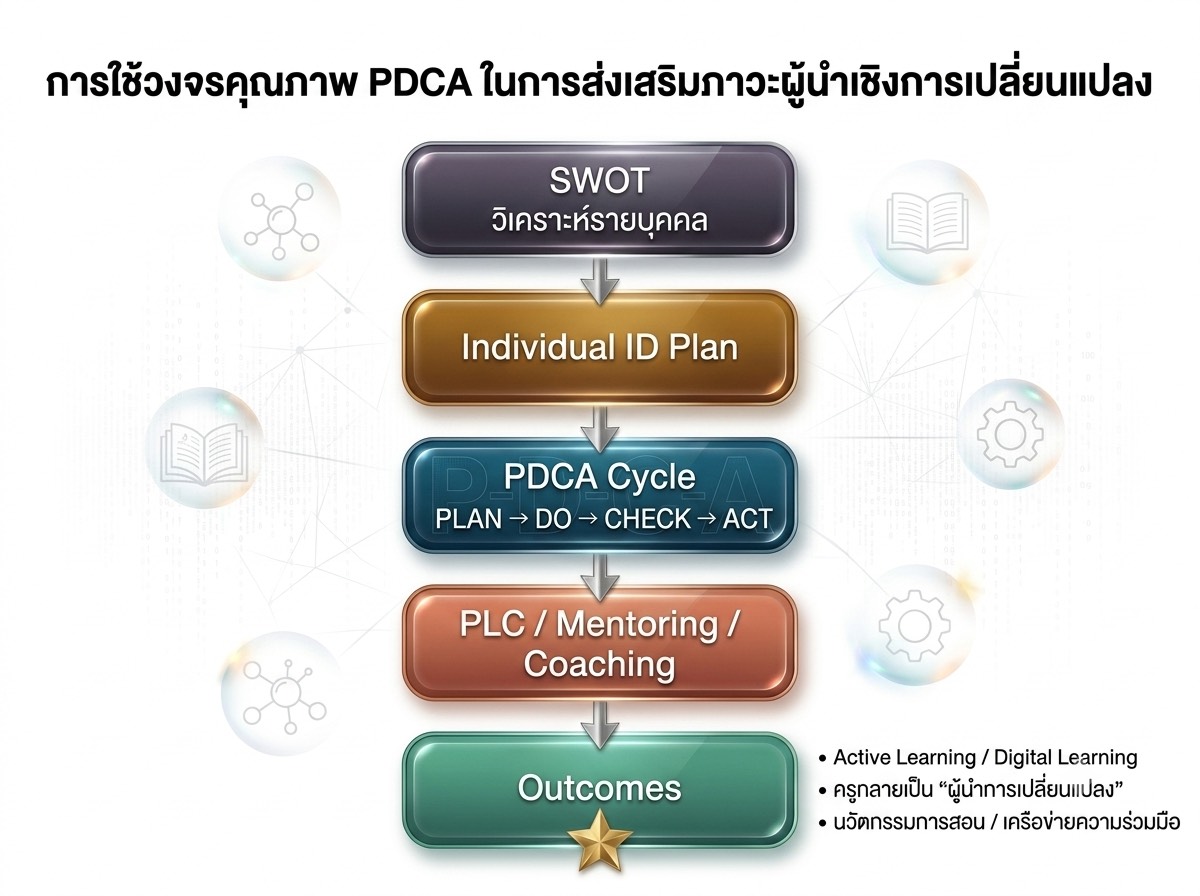
The purpose of this article is to present a practical model for enhancing transformational leadership among foreign language teachers by applying the PDCA quality cycle (Plan - Do - Check - Act), using SWOT analysis as the diagnostic foundation. SWOT results were utilized to identify individual strengths, weaknesses, opportunities, and threats, which were then used to develop personalized development plans (ID Plans) and select relevant professional development activities. The PDCA cycle structured the development process: planning based on SWOT data, implementing development activities such as workshops, PLC - based collaboration, classroom mentoring, and observation, monitoring teaching improvement, and making adjustments for continuous improvement.
The study found that:
The integration of SWOT and PDCA enables systematic and goal - oriented teacher development. Teachers improved instructional practices by adopting learner - centered approaches, incorporating digital technology, and generating instructional innovations through collaborative work within PLCs. As a result, teachers demonstrated transformational leadership characteristics, including inspiring students, mentoring peers, initiating instructional innovations, and driving positive change at both the classroom and organizational levels. The structured PDCA cycle also fostered continuous reflection and accountability, leading to sustainable instructional improvement across the department.
Policy recommendations include providing institutional support for teacher development through professional mentoring, technological resources, and dedicated time for continuous learning. The model can be scaled and adapted to other educational contexts to strengthen teacher leadership and enhance instructional quality at the organizational and system levels.
Downloads
References
ทิศนา แขมมณี. (2559). ศาสตร์การสอน: องค์ความรู้เพื่อการจัดการเรียนรู้ที่มีประสิทธิภาพ (พิมพ์ครั้งที่ 20). กรุงเทพฯ: สำนักพิมพ์จุฬาลงกรณ์มหาวิทยาลัย.
วิจารณ์ พานิช. (2560). ชุมชนการเรียนรู้ทางวิชาชีพ (PLC) เพื่อการพัฒนาครูและการเรียนรู้ของผู้เรียน. กรุงเทพฯ: สถาบันส่งเสริมการเรียนรู้เพื่ออนาคต.
สุวิมล ว่องวาณิช. (2562). การประเมินคุณภาพการศึกษาและการพัฒนาอย่างต่อเนื่องในสถานศึกษาไทย. กรุงเทพฯ: สำนักพิมพ์จุฬาลงกรณ์มหาวิทยาลัย.
Bass, B. M., & Riggio, R. E. (2018). Transformational Leadership (3rd ed.). Routledge.
Bryson, J. M. (2018). Strategic Planning for Public and Nonprofit Organizations: A Guide to Strengthening and Sustaining Organizational Achievement (5th ed.). Wiley.
Gürel, E. (2017). SWOT analysis: A theoretical review. Journal of International Social Research, 10(51), 994 - 1006. https://www.sosyalarastirmalar.com/articles/swot-analysis-a-theoretical-review.pdf
Hallinger, P. (2021). School Leadership for Learning: Lessons from 40 years of Empirical Research. Journal of Educational Administration, 59(2), 125 - 142. https://doi.org/10.1108/JEA-10-2020-0212
Hord, S. M. (2020). Professional Learning Communities: Communities of Continuous Inquiry and Improvement. SEDL.
Ministry of Education. (2017). The National Education Plan B.E. 2560 - 2579 (2017 - 2036). Office of the Education Council.
Ng, F. S. D. (2017). Transformational School Leadership and Student Outcomes: A Study of Mediating Variables. Educational Management Administration & Leadership, 45(2), 243 - 260. https://doi.org/10.1177/1741143215607872
Office of the Basic Education Commission. (2023). Policy and Strategic Plan for Teacher Professional Development. OBEC.
Phadermrod, B., Crowder, R. M., & Wills, G. B. (2019). Importance Performance Analysis Based SWOT Analysis. International Journal of Information Management, 44, 194 - 203. https://doi.org/10.1016/j.ijinfomgt.2016.03.009
Shrestha, B., Pant, P. R., & Maharjan, P. (2021). Application of PDCA Cycle in Quality Improvement of Higher Education Institutions. International Journal of Quality & Reliability Management, 38(6), 1392 - 1410. https://doi.org/10.1108/IJQRM-04-2020-0130
Stoll, L., Bolam, R., McMahon, A., Wallace, M., & Thomas, S. (2018). Professional Learning Communities: A Review of the Literature (Updated). Journal of Educational Change, 19(4), 221 - 258. https://doi.org/10.1007/s10833-018-9318-8
Downloads
Published
How to Cite
Issue
Section
License
Copyright (c) 2026 Journal of Buddhist Educational Innovation

This work is licensed under a Creative Commons Attribution-NonCommercial-NoDerivatives 4.0 International License.
This article is published under a Creative Commons Attribution-NonCommercial-NoDerivatives 4.0 International License (CC BY-NC-ND 4.0), which allows others to share the article with proper attribution to the authors and prohibits commercial use or modification. For any other reuse or republication, permission from the journal and the authors is required.