Factors Influencing Generation Z’s Intention to Use the Job BKK Job Search Application
Keywords:
การยอมรับเทคโนโลยี, ความตั้งใจเชิงพฤติกรรม, ภาพลักษณ์แบรนด์, การบอกต่อทางอิเล็กทรอนิกส์, เจเนอเรชันแซดAbstract
This study, entitled “Factors Affecting the Intention to Use the Job BKK Job Search Application Among Generation Z,” aims to analyze the factors influencing users’ intention to use the Job BKK application and to propose strategic guidelines for application development in alignment with the behaviors and needs of Generation Z users. This research adopts a qualitative approach, employing focus group discussions with a sample of 40 participants who have experience using the Job BKK job search application.
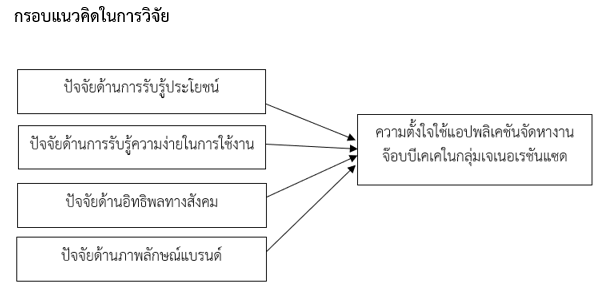
The findings reveal that the factors influencing usage intention can be categorized into four key dimensions. First, perceived usefulness is identified as the most influential factor, as users perceive that the application enhances job search efficiency and reduces the time required for job applications. Second, perceived ease of use plays a significant role, as a simple interface, non-complex functionality, and clear procedures contribute to user acceptance and continued usage. Third, social influence is reflected through recommendations and communication via social media platforms, particularly electronic word-of-mouth (eWOM), which helps build trust. Finally, brand image, encompassing credibility, professionalism, and platform reputation, directly affects users’ level of trust. In terms of development guidelines, the application should focus on improving the accuracy of its job-matching system, enhancing user-friendly design while minimizing unnecessary steps, leveraging social media strategies to increase awareness and stimulate eWOM, and strengthening a modern and credible brand image. These approaches are expected to enhance users’ intention to adopt and continue using the application in the long term.
References
พิเชษฐ์ วงศ์เกียรติ์ขจร. (2559). การวิจัยเชิงคุณภาพ. บริษัท ส.เอเซียเพรส (1989) จำกัด.
สำนักงานสถิติแห่งชาติ. (2569). สรุปผลที่สำคัญ การสำรวจภาวะการทำงานของประชากร ไตรมาสที่ 4 พ.ศ. 2568. https://www.nso.go.th/nsoweb/storage/survey_detail/2026/20260206093028_78570.pdf
Aaker, D. A. (1991). Managing brand equity: Capitalizing on the value of a brand name. The Free Press.
Aggarwal, A., & Sandhu, N. (2024). Factors affecting Generation Z job seekers’ behavioral intention toward online recruitment platforms in India. Journal of Management Changes in the Digital Era, 1(1). https://doi.org/10.33168/JMCDE.2024.0108
Ajzen, I. (1991). The theory of planned behavior. Organizational Behavior and Human Decision Processes, 50(2), 179–211. https://doi.org/10.1016/0749-5978(91)90020-T
Braun, V., & Clarke, V. (2006). Using thematic analysis in psychology. Qualitative Research in Psychology, 3(2), 77–101. https://doi.org/10.1191/1478088706qp063oa
Davis, F. D. (1989). Perceived usefulness, perceived ease of use, and user acceptance of information technology. MIS Quarterly, 13(3), 319–340. https://doi.org/10.2307/249008
Denzin, N. K. (1970). Sociological methods: A sourcebook. Aldine.
Dimock, M. (2019, January 17). Defining generations: Where Millennials end and Generation Z begins. Pew Research Center. https://www.pewresearch.org/short-reads/2019/01/17/where-millennials-end-and-generation-z-begins/
Fishbein, M., & Ajzen, I. (2010). Predicting and changing behavior: The reasoned action approach. Psychology Press.
Hosain, M. S., Mia, M. A. H., & Rob, R. (2023). Impact of COVID-19 on job seekers toward e-recruitment. Bangladesh Journal of MIS, 10(2). https://bjmis.du.ac.bd/index.php/about/article/view/59
Jayatissa, K. A. D. U. (2023). Generation Z: A new lifeline—A systematic literature review. Sri Lanka Journal of Social Sciences and Humanities, 3(2), 179–186. https://doi.org/10.4038/sljssh.v3i2.110
Keller, K. L. (1993). Conceptualizing, measuring, and managing customer-based brand equity. Journal of Marketing, 57(1), 1–22. https://doi.org/10.1177/002224299305700101
Marketing Oops. (2025). สรุปสถิติ Digital 2025 ทั้งจากทั่วโลกและในประเทศไทย. https://www.marketingoops.com/reports/media-stat/digital-2025-global-overview-report/
Marikyan, D., Papagiannidis, S., & Alamanos, E. (2023). Technology acceptance research: A meta-analysis. Journal of Information Science. Advance online publication. https://doi.org/10.1177/01655515231191177
Thai PBS News. (2023). วิจัยชี้เยาวชน 15–24 ปี กว่า 1.4 ล้านคน ไม่เรียน–ไม่ทำงาน. https://www.thaipbs.or.th/news/content/326042
Thai PBS Policy Watch. (2024). วิกฤติกำลังแรงงานไทย อีก 30 ปี ลดเหลือครึ่งเดียว. https://policywatch.thaipbs.or.th/article/life-11
Venkatesh, V., Morris, M. G., Davis, G. B., & Davis, F. D. (2003). User acceptance of information technology: Toward a unified view. MIS Quarterly, 27(3), 425–478. https://doi.org/10.2307/30036540
Downloads
Published
How to Cite
Issue
Section
License
Copyright (c) 2026 คณะวิทยาการจัดการ มหาวิทยาลัยราชภัฏบ้านสมเด็จเจ้าพระยา

This work is licensed under a Creative Commons Attribution-NonCommercial-NoDerivatives 4.0 International License.
บทความที่ได้รับการตีพิมพ์เป็นลิขสิทธิ์ของคณะวิทยาการจัดการ มหาวิทยาลัยราชภัฏบ้านสมเด็จเจ้าพระยา