- Beauty Pageant Business as a Soft Power Instrument: An Integrated Analysis of Marketing Strategies, Image Communication, and Sustainability
-
Keywords:
Beauty Pageant, Soft Power, Marketing Strategy, Image Communication, SustainabilityAbstract
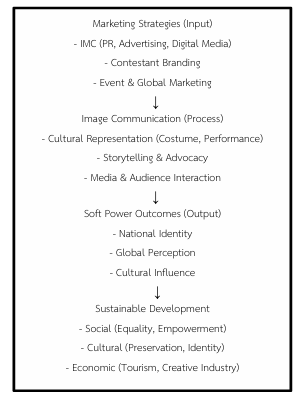
This study examines the integration of marketing strategies, image communication, and sustainability within the beauty pageant industry as a multidimensional platform of Soft Power. The research aims to: (1) analyze marketing strategies at national and international levels, (2) investigate image communication as a mechanism of Soft Power, and (3) explore sustainability practices across social, cultural, and economic dimensions. A qualitative research design was employed using documentary analysis and thematic content analysis. Data were collected from academic literature, media content, and selected case studies of international pageants. The findings reveal three core dynamics: (1) marketing strategies have evolved into integrated global branding systems driven by digital media and storytelling; (2) image communication functions as a mediating mechanism transforming cultural representation into Soft Power outcomes; and (3) sustainability is embedded as a strategic extension of branding and Soft Power rather than a separate dimension. The study proposes the “Sustainable Soft Power Branding Model,” demonstrating how marketing inputs are transformed through communication processes into long-term socio-cultural and economic impacts. This research contributes to interdisciplinary scholarship by integrating marketing communication, cultural studies, and sustainability into a unified analytical framework.
References
Anholt, S. (2007). Competitive identity: The new brand management for nations, cities and regions. Palgrave Macmillan.
Boongerd, C., & Chairat, P. (2022). Political and social values in beauty pageants. Journal of Political Science and Public Administration, 13(1), 35–60. https://so05.tci-thaijo.org/index.php/polscicmujournal/article/view/253585
Butphuang, C., & Bupphapan, S. (2023). The image of modern Hmong-Lao women: Reflections through beauty pageant contexts. Journal of Humanities, Social Sciences and Innovation Kalasin University, 2(2), 64–73. https://so02.tci-thaijo.org/index.php/hsi_01/article/view/264364
Chaitaisong, S. (2020). Gender identity communication among beauty pageant fans. Chandrakasem Rajabhat University Journal, 26(2), 264–278. https://li01.tci-thaijo.org/index.php/crujournal/article/view/240155
Chaitaisong, S., & Hinwiman, S. (2020a). National identity communication among beauty pageant fan communities. Journal of Humanities and Social Sciences Thaksin University, 15(2), 33–58. https://so02.tci-thaijo.org/index.php/HUSOTSU/article/view/246598
Chaitaisong, S., & Hinwiman, S. (2020b). The development of fan communities in Thai beauty pageants. Connexion: Journal of Humanities and Social Sciences, 9(1), 123–148. https://so05.tci-thaijo.org/index.php/MFUconnexion/article/view/241495
Dinnie, K. (2016). Nation branding: Concepts, issues, practice (2nd ed.). Routledge.
Elkington, J. (1997). Cannibals with forks: The triple bottom line of 21st century business. Capstone.
Fan, Y. (2006). Branding the nation: What is being branded? Journal of Vacation Marketing, 12(1), 5–14. https://doi.org/10.1177/1356766706056633
Jakkit, S. (2025). Beauty pageant management: Strategic analysis and impacts on entertainment industry development. Journal of Social Science for Local Development Rajabhat Maha Sarakham University, 9(2), 715–725. https://so02.tci-thaijo.org/index.php/soc-rmu/article/view/277746
Jiambooranakul, A. (2019). Beauty discourse and the negotiation of cultural identity in consumer society. Chiang Mai University Journal of Social Sciences, 18(1–2), 133–167. https://so04.tci-thaijo.org/index.php/jss/article/view/174663
Jutavipat, W. (2018). Thai national costumes on the Miss Universe stage: Past to present. Journal of Fine and Applied Arts Research and Creative Work, 5(1).
Kaewnet, P. (2023). Soft power reflected in the beauty pageant business. Journal of Sustainable Tourism Development, 5(2), 75–82. https://so04.tci-thaijo.org/index.php/JSTD/article/view/264740
Kasampolkoon, A., & Somkane, P. (2022). Folklore and beauty pageants: Roles and reflections in Thai society. Academic Journal of Humanities and Social Sciences Burapha University, 30(2), 179–196. https://so06.tci-thaijo.org/index.php/husojournal/article/view/253971
Kooha, M., & Parisaya. (2019). Communicating Thai identity through hosting Miss Universe 2018 in Thailand [Master’s thesis, Chulalongkorn University]. Chulalongkorn University Digital Collections. https://digital.car.chula.ac.th/chulaetd/9262/
Kotler, P., & Keller, K. L. (2016). Marketing management (15th ed.). Pearson.
Kuhalert, S. (2025). Folklore in beauty pageant contests: Creative cultural capital. Journal of Human and Society, 11(2), 74–98. https://so06.tci-thaijo.org/index.php/husocjournal/article/view/286769
Kumpusiri, P., Supasetsiri, P., & Nopudomphan, K. (2022). The role of beauty queens in Thai society. Journal of Buddhist Anthropology, 7(8), 55–66. https://so04.tci-thaijo.org/index.php/JSBA/article/view/260457
Nijrom, N., & Kaewsuwan, J. (2024). Cultural representation through Chinese national costumes on the Miss Universe stage. Lawarath Social E-Journal, 6(1), 19–44. https://so04.tci-thaijo.org/index.php/lawarathjo/article/view/264890
Downloads
Published
How to Cite
Issue
Section
License
Copyright (c) 2026 คณะวิทยาการจัดการ มหาวิทยาลัยราชภัฏบ้านสมเด็จเจ้าพระยา

This work is licensed under a Creative Commons Attribution-NonCommercial-NoDerivatives 4.0 International License.
บทความที่ได้รับการตีพิมพ์เป็นลิขสิทธิ์ของคณะวิทยาการจัดการ มหาวิทยาลัยราชภัฏบ้านสมเด็จเจ้าพระยา