การยอมรับเทคโนโลยีและนวัตกรรมบริการที่ส่งผลต่อความภักดี ในการใช้บริการธุรกิจทำความสะอาดในเขตกรุงเทพมหานคร ปริมณฑลและจังหวัดสงขลา
Keywords:
การยอมรับเทคโนโลยี, นวัตกรรมบริการ, ความภักดีของลูกค้า, ธุรกิจทำความสะอาดผ่านแพลตฟอร์มออนไลน์Abstract
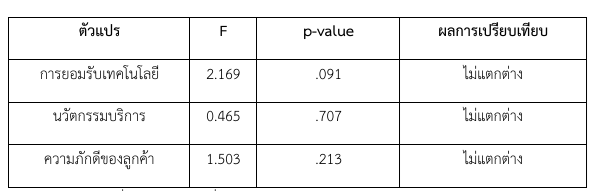
This study aims to (1) examine the levels of technology acceptance, service innovation, and customer loyalty in the cleaning service business via online platforms, (2) investigate the influence of technology acceptance and service innovation on customer loyalty, and (3) compare these variables across Bangkok, the metropolitan region, and Songkhla province. A quantitative research design was employed, and data were collected through questionnaires from 400 respondents who have experience using cleaning services via online platforms. The data were analyzed using descriptive and inferential statistics.
The conceptual framework integrates the Technology Acceptance Model (TAM) with the concept of service innovation to explain the relationships among variables affecting customer loyalty. The findings indicate that both technology acceptance and service innovation have a statistically significant positive influence on customer loyalty. In particular, perceived usefulness and perceived ease of use significantly affect users’ attitudes and behavioral intentions, which subsequently lead to repurchase behavior and word-of-mouth. Furthermore, differences in perception and behavioral patterns were observed across the study areas.
The results highlight the critical role of technology adoption and service innovation in enhancing customer loyalty and provide practical implications for strengthening the competitiveness of cleaning service businesses in the digital economy.
Keywords: Technology Acceptance; Service Innovation; Customer Loyalty; Cleaning Service Business; Online Platform
References
ธิดา อิงคสฤษฎ์ และฉัตรพล ไขแสงทอง. (2563). การยอมรับเทคโนโลยีและนวัตกรรมบริการที่มีผลต่อความภักดีของลูกค้า. วารสารการจัดการสมัยใหม่, 18(1), 75–90.
Cochran, W. G. (1977). Sampling techniques (3rd ed.). John Wiley & Sons.
Davis, F. D. (1989). Perceived usefulness, perceived ease of use, and user acceptance of information technology. MIS Quarterly, 13(3), 319–340. https://doi.org/10.2307/249008
Den Hertog, P., Van der Aa, W., & De Jong, M. W. (2010). Capabilities for managing service innovation: Towards a conceptual framework. Journal of Service Management, 21(4), 490–514. https://doi.org/10.1108/09564231011066123
Dick, A. S., & Basu, K. (1994). Customer loyalty: Toward an integrated conceptual framework. Journal of the Academy of Marketing Science, 22(2), 99–113. https://doi.org/10.1177/0092070394222001
Nunnally, J. C., & Bernstein, I. H. (1994). Psychometric theory (3rd ed.). McGraw-Hill.
Oliver, R. L. (1999). Whence consumer loyalty? Journal of Marketing, 63(Special Issue), 33–44. https://doi.org/10.1177/00222429990634s105
Rovinelli, R. J., & Hambleton, R. K. (1977). On the use of content specialists in the assessment of criterion-referenced test item validity. Dutch Journal of Educational Research, 2, 49–60.
Downloads
Published
How to Cite
Issue
Section
License
Copyright (c) 2026 คณะวิทยาการจัดการ มหาวิทยาลัยราชภัฏบ้านสมเด็จเจ้าพระยา

This work is licensed under a Creative Commons Attribution-NonCommercial-NoDerivatives 4.0 International License.
บทความที่ได้รับการตีพิมพ์เป็นลิขสิทธิ์ของคณะวิทยาการจัดการ มหาวิทยาลัยราชภัฏบ้านสมเด็จเจ้าพระยา