
Development of an English for Medical Purposes Instructional Model Based on Dialogue and Semantic Mapping to Enhance English Critical Reading Abilities and Vocabulary Retention for Nursing Students in Western Bangkok
Article Sidebar
Main Article Content
บทคัดย่อ
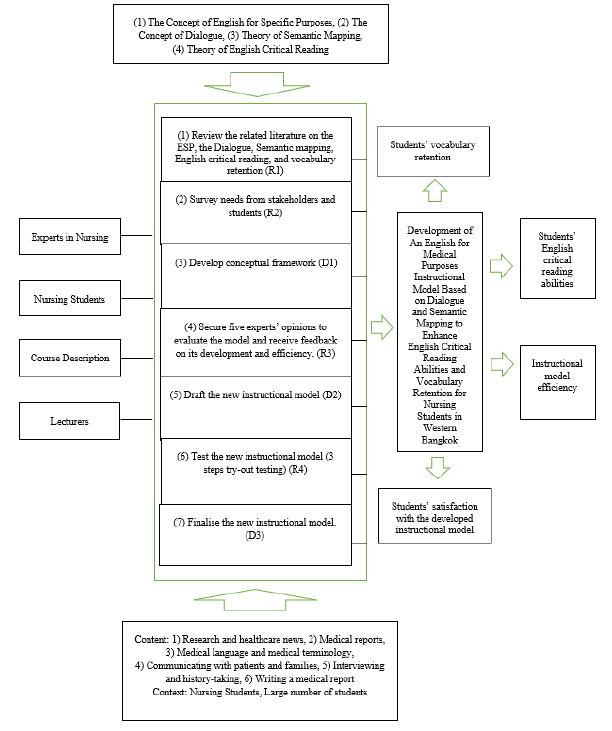
This research aimed to: 1) develop an English for Medical Purposes (EMP) instructional model based on dialogue and semantic mapping to enhance critical reading ability and vocabulary retention for nursing students in Western Bangkok; 2) examine the model’s efficiency; and 3) assess student satisfaction. The sample comprised 100 nursing students from Bangkokthonburi University, selected using a simple random sampling technique, with the university serving as the sampling unit. The research instruments consisted of: 1) the instructional model evaluation form, 2) the English critical reading test, 3) the English medical terminology test, 4) the instructional packages including the teaching manual, lesson plans, post-assessments, exercises, and teaching materials, and 5) the semi-structured questionnaire on students’ opinions towards the developed instructional mode. A mixed-methods approach was employed, and data were analysed using descriptive statistics, paired-sample t-tests, the E1/E2 efficiency formula, and content analysis.
The research findings revealed that: 1) the developed instructional model consisted of six steps and was rated by experts at the highest level of satisfaction (M = 4.56, SD = 0.53); 2) the instructional model met the E1/E2 criterion, surpassing the 80/80 benchmark in all three testing phases (81.11/85.55, 81.33/80.83, and 80.63/80.35), indicating high efficiency in its application. Moreover, students’ post-instruction scores in critical English reading were significantly higher than their pre-instruction scores at the .05 level, demonstrating improved learning outcomes. Additionally, medical English vocabulary test scores taken 14 days after the instructional activities remained significantly higher than the immediate post-test scores, also at the .05 level, suggesting that the model effectively supported long-term retention; and 3) nursing students reported the highest level of satisfaction with the instructional model (M = 4.69, SD = 0.48) and expressed positive attitudes toward the learning experience. Ethical approval for the study was granted by the BTU Human Research Ethics Committee (BTUIRB No. 2568/81(5)).
Downloads
Article Details

อนุญาตภายใต้เงื่อนไข Creative Commons Attribution-NonCommercial-NoDerivatives 4.0 International License.
เอกสารอ้างอิง
Al-Khasawneh & AlHawamdeh. (2023). The Potential of Semantic Mapping Strategy to Enhance Vocabulary Learning. Journal of Southwest Jiaotong University, 58(1): 924-934.
Artsanthia, J., & Chaleoykitti, S. (2016). English language communication problems of Thai medical personnel in providing health care services to foreign patients. Proceedings of the 6th International Conference on Language, Education, and Innovation (ICLEI), 20-26.
Basturkmen, H. (2019). Developing courses in English for specific purposes. Palgrave Macmillan.
Brahmawong, C. (2024). Advanced Research Methodology in Teaching English, Department of Curriculum and Instruction, Mahachulalongkornrajavidyalaya University.
Brahmawong., C. (2013). Developmental Testing of Media and Instructional Package. Silpakorn
Carless, D., & Boud, D. (2020). Sustainable assessment. Routledge.
Clarke, S. (2021). Outstanding formative assessment: Culture and practice. 2nded. Hodder Education.
Coyle, D., Hood, P., & Marsh, D. (2021). CLIL: Content and Language Integrated Learning (Updated ed.). Cambridge University Press.
DePascale and Brookhart (2023), Assessment to Inform Teaching and Learning. 3rded. OSF. Chapter draft for the 5th Edition of Educational Measurement.
Dudley-Evans, T., & St. John, M.J. (1998). Developments in English for Specific Purposes: A multi-disciplinary approach. Cambridge: Cambridge University Press.
Gibbons, P. (2022). Scaffolding language, scaffolding learning: Teaching English language learners in the mainstream classroom. 3rded. Heinemann.
Hattie, J., & Clarke, S. (2019). Visible learning: Feedback. Routledge.
Hutchinson, T., & Waters, A. (1987). English for specific purposes: A learning-centred approach. Cambridge: Cambridge University Press.
Hyland, K. (2016). English for academic purposes: An advanced resource book. Routledge.
International Labour Organization. (2024). Labour migration in Thailand: Trends and policy challenges. ILO Regional Office for Asia and the Pacific.
Jeerawan Gerdruam. (2024). A Development of Sciences Learning Model Mixed Active Learning Approaches Between Flipped Classroom and Creativity-Based Learning for Developing Creative Thinking and Innovation in Science for Matthayomsuksa 2 (Grade 8) Students at the Demonstration School of Ramkhamhaeng University. Educational Research Journal, 5(1): 7-20. (in Thai).
Jensen, E.P., & McConchie, L. (2020). Brain-based learning: Teaching the way students really learn. 3rded. Corwin Press.
Jongjorhor and Sittiwong. (2014). The Use of Dialogue and Deep Listening to Enhance Information Literacy Skills for Gen Y: The Experiences of Trilateral Cooperation. PULINET Journal Vol. 1, No.3, September-December 2014: 91-101
Kormos and Csizér. (2014). The Interaction of Motivation, Self-Regulatory Strategies, and Autonomous Learning Behavior in Different Learner Groups. TESOL Quarterly 48(2): 275-299.
Lee, J., & Hannafin, M.J. (2021). Adaptive Instructional Design in Complex Learning Environments. Educational Technology Research and Development, 69(3): 567–584.
Meyer, A., Rose, D.H., & Gordon, D. (2021). Universal Design for Learning: Theory and practice. 2nd ed. CAST Professional Publishing.
Nation, I.S.P. (2020). Learning vocabulary in another language. 2nd ed. Cambridge University Press.
Nesbit, J. C., & Adesope, O.O. (2006). Learning with concept and knowledge maps: A meta-analysis. Review of Educational Research, 76(3), 413–448. https://doi.org/10.3102/00346543076003413
Nguyen, H.T., Do, T.M., & Le, M.H. (2020). “Task-Based Learning in English for Health Science Students.” Asian EFL Journal, Vol.24, No. 6: 145–166.
Novak, J.D., & Cañas, A.J. (2020). The theory underlying concept maps and how to construct and use them (Rev. ed.). Institute for Human and Machine Cognition.
Office of the National Economic and Social Development Council. (2023). Report on Thai students’ performance in reading and literacy. NESDC.
Phunphatthrachiwin, J. (23 August 2020). Is It Time for a Constructive Dialogue?. Matichon Online. [Online]. Retrieved from: https://www.matichon.co.th/newsmonitor/news_2317247.
Po Ngern, W. (2013). Using of Dialogue to Develop Question Abilities for Bachelor Degree Students in the Department of Elementary Educaiton. Journal of Faculty of Education Silpakorn University, 5(1), 21-29. (In Thai).
Poehner, M.E. (2008). Dynamic assessment: A Vygotskian approach to understanding and promoting L2 development. Springer. https://doi.org/10.1007/978-0-387-757759
Poonpon, K. (2017). Authentic assessment of learning outcomes: Concepts, methods, and practices. Bangkok: Chulalongkorn University Press. [in Thai].
Rugyatisakul, Ampunsirirat and Chidnayee. (2025). Fostering Motivation and 21st Century Skills in Nursing Education: A Task-Based Approach to English Proficiency. Journal of Nursing and Public Health Research. Vol. 5 No.2, May - August: 1-20.
Sinlarat, P. (2002). A model for the development of higher education quality. Bangkok: Chulalongkorn University Press. [in Thai].
Siriwat, P. (2016). The brain of the new century: Education for the 21st century. Bangkok: Chulalongkorn University Press. [in Thai].
Tiansoodeenon et al. (2023). Enhancing Vocabulary Acquisition through Progressive Word Increments in English Language Learning. Journal of Liberal Arts, RMUTT Vol.4 No.2 (July-December 2023).
Tomlinson, C.A. (2021). How to differentiate instruction in academically diverse classrooms (3rd ed.). ASCD.
UNESCO. (2012). Education for global citizenship: A guide for policymakers. UNESCO Publishing.
United Nations. (2024). Thailand country report: Education, skills, and employment. UN Economic and Social Commission for Asia and the Pacific.
Walqui, A., & van Lier, L. (2015). Scaffolding the academic success of adolescent English language learners: A pedagogy of promise. WestEd.
Webb, S., & Nation, P. (2017). How vocabulary is learned. Oxford University Press.
Wiliam, D. (2018). Embedded formative assessment. 2nded. Solution Tree Press.
Ying Nie. (2020). Medical English Vocabulary Teaching Research Based on Mind Mapping. Journal of Physics: Conference Series 1533 (2020) 022078. doi:10.1088/1742-6596/1533/2/022078.
