
Buddhist Psychological Principles for Enhancing Personnel Performance Capacity at Mu Si Subdistrict Municipality Office, Pak Chong District, Nakhon Ratchasima Province
Article Sidebar
Main Article Content
Abstract
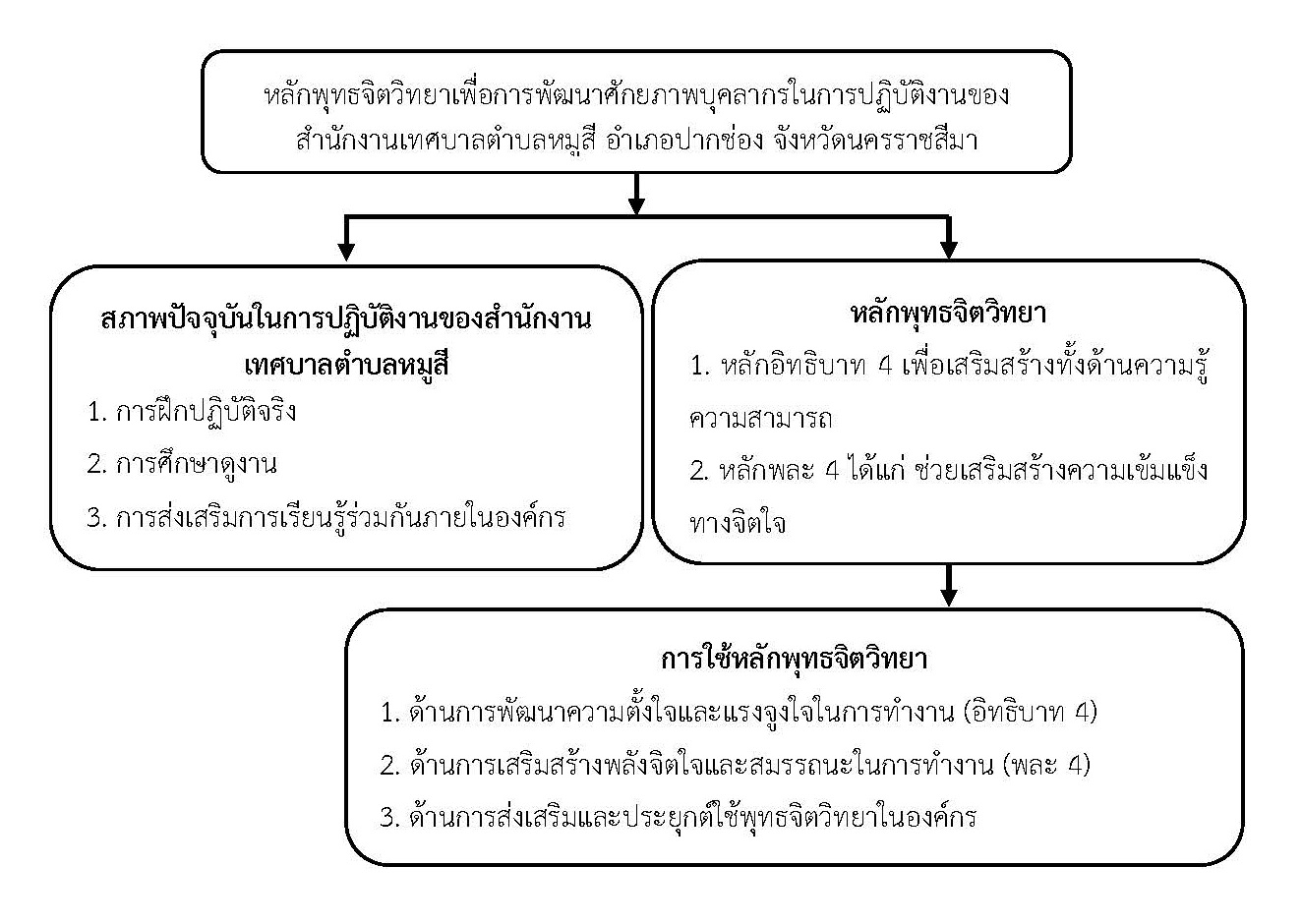
This research article aimed to: (1) investigate the current conditions and problems in developing the performance potential of personnel at Moo Si Subdistrict Municipality Office, Pak Chong District, Nakhon Ratchasima Province; (2) examine the Buddhist psychological principles applicable to personnel potential development at Moo Si Subdistrict Municipality Office; and (3) propose guidelines for applying Buddhist psychological principles to enhance the performance potential of personnel at Moo Si Subdistrict Municipality Office, Pak Chong District, Nakhon Ratchasima Province. This study employed a qualitative research methodology. Data were collected through in-depth interviews with 15 key informants selected by purposive sampling and analyzed using descriptive analysis.
The research findings revealed that: 1. The current conditions and problems in personnel potential development indicated several limitations, including an insufficient number of personnel, excessive workloads, limited budgets for personnel development, and a lack of continuous capacity development and individualized development plans. Some personnel also lacked specialized competencies, particularly in digital technology, English language proficiency, and knowledge of frequently updated laws and government regulations. Nevertheless, personnel demonstrated strengths in work experience, responsibility, and a strong understanding of the local community context. 2. The Buddhist psychological principles for personnel potential development consisted of the Four Bases of Success (Iddhipada IV), which enhanced motivation, determination, responsibility, and continuous work improvement. In addition, the Five Spiritual Powers (Panca Bala) faith (Saddha), effort (Viriya), mindfulness (Sati), concentration (Samadhi), and wisdom (Panna) strengthened mental resilience, carefulness, and rational decision-making, enabling personnel to develop knowledge, professional skills, and moral integrity in their work. 3. The guidelines for applying Buddhist psychological principles included ethics and morality training, meditation practice, study visits, and the promotion of collaborative learning within the organization. These approaches fostered public-mindedness, responsibility, effective teamwork, and adaptability to organizational changes, ultimately contributing to the development of a strong, transparent, and sustainable organization.
Downloads
Article Details

This work is licensed under a Creative Commons Attribution-NonCommercial-NoDerivatives 4.0 International License.
References
กัญญาภัค นาคนคร. (2560). การศึกษาการบริหารงานบุคคลของเทศบาลตำบลในเขตอำเภอบ้านแหลม จ. เพชรบุรี. วิทยานิพนธ์รัฐประศาสนศาสตรมหาบัณฑิต, สาขาวิชารัฐประศาสนศาสตร์, บัณฑิตวิทยาลัย, มหาวิทยาลัยขอนแก่น.
จรวยพร ธรณินทร์. (2552). 12 ไม้เด็ดสูตรสำเร็จข้าราชการ. กรุงเทพฯ: อินสปรายร์.
พระพรหมคุณาภรณ์ (ป.อ. ปยุตฺโต). (2556). การพัฒนาที่ยั่งยืน. กรุงเทพฯ: ผลิธัมม์.
พระราชวรมุนี (ป.อ. ปยุตโต). (2540). “ความสุขที่แท้จริงของชีวิตกับจิตพิสัย” จิตพิสัย: มิติสำคัญของการพัฒนาคน. กรุงเทพฯ: สำนักงานคณะกรรมการวัฒนธรรมแห่งชาติ.
พระมหาสุวิทย์ สิริวฑฺโน (พรหมเกิด). (2559). การบริหารงานตามหลักอิทธิบาท 4 ขององค์การบริหารส่วนตำบล อำเภอทุ่งสง จังหวัดนครศรีธรรมราช. วิทยานิพนธ์พุทธศาสตรมหาบัณฑิต, สาขาวิชาพระพุทธศาสนา, บัณฑิตวิทยาลัย, มหาวิทยาลัยมหาจุฬาลงกรณราชวิทยาลัย.
พระมหาปรีชา เขมนนฺโท (เหล่าทวีคุณ). (2561). การประยุกต์หลักอิทธิบาทธรรมเพื่อการบริหารจัดการสำนักปฏิบัติธรรม ในจังหวัดพระนครศรีอยุธยา, ดุษฎีนิพนธ์พุทธศาสตรดุษฎีบัณฑิต, สาขาวิชา การจัดการเชิงพุทธ, บัณฑิตวิทยาลัย, มหาวิทยาลัยมหาจุฬาลงกรณมหาวิทยาลัย.
พระรุ่งเกียรติ อินฺทปญฺโญ (ศิริสุขเจริญพร). (2564) แนวทางการพัฒนาการปฏิบัติธรรมตามหลักพุทธจิตวิทยา สำหรับประชาชนในจังหวัดลพบุรี. วารสาร มจร มนุษยศาสตร์ปริทรรศน์, 7(1): 141-152.
ประเวศ วะสี. (2541). คุยกันเรื่องความคิด, พิมพ์ครั้งที่ 4. กรุงเทพฯ: มูลนิธิโกมลคีมทอง.
วิจารณ์ พานิช. (2568). การเรียนรู้ตลอดชีวิต: รากฐานสู่ความงอกงามของชีวิต. กรุงเทพฯ: มูลนิธิสยามกัมมาจล.
สมคิด บางโม. (2545). การบริหาร. กรุงเทพฯ: ไทยวัฒนาพานิช.
อาภรณ์ ภู่วิทยพันธุ์ .(2565). การบริหารคนเก่งในองค์กร. กรุงเทพฯ: เอชอาร์เซ็นเตอร์.