The Development of Clay Pottery Practical Skill using Project based Learning with the Local Wisdom of Grade 6 Students
Article Sidebar
Main Article Content
Abstract
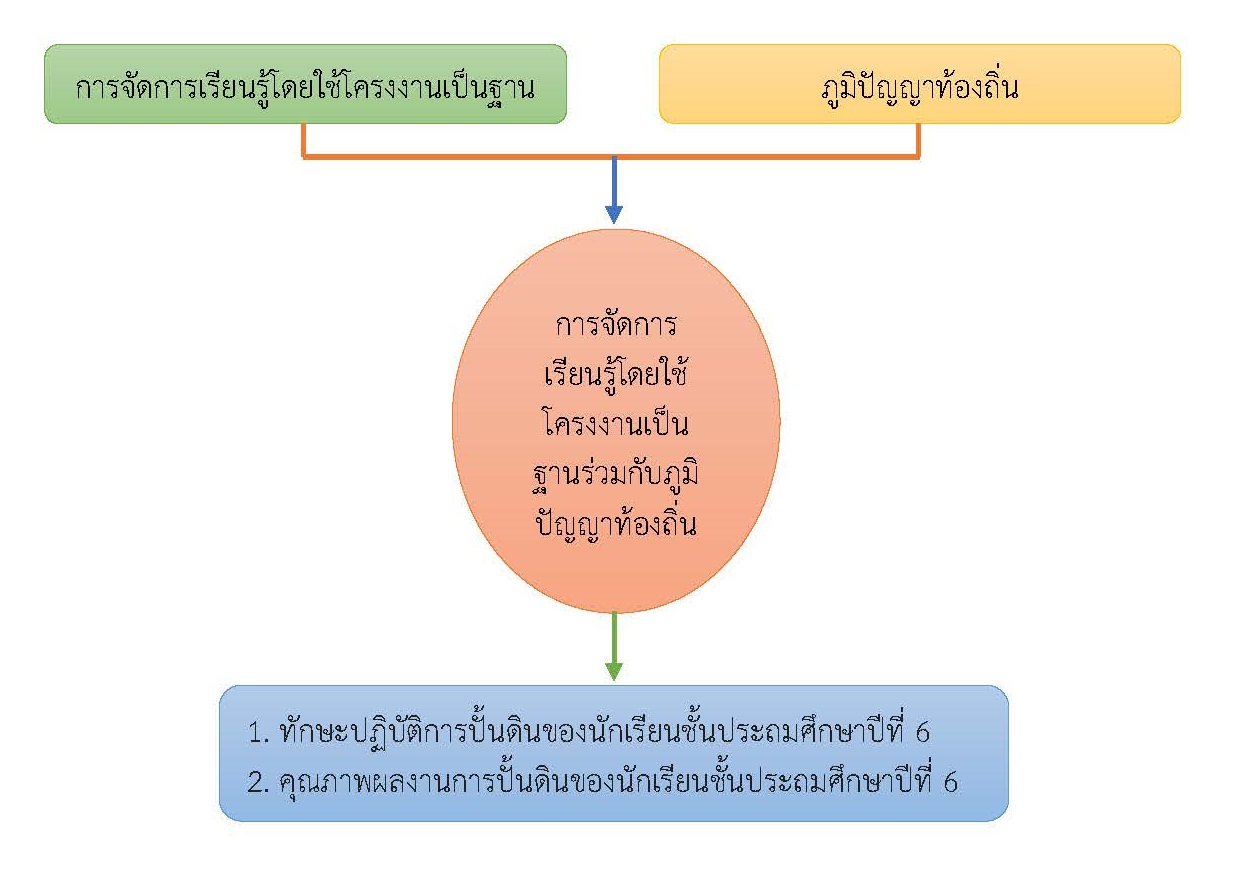
This research article aims to study 1) develop clay modeling practical skills through project-based learning integrated with local wisdom among Grade 6 students, with post-learning achievement exceeding the established criterion; and (2) investigate the quality level of clay modeling products after learning through project-based learning integrated with local wisdom. The sample consisted of Grade 6 students at Ban Tha-ang School in the 2025 academic year, selected through cluster random sampling. The research instruments included lesson plans, a clay modeling practical skills assessment form, and a product quality assessment form developed based on the evaluation criteria Data were analyzed using the mean (X) and standard deviation (S.D.). The normality of data distribution was examined prior to hypothesis testing.
The research hypothesis was tested using a one-Sample t-test. The research results were found as follows:- 1) The clay modeling practical skills of Grade 6 students after learning through project-based learning integrated with local wisdom were significantly higher than the criterion of 80 percent at the 0.05 level of statistical significance. 2) The quality of students’ clay modeling products after learning through project-based learning integrated with local wisdom was at a very good level, with a mean score of 43.75 and a standard deviation of 1.48, representing 87.50 percent.
Downloads
Article Details

This work is licensed under a Creative Commons Attribution-NonCommercial-NoDerivatives 4.0 International License.
References
กรมวิชาการ. (2538). ฐานข้อมูลภูมิปัญญา. [ออนไลน์]. แหล่งที่มา: https://www.thawat.go.th/fileupload/2025-12-257564206584.pdf
กฤษณา วงษาสันต์. (2542). วิถีไทย. กรุงเทพฯ: เธิร์ดเวฟ เอ็ดดูเคชัน
เกรียงไกร ดวงขจร. (2566). การพัฒนางานหัตถกรรมเครื่องปั้นดินเผาจากภภูมิปัญญาท้องถิ่นการปั้นหม้อ บ้านลำโพง ต.พุดซา อ.เมือง จ.นครราชสีมา เพื่อถ่ายทอดองค์ความรู้สำหรับครูสอนศิลปะ. ปริญญานิพนธ์มหาบัณฑิต, สาขาวิชาอุตสาหกรรมศิลป์, คณะเทคโนโลยีอุตสาหกรรม, บัณฑิตวิทยาลัย, มหาวิทยาลัยรัชภัฏนครราชสีมา.
ดุษฎี โยเหลา และคณะ. (2557). การศึกษาการจัดการเรียนรู้แบบ PBL ที่ได้จากโครงการสร้างชุดความรู้ เพื่อสร้างเสริมทักษะแห่งศตวรรษที่ 21 ของเด็กและเยาวชน: จากประสบการณ์ความสำเร็จ ของโรงเรียนไทย. กรุงเทพฯ: หจก.ทิพยวิสุทธิ์.
เด่น รักซ้อน และกานต์ สุรนันท์. (2558). การพัฒนาเนื้อดินปั้นบ้านด่านเกวียนด้วยวัตถุดิบที่มีอยู่ในท้องถิ่น. รายงานการวิจัย, มหาวิทยาลัยเทคโนโลยีราชมงคล อีสาน.
ทิศนา แขมมณี. (2551). รูปแบบการเรียนการสอน ทางเลือกที่หลากหลาย. กรุงเทพฯ: สำนักพิมพ์แห่งจุฬาลงกรณมหาวิทยาลัย.
ปาริฉัตร เนียมชูชื่น และอดิศร บาลโสง. (2568). การพัฒนาผลสัมฤทธิ์ทางการเรียน และทักษะกระบวน การทำงานวิชาการงานอาชีพ เรื่องงานประดิษฐ์ด้วยการจัดการเรียนรู้โดยใช้โครงงานเป็นฐานของนักเรียนชั้นประถมศึกษาปีที่ 6. วารสารวิชาการและวิจัยสหวิทยาการ, 5(3): 1005-1014.
ศิริพร พึ่งเพ็ชร์, วิไลวรรณ ศิริประภาภูวดล และไพโรจน์ ศรีคง. (2566). อำนาจละมุนอัตลักษณ์ชุมชน เพื่อการเสริมสร้างรายได้ผู้สูงวัยของชุมชนบ้านโนนเขวา อำเภอเกษตรสมบูรณ์ จังหวัดชัยภูมิ. วารสารนวัตกรรมการจัดการศึกษาและการวิจัย, 5(3), 533-542.
ศักดิ์ชัย เกียรตินาคินทร์. (2542). ทะเบียนภูมิปัญญาท้องถิ่น. [ออนไลน์]. แหล่งที่มา: http://www.sanpong.go.th/webs/Public/Files/304.pdf
สมพร ล้ำจุมจัง และสมร ทวีบุญ. (2566). การพัฒนาการจัดการเรียนรู้แบบโครงงานรายวิชาการงานอาชีพ สำหรับชั้นประถมศึกษาปีที่ 6. วารสารวิชาการมหาวิทยาลัยราชภัฏศรีสะเกษ, 17(3): 1-9
Dewey, J. (2005). How we think: a restatement of the relation of reflective thinking and the educational process. NY: D.C Heath.
Kolb, D.A. (1984). Experiential learning: Experience as the source of learning and development. Prentice-Hall.
Vygotsky, L.S. (1978). Mind in society: The development of higher psychological processes. Harvard University Press.
