
Development of a Buddhist Community Model to Promote to Compassionate Intergenerational Coexistence in Surin Province
Article Sidebar
Main Article Content
Abstract
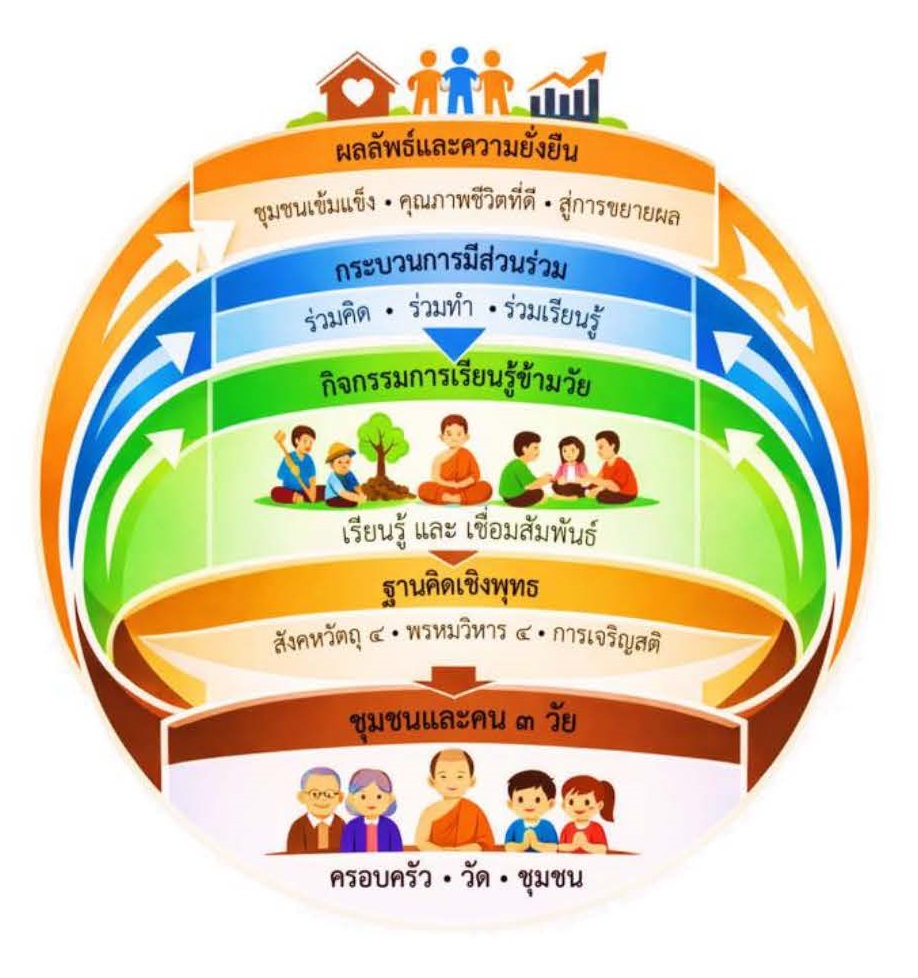
This research article aimed to: (1) investigate the potential of a Buddhist community in promoting harmonious coexistence among three generations; (2) develop Buddhist-based activities that foster intergenerational harmony; and (3) develop a Buddhist model community that can be implemented and expanded in real community contexts. The study employed a Research and Development (R&D) approach integrated with a mixed-methods research design. The study was conducted in the community surrounding Wat Sawang Arom, Prasat District, Surin Province. The participants were selected through purposive sampling and consisted of 50 community members, including youth, working-age adults, and older adults, together with 10 key informants, comprising community leaders, administrators of community learning centers, Buddhist scholars, administrators of elderly schools, and public health academics. Research instruments included questionnaires, in-depth interview guides, and focus group discussion protocols. Quantitative data were analyzed using descriptive statistics, while qualitative data were analyzed through content analysis.
The findings revealed that: (1) the Buddhist community possessed significant social and cultural capital, including the temple, community leaders, local sages, and community networks, which served as key mechanisms for strengthening relationships, mutual assistance, and compassionate coexistence among the three generations; (2) the development of Buddhist-based activities integrating Buddhist principles with community practices such as merit-making ceremonies, volunteer service, intergenerational learning activities, and moral and ethical development programs enhanced mutual understanding, unity, and compassion among youth, working-age adults, and older adults; and (3) a Buddhist model community was successfully developed, emphasizing participation from all sectors, the temple as the center of community development, the integration of Buddhist principles into daily life, and the establishment of sustainable community collaboration networks. The model is applicable to and can be replicated in other communities with similar contexts. Its implementation contributes to strengthening community resilience, improving the quality of life of people across all age groups, and promoting sustainable, peaceful, and mutually supportive coexistence.
Downloads
Article Details

This work is licensed under a Creative Commons Attribution-NonCommercial-NoDerivatives 4.0 International License.
References
ปรางทิพย์ มังธานี และคณะ. (2567). การจัดการความสุขในการทำงานยุคดิจิทัลของบุคลากรในกระบวนการยุติธรรมของไทย. Journal of Modern Learning Development, 9(9): 115-128.
ปิยากร หวังมหาพร. (2567). โครงการระหว่างวัยด้านการศึกษาเพื่อการมีส่วนร่วมในกิจกรรมทางสังคมของผู้สูงอายุไทย. วารสารวิทยาการจัดการมหาวิทยาลัยราชภัฏสกลนคร, 4(1): 1-12.
เผด็จการ กันแจ่ม และคณะ. (2568). การพัฒนาระบบการส่งเสริมการอยู่ร่วมกันของคนสามวัยโดยการมีส่วนร่วมของภาคีเครือข่าย. วารสารวิชาการมหาวิทยาลัยราชภัฏอุตรดิตถ์, 20(1): 132-142.
พระครูวินัยธรชวลิต อุตฺตโม (สุวรรณ จันทร์) และคณะ. (2568). รูปแบบการประยุกต์ใช้หลักไตรสิกขาเพื่อการเสริมสร้างความสุขแบบเรียบง่ายวิถีพุทธในสังคมดิจิทัล. วารสารสังคมพัฒนศาสตร์, 8(11): 144-153.
พระมหาขวัญชัย เหมประไพ และคณะ. (2566). กลไกการสร้างสังคมสันติสุขระหว่างคน 3 วัยในมิติพระพุทธศาสนาของสังคมไทย. Journal of MCU Philosophy Review, 8(1): 257-270.
ระพีพรรณ คำหอม และคณะ. (2563). ความอยู่ดีมีสุขของครอบครัวไทยตามวงจรชีวิตครอบครัว: กรณีศึกษาภาคใต้. Journal of Social Work and Social Administration, 28(2): 24-59.
สายทิพย์ เหล่าทองมีสกุล. (2559). วิถีการดำเนินชีวิตและการทำงานของกลุ่มคน 3 ช่วงวัย: กรณีศึกษา ข้าราชการครูและบุคลากรทางการศึกษา. วารสารสังคมศาสตร์และมนุษยศาสตร์ มหาวิทยาลัย เกษตรศาสตร์, 42(2): 80-99.
สุธาสินี แสงมุกดา. (2565). การบริหารจัดการแบบมีส่วนร่วมของชุมชนเพื่อเสริมสร้างกระบวนการพัฒนาคุณภาพชีวิตสังคมผู้สูงวัยแบบวิถีพุทธ. Journal of Yanasangvorn Research Institute Mahamakut Buddhist University, 13(2): 59-70.
หทัยภัทร ตังกุลา และอัญญรัตน์ เชิงค้า. (2563). รูปแบบการสร้างจิตอาสาอย่างสร้างสรรค์เพื่อความเป็นพลเมืองที่ดีของสังคมไทย. วารสารสันติสุขปริทรรศน์, 1(1): 52-67.
อุทุมพร หลอดโค. (2558). กระบวนการจัดการความรู้ของศูนย์สามวัยสานใยรักแห่งครอบครัว. วารสารวิชาการ มหาวิทยาลัยราชภัฏบุรีรัมย์ สาขามนุษยศาสตร์และสังคมศาสตร์, 7(1): 103-116.
