
Legal Measures in Thailand for Surrogate Medical Decision-Making for Patients unable to Express Their Wishes
Article Sidebar
Main Article Content
Abstract
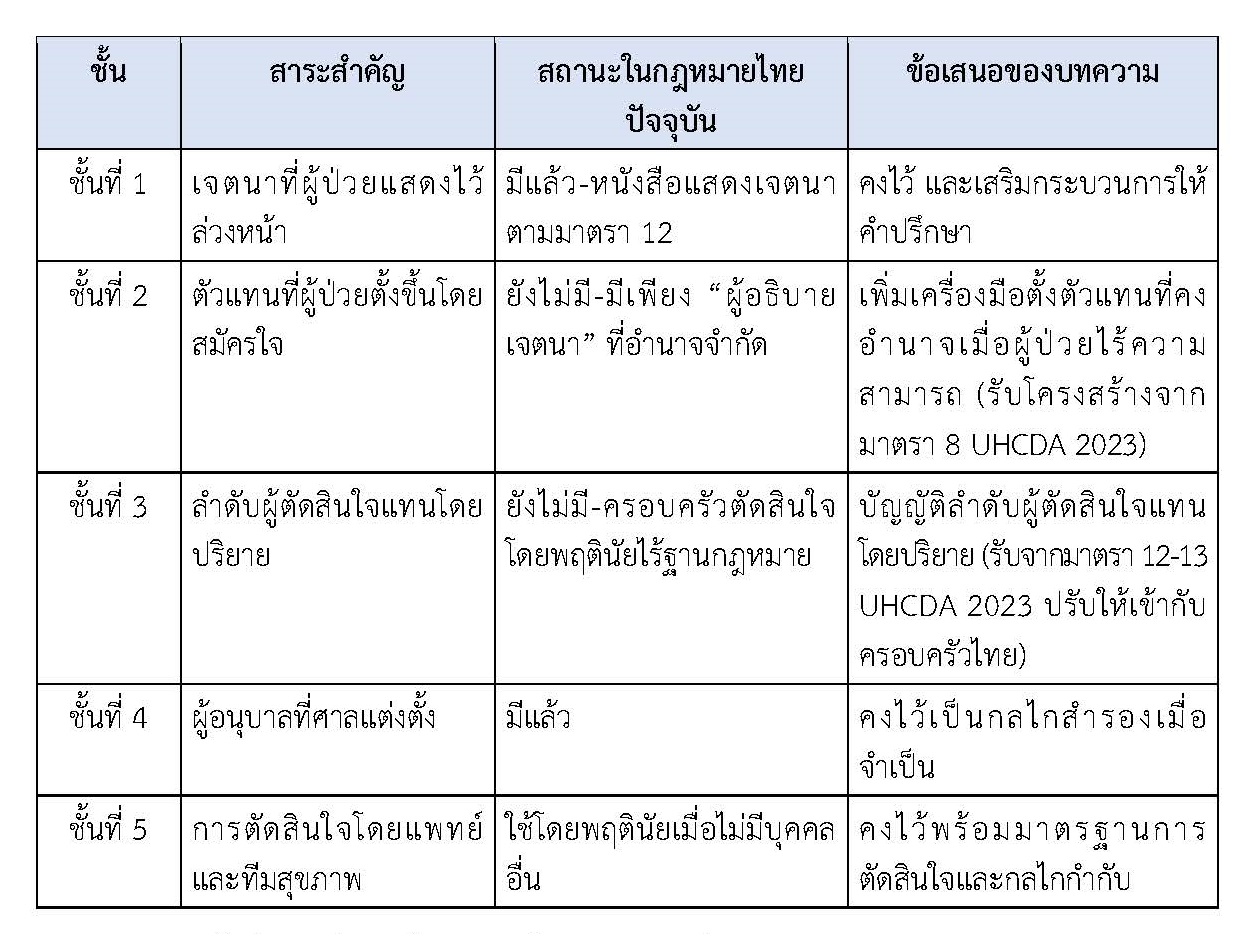
When a patient reaches the final stage of life and loses the capacity to make decisions, the question of who holds the authority to make medical decisions on the patient's behalf remains a problem to which Thai law offers no clear answer. Although Section 12 of the National Health Act B.E. 2550 (2007) recognizes an individual's right to execute a living will declining public health services that serve only to prolong dying in the terminal phase of life or to relieve the suffering caused by illness, this right is personal in nature and cannot be delegated to or exercised by another. In practice, families and physicians jointly make decisions on behalf of the patient without any supporting legal framework. Employing doctrinal legal analysis in conjunction with functional comparative law, this article demonstrates that Thai law lacks both a mechanism enabling patients to appoint an agent to make healthcare decisions on their behalf once they become incapacitated, and a statutory default hierarchy of surrogate decision-makers. Drawing lessons from the legal system of the United States, which has developed both mechanisms over a long period, the article proposes that Thailand establish a hierarchical legal framework that would (1) confer formal legal status upon the role of the family already exercised de facto as a matter of ordinary practice through a statutory order of healthcare surrogate decision-makers, and (2) introduce a mechanism allowing patients to appoint an agent voluntarily, while adapting it to Thailand's family-centered culture. This proposal would bring legal clarity to end-of-life medical decision-making, reduce uncertainty in healthcare professionals' practice, and promote respect for patients' wishes alongside the role of the family.
Downloads
Article Details

This work is licensed under a Creative Commons Attribution-NonCommercial-NoDerivatives 4.0 International License.
References
ฐากูร กาญจโนภาศ และศรัณย์ ธนพฤฒิวงศ์. (2567). การวางแผนดูแลล่วงหน้าในผู้สูงอายุ. Ramathibodi Medical Journal, 47(4): 46-60.
พิมอากรณ์ เสียมไหม, สายพิณ หัตถีรัตน์ และกิติพล นาควิโรจน์. (2565). แพทย์เวชปฏิบัติทั่วไปและแพทย์เวชศาสตร์ครอบครัวของไทยเผชิญกับความท้าทายอะไรบ้าง เมื่อพูดคุยเรื่องการวางแผน ดูแลล่วงหน้ากับผู้ป่วยระยะประคับประคองและครอบครัว: การวิจัยเชิงคุณภาพ. วารสารกรมการแพทย์, 47(1): 94-102.
พิสิษฐ์ ศรีอัคคโภคิน. (2561). การสำรวจความรู้ความเข้าใจของนักกฎหมายไทยที่มีต่อเรื่องสิทธิผู้ป่วยและญาติในการปฏิเสธการรักษาพยาบาลในวาระสุดท้ายของชีวิต. วารสารนิติศาสตร์ มหาวิทยาลัย แม่ฟ้าหลวง, 1(1): 139-158.
Annas, G.J. (1991). The health care proxy and the living will. N Engl J Med, 324(17): 1210-1213.
Blackhall, L.J., Murphy, S.T., Frank, G., Michel, V., & Azen, S. (1995). Ethnicity and Attitudes Toward Patient Autonomy. JAMA, 274(10): 820-825.
Buchanan, A., & Brock, D.W. (1986). Deciding for others. Milbank Q, 64(Suppl. 2): 17-94.
Chutarattanakul, L., Jarusukthavorn, V., Dejkriengkraikul, N., Oo, M.Z., Tint, S.S., Angkurawaranon, C., & Wiwatkunupakarn, N. (2024). Misconception between palliative care and euthanasia among Thai general practitioners: a cross-sectional study. BMC Palliative Care, 23(1): 96.
Eisenberg, K.G. (1988). Privacy I: surrogate decision making for the terminally ill. Annual Survey of American Law, 1988(2): 353-384.
Foiles, T. (2007). State Surrogate Decision-Making Statutes: A Need for Change. Adelphia Law Journal, 16(1): 21-38.
Kutner, L. (1968). Due process of euthanasia: the living will, a proposal. Ind. LJ, 44: 539.
Limpawattana, P., Srinonprasert, V., Manjavong, M., Pairojkul, S., Chindaprasirt, J., Kaiyakit, S., Juntararuangtong, T., Yongrattanakit, K., & Kuichanuan, T. (2019). Thai medical students’ attitudes regarding what constitutes a “good death”: a multi-center study. BMC Medical Education, 19(1): 78.
Orentlicher, D. (2020). Cruzan and surrogate decision-making. SMU Law Review, 73(1): 155-162.
Paris, J., & O’Connell, K. (1991). The Patient Self-Determination Act of 1990. Clinical Ethics Report, 5: 1-10.
Perkins, H.S. (2007). Controlling death: the false promise of advance directives. Ann Intern Med, 147(1): 51-57.
Robertson, J.A. (1991). Cruzan and the constitutional status of nontreatment decisions for incompetent patients. Georgia Law Review, 25(5): 1139-1202.
Srinonprasert, V., Kajornkijaroen, A., Bangchang, P.N., Wangtrakuldee, G., Wongboonsin, J., Kuptniratsaikul, V., Kornbongkotmas, S., Assanasen, J., & Praditsuwan, R. (2014). A survey of opinions regarding wishes toward the end-of-life among Thai elderly. Journal of the Medical Association of Thailand, 97(Suppl 3): S216-222.
Stonington, S., & Ratanakul, P. (2006). Is There a Global Bioethics? End-of-Life in Thailand and the Case for Local Difference. PLoS Medicine, 3(10): e439.
Strätling, M., Scharf, V.E., & Schmucker, P. (2004). Mental competence and surrogate decision-making towards the end of life. Medicine, Health Care and Philosophy, 7(2): 209-216.
Tengaumnuay, T. (2023). Advance Directives: The Thai Context. In D. Cheung & M. Dunn (Eds.), Advance Directives Across Asia: A Comparative Socio-legal Analysis (pp. 90-109). Cambridge University Press.
