
“Cultural Backlash”: A Case Study of Aristocratic Chinese Dress Culture in the Translated Literary Work “Dream of the Red Chamber”
Article Sidebar
Main Article Content
Abstract
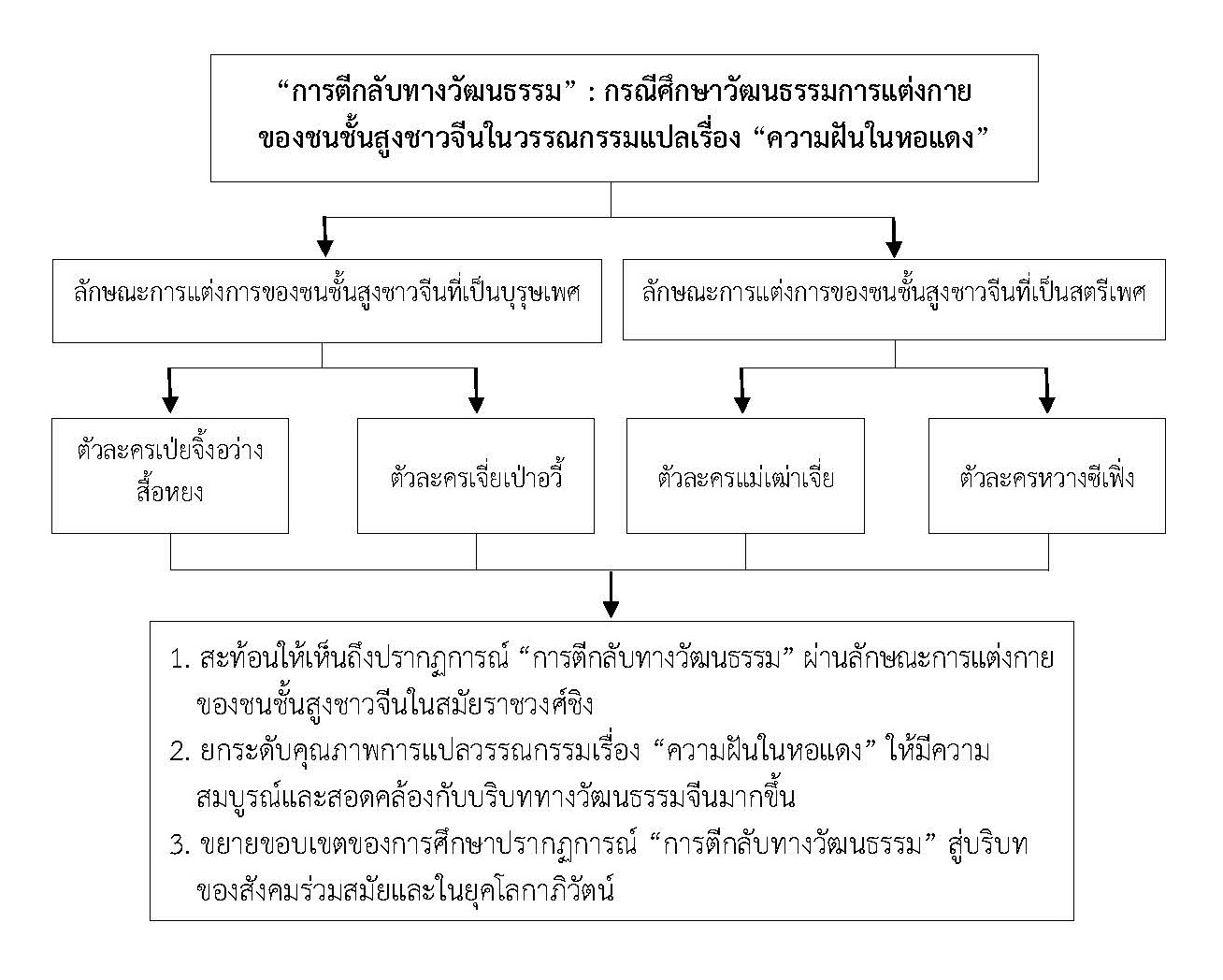
This research article aims to study the phenomenon of “cultural backlash” through the clothing styles of the Chinese aristocracy as depicted in the translated literary work “Dream of the Red Chamber”. This is a qualitative study based on documentary data, conducted through the processes of data collection, data analysis, and data presentation. The research results reveal that the clothing culture of the Chinese upper class during the Qing Dynasty is reflected through male representative characters, including Prince Beijing, Shi Yong, and Jia Baoyu, as well as female representative characters, namely Grandmother Jia and Wang Xifeng. The attire of these two groups of characters illustrates the phenomenon of “cultural backlash” in Chinese society. In other words, although the Qing Dynasty, ruled by the Manchus, maintained political control over China for nearly 300 years, it was unable to dominate the culture of the Han Chinese, who constituted the majority of the population. Consequently, the Manchu ruling class was compelled to adopt Han Chinese clothing styles from the Ming Dynasty as the standard for their own dress. This study highlights the profound influence of culture on people’s ways of thinking and modes of life. In some cases, cultural strength can exert greater power than political authority. Therefore, culture constitutes a crucial factor in shaping identity and social cohesion, while also directly contributing to the long-term stability of the nation-state.
Downloads
Article Details

This work is licensed under a Creative Commons Attribution-NonCommercial-NoDerivatives 4.0 International License.
References
กลุ่มนักข่าวการเมือง. (ม.ป.ป.). คึกฤทธิ์เปิดม่านไม้ไผ่. กรุงเทพฯ: อักษรบัณฑิต.
คึกฤทธิ์ ปราโมช, ม.ร.ว. (2553). สามนคร. นนทบุรี: ดอกหญ้า 2000.
คึกฤทธิ์ ปราโมช, ม.ร.ว. (2555). ซูสีไทเฮา. นนทบุรี: ดอกหญ้า 2000.
คึกฤทธิ์ ปราโมช, ม.ร.ว. (2556). ธรรมแห่งอริยะ. พิมพ์ครั้งที่ 2. นนทบุรี: ดอกหญ้า 2000.
เจือง ถิ หั่ง. (2568). บทประพันธ์ของหลู่ซิ่น : บทบาทและภาพสะท้อนสังคมจีนในห้วงหัวเลี้ยวหัวต่อ. วารสารวิชาการมนุษยศาสตร์และสังคมศาสตร์ มหาวิทยาลัยบูรพา, 33(3): 155-169.
เฉาเสวี่ยนฉิน และเกาเอ้อ. (2555). ความฝันในหอแดง. วิวัฒน์ ประชาเรืองวิทย์ (ผู้แปล). กรุงเทพฯ: สำนักพิมพ์ต้นไม้.
ชิดหทัย ปุยะติ. (2554). พัฒนาการและลักษณะเด่นของวรรณกรรมจีนโพ้นทะเลในประเทศไทย. วารสารศิลปศาสตร์ มหาวิทยาลัยอุบลราชธานี, 7(2): 71-91.
ภูเทพ ประภากร และคณะ. (2566). สถานภาพการศึกษาวรรณคดีจีนเรื่อง ความฝันในหอแดงในวงวิชาการไทยและจีน. วารสารศิลปศาสตร์ มหาวิทยาลัยธรรมศาสตร์, 23(2): 283-317.
สายทิพย์ สัญญะวี. (2568). มรดกทางวัฒนธรรมที่จับต้องไม่ได้ตามอนุสัญญาว่าด้วยการสงวนรักษา มรดกทางวัฒนธรรมที่จับต้องไม่ได้และการดำเนินการของประเทศไทยต่อมรดกทางวัฒนธรรมที่จับต้องไม่ได้. [ออนไลน์]. แหล่งที่มา: https://lawforasean.ocs.go.th/Content/View?Id=1264&Type=1. [10 ตุลาคม 2568].
วิวัฒน์ ประชาเรืองวิทย์. (2555). คำนำ. ใน ความฝันในหอแดง. กรุงเทพฯ: สำนักพิมพ์ต้นไม้.
วินัย สุกใส. (2553). วิวัฒนาการวรรณกรรมจีนในภาษาไทย ตั้งแต่ พ.ศ. 2411-2475 (ตอนที่ 1). วารสารจีนศึกษา, 3(3): 212-240.
หลู่ซิ่น. (2563). ตะโกนสู้ ชุมนุมเรื่องสั้นของหลู่ซิ่น. พิมพ์ครั้งที่ 2. กรุงเทพฯ: ไทยควอลิตี้บุ๊คส์ (2006).
หลู่ซวิ่น. (2546). เรื่องสั้นของหลู่ซวิ่น. นักศึกษาวิชาเอกภาษาจีน รุ่น 7 มหาวิทยาลัยธรรมศาสตร์ (ผู้แปล). กรุงเทพฯ: ชุมศิลป์ธรรมดา.
Cui Chenyao. (2017). 毛泽东对《红楼梦》的政治解读及当代启示. Master's thesis. School of Marxism, North China University of Technology.
Chen Dongsheng, et al. (2006). 解读《红楼梦》服饰的社会制约因素. Journal of Wuhan University of Science and Technology, 19(10): 51-54.
Feng Qiyong, & Li Xifan. (1991). 红楼梦大辞典. Beijing: Culture and Art Publishing House.
Han Mei. (1999). 浅析《红楼梦》中人物的服饰及其时代特征. Journal of Ming-Qing Fiction Studies, 1: 59-64.
Li Baochen. (2005). 清代宗室王公封爵制度考析. Beijing: Culture and Art Publishing House.
Mao Kunlun, et al. (2024). 清代龙袍中海水江崖纹的艺术特征及其创新设计. Wool Textile Journal, 52(9): 1-8.
Pan Huidu, et al. (2023).《红楼梦》中王熙凤的服饰特点与人物塑造在现代服饰设计中的应用. Master's thesis. School of Fashion and Art Design, Donghua University.
Wang Qizhou, et al. (2003). 绛珠还泪《红楼梦》与民俗文化. Heilongjiang: Heilongjiang People’s Publishing House.
Xu Jingbi. (2012). 本是人间富贵花— —对王熙凤出场服饰的欣赏. Anhui Literature (Second Half of the Month) Journal, 12: 125-126.
