
An Analytical Study of Business Organization Leadership in Contemporary Society
Article Sidebar
Main Article Content
Abstract
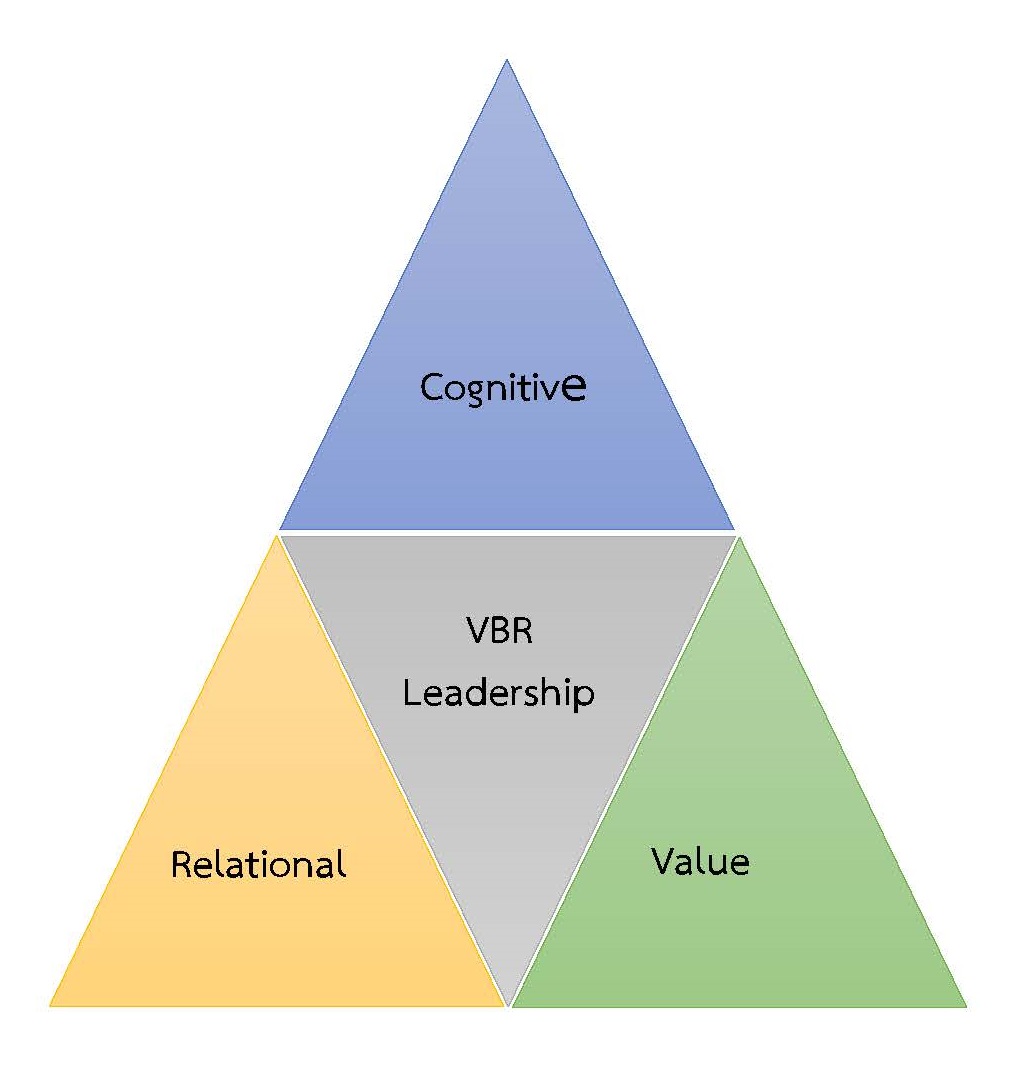
This research article aims 1) to analyze the meaning of business organization leadership in the context of contemporary society, and 2) to examine the components of leadership in terms of cognition, relationships, and values. The study employs a philosophical research methodology using conceptual analysis as the primary approach. The findings reveal that business organization leadership is not merely an individual trait or a structural role within organizations, but rather a dynamic relational process emerging through continuous interactions among leaders, followers, and organizational contexts. This leadership process can be explained through three major dimensions: 1) the cognitive dimension, involving vision, analysis, and decision-making; 2) the relational dimension, emphasizing motivation, trust, and participation; and 3) the value dimension, concerning ethics, responsibility, and the balance between organizational interests and social well-being. The study further indicates that contemporary leadership concepts have shifted from structural control toward relational and value-oriented perspectives. The major contribution of this research is the synthesis of the “VBR Leadership Model (Value-Based Relational Leadership Model),” which conceptualizes leadership as a value-based relational system integrating cognition, relationships, and values into a holistic framework for understanding and developing leadership in modern organizations.
Downloads
Article Details

This work is licensed under a Creative Commons Attribution-NonCommercial-NoDerivatives 4.0 International License.
References
กอบชัย เมฆดี และศศินันท์ ศาสตร์สาระ. (2566). ภาวะผู้นำในองค์กรยุคใหม่. กรุงเทพฯ: สำนักพิมพ์จุฬาลงกรณ์มหาวิทยาลัย.
ชาย โพธิสิตา. (2552). ศาสตร์และศิลป์แห่งการวิจัยเชิงคุณภาพ. กรุงเทพฯ: อมรินทร์พริ้นติ้ง.
พักตร์ผจง วัฒนสินธุ์. (2559). ภาวะผู้นำเชิงจริยธรรมในองค์กรธุรกิจ. กรุงเทพฯ: สำนักพิมพ์มหาวิทยาลัย ธรรมศาสตร์.
Avolio, B.J., Walumbwa, F.O., & Weber, T.J. (2009). Leadership: Current theories, research, and future directions. Annual Review of Psychology, 60, 421-449. https://doi.org/10.1146/annurev.psych.60.110707.163621
Bass, B.M. (1990). Bass & Stogdill’s handbook of leadership: Theory, research, and managerial applications (3rd ed.). New York: Free Press.
Bauman, Z. (2000). Liquid modernity. Cambridge: Polity Press.
Burns, J.M. (1978). Leadership. New York: Harper & Row.
Fry, L.W. (2003). Toward a theory of spiritual leadership. The Leadership Quarterly, 14(6), 693-727. https://doi.org/10.1016/j.leaqua.2003.09.001
Graen, G.B., & Uhl-Bien, M. (1995). Relationship-based approach to leadership: Development of leader–member exchange (LMX) theory of leadership over 25 years. The Leadership Quarterly, 6(2), 219–247. https://doi.org/10.1016/1048-9843(95)90036-5
Greenberg, J., & Baron, R.A. (2003). Behavior in organizations. (8th ed.). Upper Saddle River, NJ: Prentice Hall.
Greenleaf, R.K. (2002). Servant leadership: A journey into the nature of legitimate power and greatness. (25th anniversary ed.). Mahwah, NJ: Paulist Press.
Northouse, P.G. (2016). Leadership: Theory and practice. (7th ed.). Thousand Oaks, CA: Sage Publications.
Schermerhorn, J.R., Hunt, J.G., & Osborn, R.N. (2012). Organizational behavior. (12th ed.). Hoboken, NJ: John Wiley & Sons.
Schwandt, T.A. (2001). Dictionary of qualitative inquiry. (2nd ed.). Thousand Oaks, CA: Sage Publications.
Sennett, R. (1998). The corrosion of character: The personal consequences of work in the new capitalism. New York: W.W. Norton & Company.
Surie, G., & Ashley, A. (2008). Integrating pragmatism and ethics in entrepreneurial leadership for sustainable value creation. Journal of Business Ethics, 81(1), 235–246. https://doi.org/10.1007/s10551-007-9491-4
Yukl, G. (2013). Leadership in organizations. (8th ed.). Upper Saddle River, NJ: Pearson Education.
