
A Study of Problems in Supervising Student Teachers in the Primary Education Program, Faculty of Education, Surindra Rajabhat University
Article Sidebar
Main Article Content
Abstract
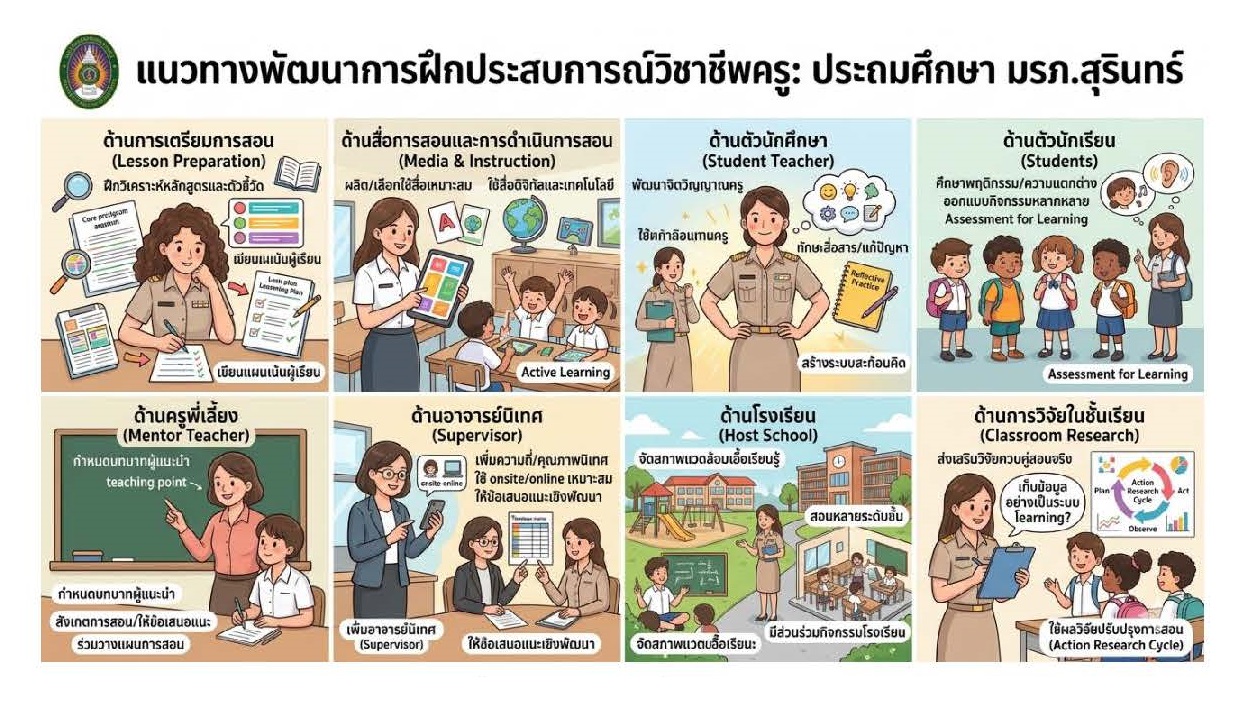
This study employed a mixed-methods research design, integrating both qualitative and quantitative research approaches. The objective of the study was to investigate (1) the problems of teaching practicum of students in the Elementary Education program, Faculty of Education, Surindra Rajabhat University; and (2) guidelines for developing the teaching practicum of students in the Elementary Education program, Faculty of Education, Surindra Rajabhat University. The population used in this study consisted of 56 fourth-year students in the Elementary Education program at the Faculty of Education, Surindra Rajabhat University who were undergoing teaching practicum. The researcher studied the entire population. The key informants were 6 participants selected through purposive sampling. The research instruments included questionnaires and interviews. The statistical methods used for data analysis were frequency, percentage, mean, and standard deviation. 1. The results of the study revealed that: The overall problems of teaching practicum of students in the Elementary Education program, Faculty of Education, Surindra Rajabhat University were at a moderate level (μ = 3.21). When considering each aspect, the highest mean was found in the mentor teacher aspect (μ = 3.32), followed by classroom action research (μ = 3.28), while the lowest mean was in the student aspect (μ = 3.09). 2. The guidelines for developing the teaching practicum of students in the Elementary Education program, Faculty of Education, Surindra Rajabhat University focused on enhancing teacher quality through hands-on practice in schools by integrating theoretical knowledge into real teaching practice. This was combined with the development of active learning instructional skills to promote student engagement and critical thinking, as well as the development of classroom action research skills for systematic instructional improvement. In addition, emphasis was placed on cultivating teacher ethics and professional attributes, along with the effective use of educational technology. Furthermore, collaboration networks between the university and schools were established to support practicum experiences aligned with real contexts, which would help students be fully prepared with knowledge, skills, and attributes for becoming professional teachers in the 21st century.
Downloads
Article Details

This work is licensed under a Creative Commons Attribution-NonCommercial-NoDerivatives 4.0 International License.
References
กระทรวงศึกษาธิการ. (2563). แนวทางการจัดการเรียนการสอนของโรงเรียนสังกัดสำนักงานคณะกรรมการ การศึกษาขั้นพื้นฐาน ในสถานการณ์การแพร่ระบาดของโรคติดเชื้อไวรัสโคโรนา 2019 (COVID-19) ปีการศึกษา 2563. กรุงเทพฯ: โรงพิมพ์ชุมนุมสหกรณ์การเกษตรแห่งประเทศไทย.
คุรุสภา. (2562). ข้อบังคับคุรุสภา ว่าด้วยมาตรฐานวิชาชีพ (ฉบับที่ 4) พ.ศ. 2562. กรุงเทพฯ: สำนักงานเลขาธิการคุรุสภา.
เทอดทูน ค้าขาย, เกษฎา สาลา และอรอุมา ปราชญ์ปรีชา. (2562). การศึกษาสภาพปัญหาในการฝึกประสบการณ์ วิชาชีพครูของนักศึกษาหลักสูตรประกาศนียบัตรบัณฑิตทางการสอน คณะศึกษาศาสตร์ มหาวิทยาลัยวงษ์ชวลิตกุล. สิกขาวารสารศึกษาศาสตร์, 6(2): 33-46.
ไพฑูรย์ สินลารัตน์. (2561). ผู้นำเชิงสร้างสรรค์และผลิตภาพ: กรอบแนวคิดใหม่และทิศทางใหม่ของการศึกษาไทย. กรุงเทพฯ: สำนักพิมพ์จุฬาลงกรณ์มหาวิทยาลัย.
รัตนะ บัวสนธ์. (2560). วิจัยเชิงคุณภาพทางการศึกษา. พิมพ์ครั้งที่ 4. กรุงเทพฯ: สำนักพิมพ์แห่งจุฬาลงกรณ์ มหาวิทยาลัย.
สุวิมล ว่องวาณิช. (2559). การวิจัยประเมินความต้องการจำเป็น. พิมพ์ครั้งที่ 3. กรุงเทพฯ: สำนักพิมพ์แห่งจุฬาลงกรณ์มหาวิทยาลัย.
สำนักงานเลขาธิการสภาการศึกษา. (2560). แผนการศึกษาแห่งชาติ พ.ศ. 2560-2579. กรุงเทพฯ: พริกหวาน กราฟฟิค.
สำนักงานศึกษาธิการจังหวัดสุรินทร์. (2565). แผนปฏิบัติราชการประจำปีงบประมาณ พ.ศ. 2565. สุรินทร์: สำนักงานศึกษาธิการจังหวัดสุรินทร์.
อุเทน ลาพิงค์ และคณะ. (2562). แนวทางพัฒนาการฝึกประสบการณ์วิชาชีพครูของนักศึกษาสาขาวิชาการสอนภาษาอังกฤษ คณะศึกษาศาสตร์ มหาวิทยาลัยมหามกุฏราชวิทยาลัย วิทยาเขตล้านนา. วารสารธรรมทรรศน์, 19(2): 13-22.
Dewey, J. (1938). Experience and Education. New York: Macmillan.
Kolb, D.A. (1984). Experiential Learning: Experience as the Source of Learning and Development. New Jersey: Prentice-Hall.
