An Analysis of English Loanwords usage on the Travel Europe by Yourself Facebook Page
Article Sidebar
Main Article Content
Abstract
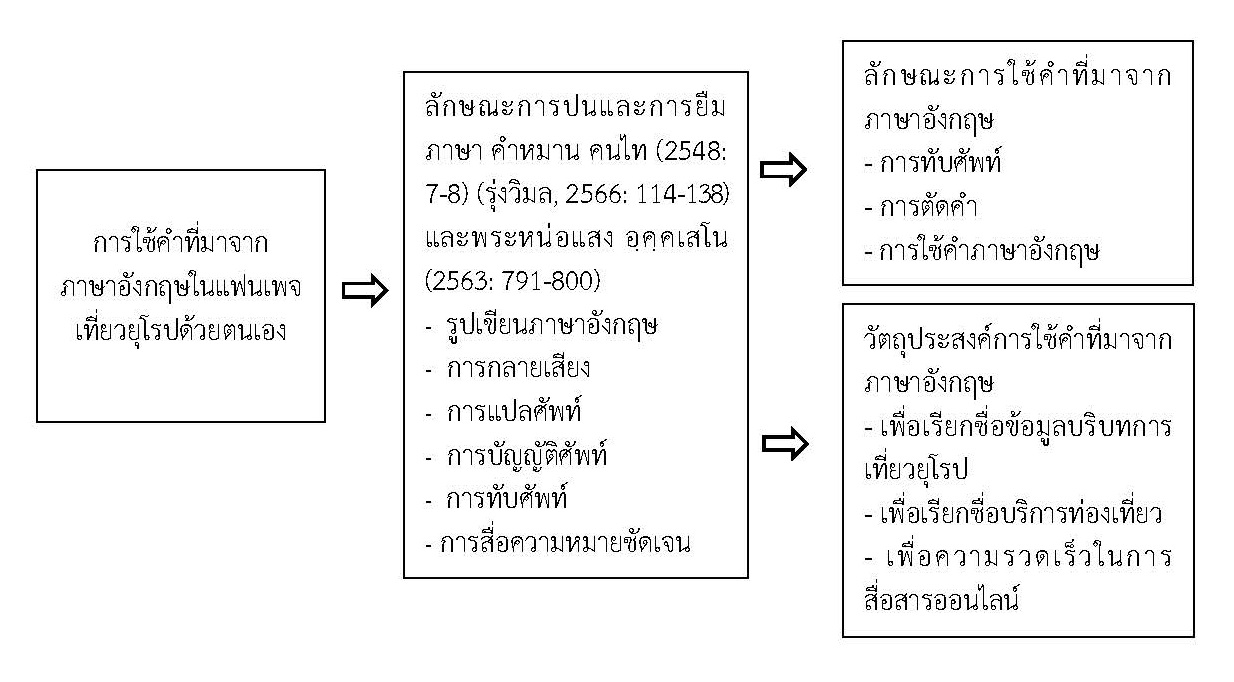
The objective of this research Article was to analyze the characteristics and purposes of English loanwords usage on the Travel Europe by Yourself Facebook page. The research focuses on usage characteristics and objectives to reflect of English into the Thai language within social media contexts. Furthermore, it provides insight into contemporary linguistic phenomena, as English has become a vital tool for understanding the communication behaviors of social media users. This research employs a mixed-methods approach, utilizing both quantitative and qualitative research. The data consisted of 854 posts collected in a total of 1,215 English words on the page during November and December 2025. The research instrument employed was a content analysis table. The data were analyzed using tabular summaries and descriptive analysis. The findings regarding the characteristics of English usage revealed five distinct forms: the exclusive use of English words, transliteration, the use of English abbreviations, the clipping of English words, and the clipping of transliterated words. Furthermore, the analysis identified six primary purposes for this English usage: to refer to country names, city names, tourist attraction names, travel-related services, restaurant names, and food names.
Downloads
Article Details

This work is licensed under a Creative Commons Attribution-NonCommercial-NoDerivatives 4.0 International License.
References
กรรณิกา ปาใข และเสาวลักษณ์ แซ่ลี้. (2562). การปนภาษาอังกฤษในภาษาไทยของข่าวบันเทิงจากเว็บไซต์sanook.com. รายงานการประชุมวิชาการการนำเสนอผลงานระดับชาติของนักศึกษาด้านมนุษยศาสตร์ และสังคมศาสตร์ครั้งที่ 2. คณะมนุษยศาสตร์และสังคมศาสตร์, มหาวิทยาลัยราชภัฏสวนสุนันทา.
คำหมาน คนไค. (2548). การใช้ภาษาอังกฤษในภาษาไทย. วารสารภาษาปริทัศน์, 20(2): 6-9.
นงลักษณ์ บัณฑุวงศ์. (2560). การใช้คำภาษาต่างประเทศในภาษาไทย. รายงานการวิจัย, คณะมนุษยศาสตร์, มหาวิทยาลัยหอการค้าไทย.
พรรณษา พลอยงาม. คำยืมภาษาอังกฤษในภาษาไทย. [ออนไลน์]. แหล่งที่มา: https://bsru.net/คำยืมภาษาอังกฤษในภาษาไ-2/ [13 ธันวาคม 2568].
พระหน่อแสง อฺคฺคเสโน. (2563). อิทธิพลของคำยืมภาษาอังกฤษในภาษาไทย. วารสาร มจร อุบลปริทรรศน์, 5(2): 791-800.
รุ่งวิมล รุ่งโรจน์สุวรรณ. (2566). การปนภาษาและการยืมภาษาอังกฤษในภาษาไทย. วารสารภาษาและภาษาศาสตร์, 41(2): 114-138.
วัฒนากานต์ อินธิมาศ และคณะ. (2564). การศึกษาการปนภาษาอังกฤษในภาษาไทยที่ปรากฏในรายการวาไรตี้ทอล์กกะเทยช่วงเดือนเมษายน-มิถุนายน พ.ศ. 2563. วารสารวิชาการมนุษย์และสังคม มหาวิทยาลัยราชภัฏศรีสะเกษ, 5(1): 79-95.
อนุชิต ตู้มณีจินดา และคณะ. (2565). ลักษณะการปนภาษาอังกฤษในภาษาไทยที่ใช้ในการสื่อสารของศูนย์บริหารสถานการณ์การแพร่ระบาดของโรคติดเชื้อไวรัสโคโรน่า 2019 (ศบอ.). วารสารศิลปศาสตร์ มหาวิทยาลัยธรรมศาสตร์, 22(3): 492-510.
Dailynews Online. ส่องเทรนด์คนไทยเที่ยวต่างประเทศ ปี 2567ประเทศไหนฮิต HappyTrip สุด. [ออนไลน์]. แหล่งที่มา: https://www.dailynews.co.th/news/4220698/ [9 ธันวาคม 2568].
