The Development of a Manual for Enhancing O-Net Achiement based on Tuthiyapaphanikhasutta of School under Nakhon Si Thammarat Primary Educational Service Area Office 3
Article Sidebar
Main Article Content
Abstract
This research aimed to: (1) investigate the current conditions of enhancing students’ achievement in the Ordinary National Educational Test (O-NET); (2) develop a manual for improving O-NET achievement based on the principles of Tuthiyapaphanikhasutta principles and (3) present and evaluate the developed manual. This study employed a mixed-methods research design conducted in three phases. Phase 1 examined the current conditions of O-NET achievement improvement in schools under Nakhon Si Thammarat Primary Educational Service Area Office 3. Data were collected using questionnaires administered to 44 school administrators and heads of academic affairs, and analyzed using quantitative data analysis techniques. Phase 2 involved the development of the manual through in-depth interviews with five experts, and the data were analyzed using content analysis. Phase 3 focused on the presentation and evaluation of the manual using an evaluation form through focus group discussions with seven experts. The qualitative data were analyzed to synthesize findings in terms of suitability, feasibility, and utility of manual.
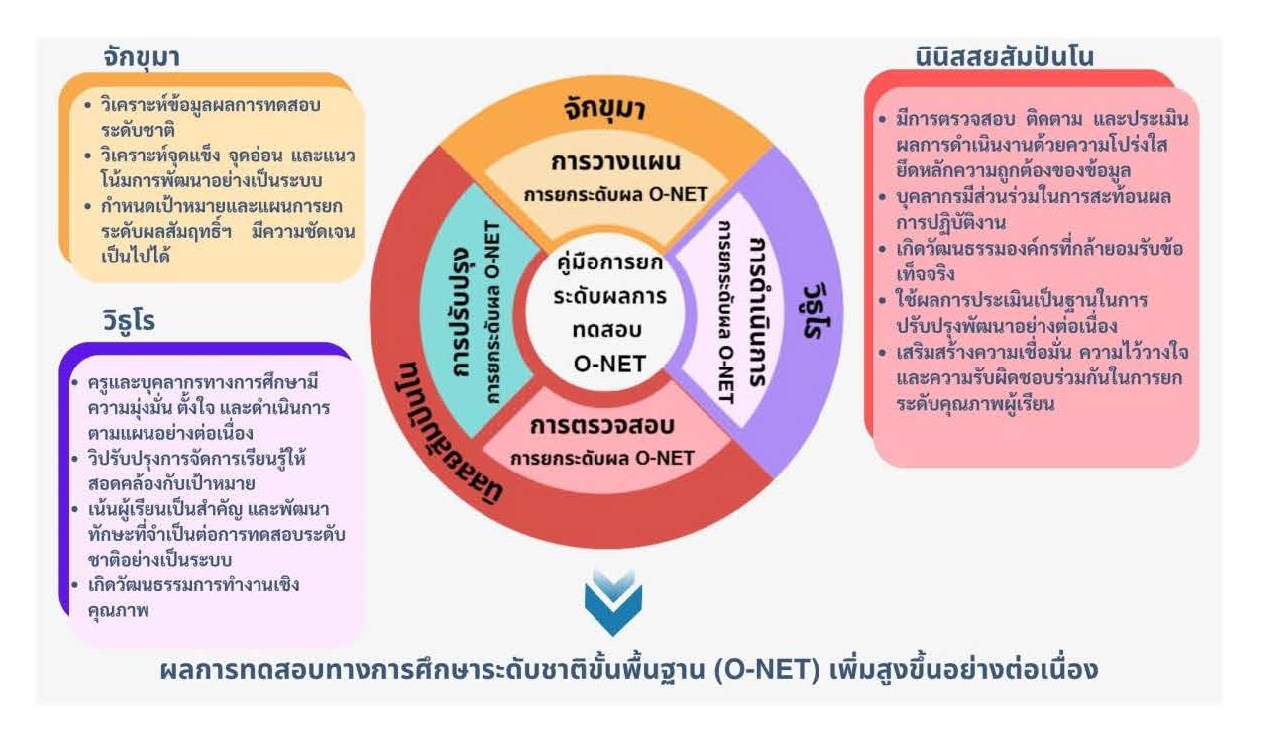
The findings revealed that: (1) the overall conditions of O-NET achievement enhancement were at a high level, encompassing all stages of the PDCA (Plan–Do–Check–Act) quality management cycle, with planning receiving the highest mean score, indicating a strong emphasis on data-driven management practices; (2) the developed manual demonstrated a clear and systematic structure, effectively integrating the Tuthiyapaphanikhasutta principles namely Cakkhuma (insightful understanding), Vidhuro (diligence), and Nissayasampanno (integrity and accountability) with the PDCA cycle, resulting in a coherent integrative framework that bridges academic rigor and ethical dimensions, and can be practically implemented in academic management and instructional practices to enhance O-NET performance; and (3) the evaluation results indicated that the manual was rated at a high level in terms of suitability, feasibility, and usefulness, and was applicable in real school contexts, particularly in fostering data-driven management systems, participatory practices among educational personnel, and continuous improvement processes.
Downloads
Article Details

This work is licensed under a Creative Commons Attribution-NonCommercial-NoDerivatives 4.0 International License.
References
กระทรวงศึกษาธิการ. (2563). นโยบายและแนวทางการพัฒนาคุณภาพการศึกษาในศตวรรษที่ 21. กรุงเทพฯ: กระทรวงศึกษาธิการ.
พระธรรมโกศาจารย์ (ประยูร ธมฺมจิตฺโต). (2549). พุทธวิธีบริหาร. กรุงเทพฯ: มหาจุฬาลงกรณราชวิทยาลัย.
พระธรรมปิฎก (ป.อ. ปยุตฺโต). (2546). พุทธธรรม (ฉบับปรับปรุงและขยายความ). กรุงเทพฯ: มหาจุฬาลงกรณ ราชวิทยาลัย.
ริดา บุรชาติ และคณะ. (2565). การวิเคราะห์ผลการทดสอบทางการศึกษาระดับชาติขั้นพื้นฐาน (O-NET) เพื่อพัฒนาคุณภาพผู้เรียน. วารสารการศึกษาไทย, 19(2): 45-60.
สำนักงานเขตพื้นที่การศึกษาประถมศึกษานครศรีธรรมราช เขต 3. (2567). รายงานผลการดำเนินงานทางการศึกษา. นครศรีธรรมราช: สำนักงานเขตพื้นที่การศึกษาประถมศึกษานครศรีธรรมราช เขต 3.
สำนักงานคณะกรรมการการศึกษาขั้นพื้นฐาน. (2566). แนวทางการพัฒนาคุณภาพการศึกษาโดยใช้ข้อมูลสารสนเทศ. กรุงเทพฯ: สำนักงานคณะกรรมการการศึกษาขั้นพื้นฐาน.
Deming, W.E. (1986). Out of the Crisis. Cambridge, MA: MIT Press.
Fullan, M. (2001). The New Meaning of Educational Change. New York: Teachers College Press.
Guest, G., Bunce, A., & Johnson, L. (2006). How many interviews are enough?. Field Methods, 18(1): 59-82.
Senge, P.M. (1990). The Fifth Discipline: The Art and Practice of the Learning Organization. New York: Doubleday.
Tashakkori, A., & Teddlie, C. (1998). Mixed Methodology: Combining Qualitative and Quantitative Approaches. Thousand Oaks, CA: Sage Publications.
Yarbrough, D.B., Shulha, L.M., Hopson, R.K., & Caruthers, F.A. (2011). The Program Evaluation Standards: A Guide for Evaluators and Evaluation Users. Thousand Oaks, CA: Sage Publications.
