The Guidelines for Learning Organization Development of Schools under the Secondary Educational Service Area Office Pathum Thani
Article Sidebar
Main Article Content
Abstract
This research aimed to: 1) investigate the current and desired states of a learning organization in schools, and 2) explore guidelines for developing a learning organization in schools under the Pathum Thani Secondary Educational Service Area Office. Using a mixed methods research design, the research samples, derived from stratified random sampling, consisted of 327 teachers in schools under the Pathum Thani Secondary Educational Service Area Office. Additionally, seven key informants were selected through purposive sampling for in-depth interviews. The research instruments included a 5-point Likert scale questionnaire and semi-structured interview forms. The questionnaire yielded an Index of Item-Objective Congruence (IOC) between 0.8–1.0, with reliability coefficients of 0.955 for the desired state and 0.972 for the current state. Data were analyzed using frequency, percentage, mean, standard deviation, and qualitative content analysis.
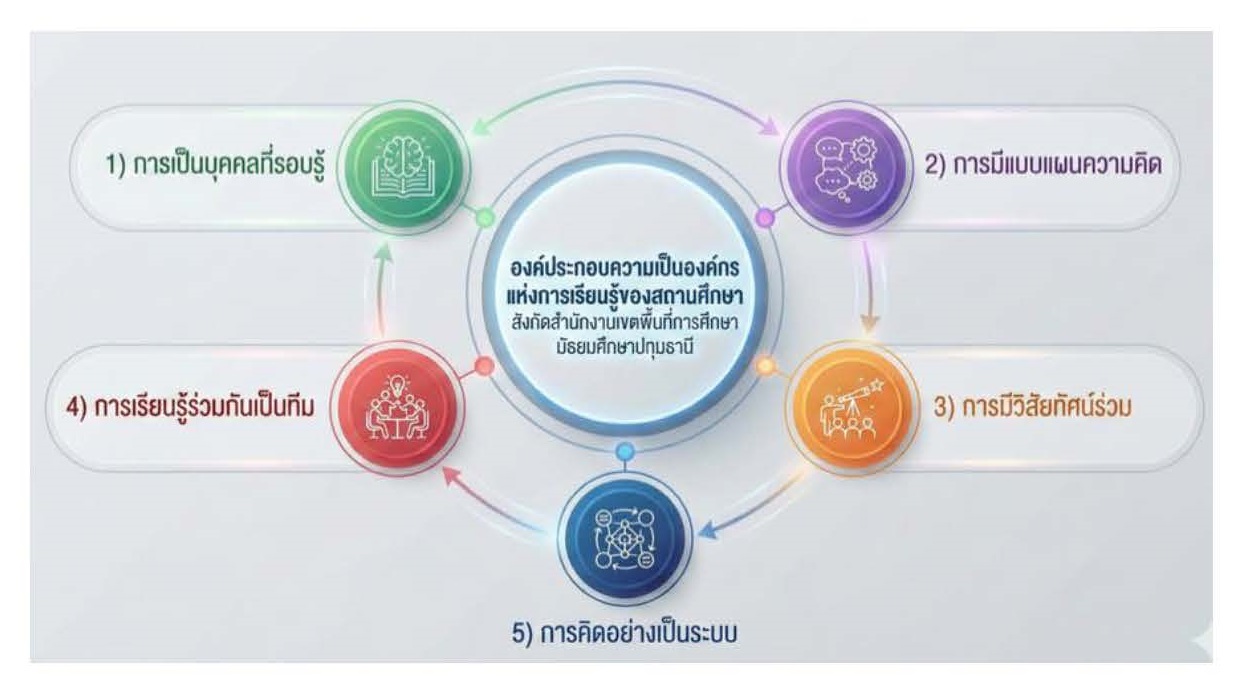
The results showed that: 1) the overall current state of a learning organization in schools was at a high level, while the overall desired state was at the highest level. 2) The guidelines for developing a learning organization in schools under the Pathum Thani Secondary Educational Service Area Office were categorized into five aspects: (1) Personal Mastery: School administrators should promote a culture of active learning and enhance teachers' capabilities to become innovators who consistently produce high-quality work. (2) Mental Models: School administrators should promote reflective thinking through safe academic spaces and Professional Learning Community (PLC) processes to shift personnel’s work attitudes. (3) Shared Vision: School administrators should encourage personnel to actively participate in goal setting to concretely align the organization’s vision with individual goals. (4) Team Learning: School administrators should organize activities that foster synergy and reduce compartmentalized work practices to achieve collective organizational success. (5) Systems Thinking: School administrators must shift personnel’s mindset from fragmented problem-solving to a holistic perspective by understanding “feedback loops” and structural relationships within the entire system to ensure sustainable school development.
Downloads
Article Details

This work is licensed under a Creative Commons Attribution-NonCommercial-NoDerivatives 4.0 International License.
References
กมลวรรณ แสนเสนาะ และนันทิยา น้อยจันทร์. (2567). ความเป็นองค์การแห่งการเรียนรู้ของสถานศึกษา สังกัดสำนักงานเขตพื้นที่การศึกษาประถมศึกษานครปฐม เขต 1 กลุ่ม 2. วารสารสิรินธรปริทรรศน์, 25(2): 2294-2302.
จันทร์จิรา เหลาราช. (2564). การจัดการความรู้ในยุคดิจิทัลเพื่อการพัฒนาองค์กร. กรุงเทพฯ: โรงพิมพ์มหาวิทยาลัยธรรมศาสตร์.
จิรดา มงคลคลสวัสดิ์. (2566). การบริหารสถานศึกษาในยุคดิจิทัลเพื่อส่งเสริมองค์กรแห่งการเรียนรู้. กรุงเทพฯ: โรงพิมพ์มหาวิทยาลัยธรรมศาสตร์.
พิมลพรรณ เพชรสมบัติ. (2561). การบริหารทรัพยากรมนุษย์ทางการศึกษา. ปทุมธานี: คณะครุศาสตร์อุตสาหกรรม มหาวิทยาลัยเทคโนโลยีราชมงคลธัญบุรี.
วันชนก อาจปรุ. (2564). แนวทางการพัฒนาความเป็นองค์กรแห่งการเรียนรู้ของสถานศึกษา สังกัดสำนักงานส่งเสริมการศึกษานอกระบบและการศึกษาตามอัธยาศัยในเขตภาคกลาง. วิทยานิพนธ์ปริญญาศึกษาศาสตรมหาบัณฑิต, สาขาวิชาการบริหารการศึกษา, คณะครุศาสตร์ อุตสาหกรรม, มหาวิทยาลัยเทคโนโลยีราชมงคลธัญบุรี.
ศิริวรรณ ฉัตรมณีรัตน์. (2567). นวัตกรรมการบริหารองค์กรทางการศึกษาในยุค AI. ปทุมธานี: สำนักพิมพ์ มหาวิทยาลัยรังสิต.
สำนักงานคณะกรรมการการศึกษาขั้นพื้นฐาน. (2567). รายงานผลการดำเนินงานยกระดับคุณภาพการศึกษาตามแผนปฏิบัติราชการประจำปีงบประมาณ พ.ศ. 2567. กรุงเทพฯ: โรงพิมพ์ชุมนุมสหกรณ์การเกษตรแห่งประเทศไทย.
สำนักงานคณะกรรมการการศึกษาขั้นพื้นฐาน. (2568). ทิศทางการจัดการศึกษาขั้นพื้นฐานสู่พื้นที่นวัตกรรม (ฉบับร่าง). กรุงเทพฯ: สพฐ.
สำนักงานเลขาธิการสภาการศึกษา. (2566). สภาวการณ์การศึกษาไทยปี 2566: การขับเคลื่อนการเรียนรู้ตลอดชีวิตในยุคดิจิทัล. กรุงเทพฯ: พริกหวานกราฟฟิค.
สำนักงานเขตพื้นที่การศึกษามัธยมศึกษาปทุมธานี. (2567). แผนพัฒนาการศึกษาขั้นพื้นฐาน พ.ศ. 2567-2570. ปทุมธานี: กลุ่มนโยบายและแผน.
Garvin, D.A. (1993). Building a learning organization. Harvard Business Review, 71(4): 78-91.
Krejcie, R.V., & Morgan, D.W. (1970). Determining sample size for research activities. Educational and Psychological Measurement, 30(3): 607-610.
Marquardt, M.J. (2011). Building the learning organization: Achieving strategic advantage through a commitment to learning. 3rd ed. Nicholas Brealey.
OECD. (2024). The Future of Education and Skills 2030: Learning Compass for Digital Transformation. Paris: OECD Publishing.
Senge, P.M. (2006). The fifth discipline: The art and practice of the learning organization. Doubleday.
Seo, J., Kim, L., & Yang, H. (2024). Digital leadership and learning organizations: A strategic framework for schools. Journal of Educational Innovation, 12(2), 112-130.
World Bank. (2025). Thailand Education Monitor: Strengthening Systems for Future Readiness. Washington, DC: World Bank.
