Guidelines for Managing Management based on the Four Noble Truths at Noppitamwittaya School under the Secondary Educational Service Area Office Nakhon Si Thammarat
Article Sidebar
Main Article Content
Abstract
This research article aims to Study (1) examine the current conditions of student affairs administration; (2) explore guidelines for student affairs administration based on the Four Noble Truths; and (3) propose and evaluate such guidelines. A qualitative research methodology was employed, consisting of three phases. In the first phase, the study of current conditions was conducted through in-depth interviews with 15 key informants. In the second phase, guidelines were explored using in-depth interviews with 5 key informants (monks and laypersons). In the third phase, the proposed guidelines were presented and evaluated through a focus group discussion with 7 experts. Data were analyzed using inductive analysis. In the first phase, the study of current conditions was conducted through in-depth interviews with 15 key informants. In the second phase, guidelines were explored using in-depth interviews with 5 key informants (monks and laypersons). In the third phase, the proposed guidelines were presented and evaluated through a focus group discussion with 7 experts. Data were analyzed using inductive analysis.
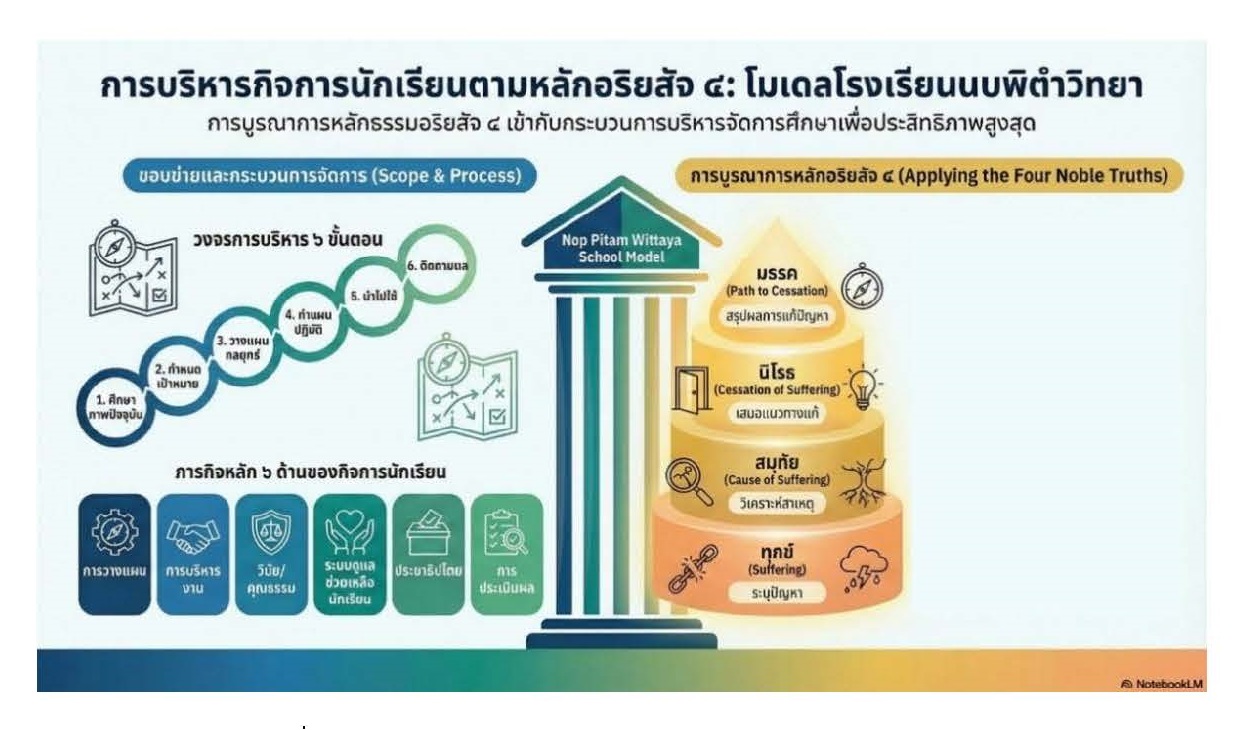
The research results were found as follows:- (1) The current state of student affairs administration in educational institutions is systematically managed, emphasizing participation from all sectors and aligning with the learners’ context. Operations follow established plans with continuous monitoring and evaluation. However, limitations were identified in interdepartmental coordination, as well as in policies and resources, which affect operational efficiency. Additionally, institutions integrate the promotion of discipline, morality, ethics, student support systems, and democratic values comprehensively, and continuously improve practices based on evaluation results. (2) The guidelines for student affairs administration based on the Four Noble Truths consist of six aspects: planning, administration, promotion of discipline and morality, student support systems, democratic promotion, and performance evaluation. These aspects are integrated with the Four Noble Truths suffering (dukkha), cause (samudaya), cessation (nirodha), and path (magga) to serve as a framework for problem analysis, goal setting, and systematic development. The process includes situational analysis, goal setting, planning, action plan development, implementation, and monitoring and evaluation. (3) The results of the presentation and evaluation indicated that the experts unanimously agreed that the proposed guidelines are appropriate, feasible, and beneficial. They can be effectively applied to student affairs administration and contribute to the holistic development of learners in terms of behavior, morality, ethics, and sustainable social coexistence.
Downloads
Article Details

This work is licensed under a Creative Commons Attribution-NonCommercial-NoDerivatives 4.0 International License.
References
กัมปนาท อาทิตย์ตั้ง และคณะ. (2565). แนวทางการบริหารงานกิจการนักเรียนในสถานศึกษา สังกัดสำนักงานเขตพื้นที่การศึกษามัธยมศึกษานครสวรรค์. วิทยานิพนธ์ครุศาสตรมหาบัณฑิต, สาขาวิชาการบริหารการศึกษา, คณะครุศาสตร์, มหาวิทยาลัยราชภัฏนครสวรรค์.
กิตติมา ปรีดีดิลก. (2532). การบริหารกิจการนักเรียน. กรุงเทพฯ: อักษรบัณฑิต. (แก้ไขเพิ่มเติมฉบับที่ 3 และฉบับแก้ไขเพิ่มเติม ฉบับที่ 4. (2562). ปฏิบัติงานโรงเรียนมัธยมศึกษา. พ.ศ. 2560. ปรับปรุง พ.ศ. 2562).
พงศักดิ์ หนูเอียด. (2567). การบริหารงานกิจการนักเรียนเพื่อส่งเสริมความรับผิดชอบของนักเรียนโรงเรียนทุ่งสงสังกัดสำนักงานเขตพื้นที่การศึกษามัธยมศึกษานครศรีธรรมราช. วิทยานิพนธ์ครุศาสตรมหาบัณฑิต, สาขาวิชาการบริหารการศึกษา, บัณฑิตวิทยาลัย มหาวิทยาลัยมหาจุฬาลงกรณราชวิทยาลัย.
พิเชษฐ อ่อนสุวรรณ. (2560). แนวทางการทำวิจัยในชั้นเรียนตามหลักอริยสัจ 4 สำหรับครูประถมศึกษาสังกัดสำนักงานเขตพื้นที่การศึกษาประถมศึกษาพระนครศรีอยุธยาเขต 2. วิทยานิพนธ์ครุศาสตร มหาบัณฑิต, สาขาวิชาการบริหารการศึกษา, คณะศึกษาศาสตร์, มหาวิทยาลัยมหาจุฬาลงกรณราชวิทยาลัย.
พระครูใบฎีกาเดชเดชา เตชธมโม พระครูโกศลอรรถกิจ และพระครูวิจิตรศีลาจาร. (2568). การส่งเสริมหลักอริยสัจ 4 เพื่อการพัฒนาคุณภาพชีวิตของชุมชนนางย่อน ตำบลคุระ อำเภอคุระบุรี จังหวัดพังงา. วารสารวิชาการ มจร บุรีรัมย์, 10(3): 289-300.
พระธรรมปิฎก (ป.อ. ปยุตฺโต). (2538). พุทธธรรม ฉบับปรับปรุงและขยายความ. กรุงเทพฯ: มหาจุฬาลงกรณราชวิทยาลัย.
พระพรหมคุณาภรณ์ (ป.อ. ปยุตฺโต). (2555). พจนานุกรมพุทธศาสตร์ ฉบับประมวลธรรม. พิมพ์ครั้งที่ 23. กรุงเทพฯ: สำนักพิมพ์ผลิธัมม์.
สรญา อินทร์แก้ว. (2567). การบริหารงานกิจการนักเรียนตามหลักพุทธธรรมของโรงเรียนทางพูนวิทยาคาร สังกัดสำนักงานเขตพื้นที่การศึกษามัธยมศึกษานครศรีธรรมราช. วิทยานิพนธ์ครุศาสตรมหาบัณฑิต, สาขาวิชาการบริหารการศึกษา, บัณฑิตวิทยาลัย, มหาวิทยาลัยมหาจุฬาลงกรณราชวิทยาลัย.
สุรพัชร เกตุรัตน์. (2561). การบริหารกิจการนักเรียนของโณงเรียนเตรียมอุดมศึกษาพัฒนการราชบุรี. สารนิพนธ์หลักสูตรศึกษาศาตรมหาบัณฑิต, สาขาวิชาการบริหารการศึกษา, บัณฑิตวิทยาลัย, มหาวิทยาลัยศิลปกร.
