The Development of Online Course via MOOC Platform: The Application of Generative AI in Buddhist Studies
Article Sidebar
Main Article Content
Abstract
This study aims to: 1) analyze the needs, perspectives, and experiences of graduate students and instructors regarding learning and the use of Generative AI in Buddhist research; 2) develop an online course through a Massive Open Online Course (MOOC) platform entitled “The Use of Generative AI in Buddhist Research” for graduate students at Mahachula- longkornrajavidyalaya University, Nakhon Ratchasima Campus; and 3) examine the perceptions, learning experiences, and opinions of graduate students toward the developed online course. The study employed a Research and Development design using a qualitative approach integrated with action research following the Plan–Action–Observe–Reflect cycle. Participants included 40 graduate students, 10 instructors, and 5 experts, with 30 students involved in the pilot implementation through purposive sampling. The instruments comprised semi-structured interviews, a MOOC-based instructional package, and reflective forms. Content validity was confirmed by experts, yielding an Index of Item–Objective Congruence (IOC) ranging from 0.80 to 1.00, and the course was evaluated as highly appropriate prior to implementation. Data were analyzed using reflective content analysis and interpretive synthesis.
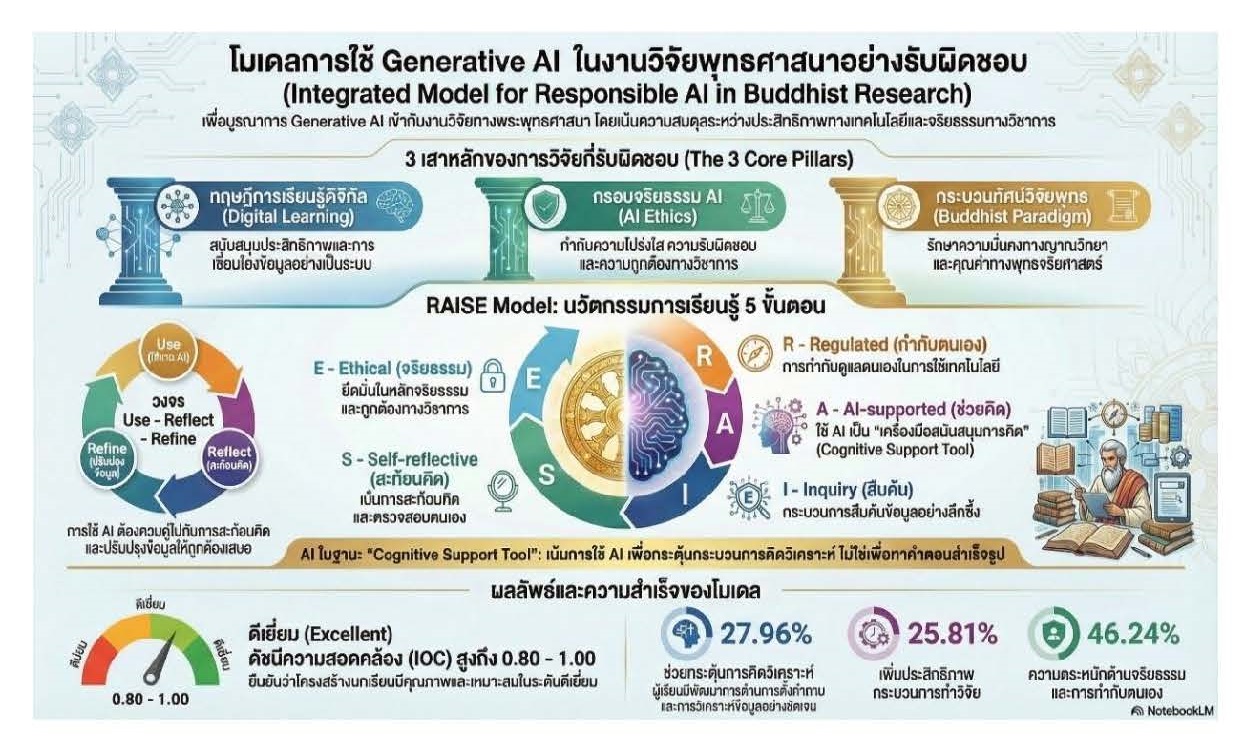
The findings revealed that both students and instructors expressed a strong need to employ Generative AI to support information retrieval, analysis, and knowledge synthesis in Buddhist research within ethical and academically responsible frameworks. The developed course integrated applied content, inquiry-based learning, critical reflection, and an ethical AI framework based on the ADDIE model and synthesized as the RAISE Model. The pilot results demonstrated qualitative improvement, as students developed confidence, metacognitive awareness, self-directed learning skills, and enhanced research quality in digital Buddhist contexts.
Downloads
Article Details

This work is licensed under a Creative Commons Attribution-NonCommercial-NoDerivatives 4.0 International License.
References
กระทรวงศึกษาธิการ. (2560). แผนการศึกษาแห่งชาติ พ.ศ. 2560–2579. กรุงเทพฯ: สำนักงานเลขาธิการ สภาการศึกษา.
ถนอมพร เลาหจรัสแสง. (2558). การออกแบบการเรียนการสอนออนไลน์: หลักการ แนวคิด และการประยุกต์ใช้. เชียงใหม่: สำนักบริการเทคโนโลยีสารสนเทศ มหาวิทยาลัยเชียงใหม่.
พระพรหมคุณาภรณ์ (ป.อ. ปยุตฺโต). (2556). พุทธธรรม (ฉบับปรับปรุงและขยายความ). กรุงเทพฯ: มูลนิธิพุทธธรรม.
มหาวิทยาลัยมหาจุฬาลงกรณราชวิทยาลัย. (2539). พระไตรปิฎกภาษาไทย ฉบับมหาจุฬาลงกรณราชวิทยาลัย. กรุงเทพฯ: โรงพิมพ์มหาจุฬาลงกรณราชวิทยาลัย.
Anderson, T., & Dron, J. (2011). Three generations of distance education pedagogy. The International Review of Research in Open and Distributed Learning, 12(3): 80-97.
Floridi, L., Cowls, J., Beltrametti, M., Chatila, R., Chazerand, P., Dignum, V., Luetge, C., Madelin, R., Pagallo, U., Rossi, F., Schafer, B., Valcke, P., & Vayena, E. (2018). AI 4 People An ethical framework for a good AI society: Opportunities, risks, principles, and recommendations. Minds and Machines, 28(4): 689–707.
Goodfellow, I., Bengio, Y., & Hinton, G. (2016). Deep learning. MIT Press.
Hollands, F.M., & Tirthali, D. (2014). MOOCs: Expectations and reality. Columbia University, Center for Benefit-Cost Studies of Education.
Holmes, W., Bialik, M., & Fadel, C. (2019). Artificial intelligence in education: Promises and implications for teaching and learning. Center for Curriculum Redesign.
Luckin, R., Holmes, W., Griffiths, M., & Forcier, L.B. (2016). Intelligence unleashed: An argument for AI in education. Pearson.
Marton, F., & Säljö, R. (1976). On qualitative differences in learning: I-Outcome and process. British Journal of Educational Psychology, 46(1): 4–11.
Ogunleye, B., Zakariyyah, K.I., Ajao, O., Olayinka, O., & Sharma, H. (2024). A systematic review of generative AI for teaching and learning practice. Education Sciences, 14(6), Article 636.
UNESCO. (2020). Distance learning strategies in response to COVID-19 school closures. UNESCO. [Online]. Retrieved from: https://unesdoc.unesco.org/
Vaswani, A., Shazeer, N., Parmar, N., Uszkoreit, J., Jones, L., Gomez, A.N., Kaiser, Ł., & Polosukhin, I. (2017). Attention is all you need. In I. Guyon et al. (Eds.), Advances in Neural Information Processing Systems. (Vol. 30). Curran Associates.
Yamane, T. (1973). Statistics: An introductory analysis. 3rd ed. Harper & Row.
