
Development of a Model Program for Thai Non-Violent Buddhist Families in Nakhon Ratchasima Province
Article Sidebar
Main Article Content
Abstract
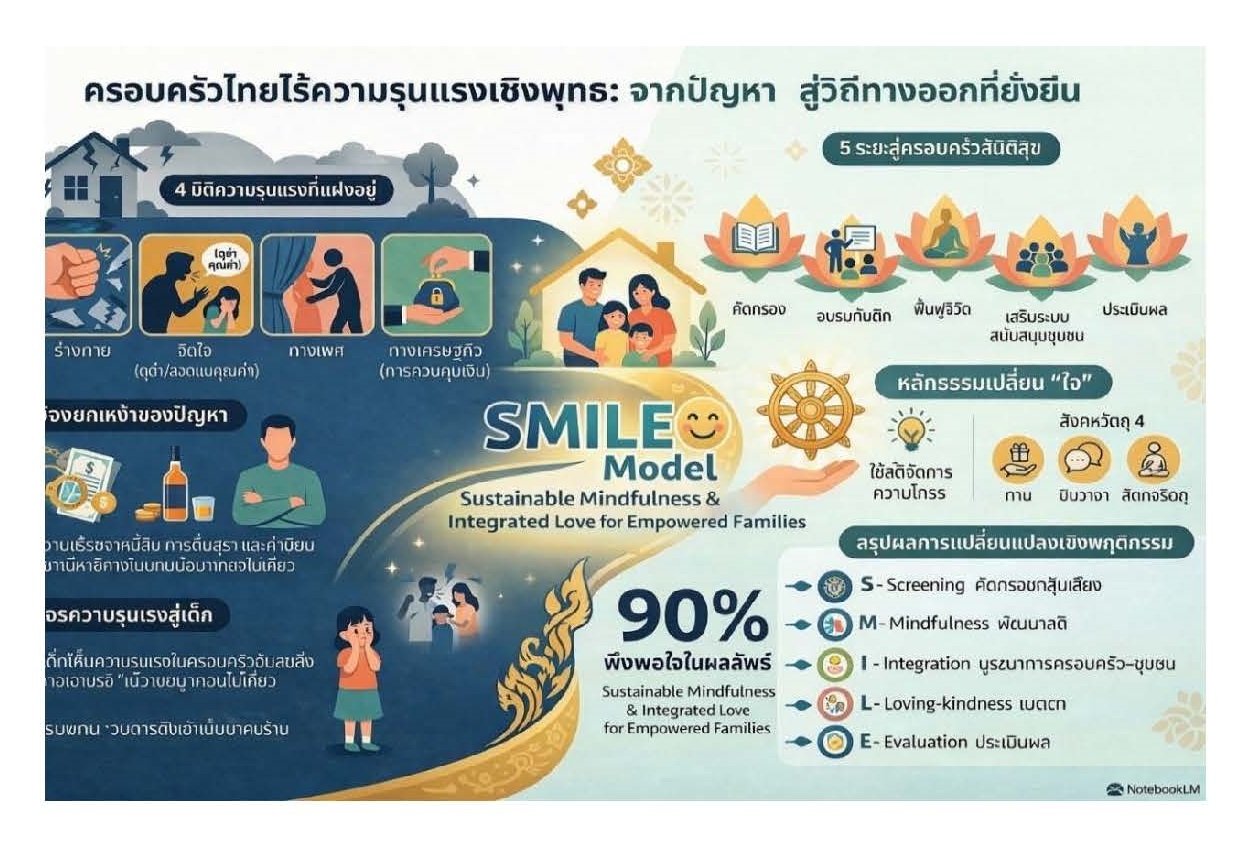
This research article aims (1) to investigate the problems related to domestic violence in Thai families in Nakhon Ratchasima Province, (2) to develop a prototype program for a Buddhist-based non-violent Thai family model in Nakhon Ratchasima Province, and (3) to evaluate the effectiveness of the developed prototype program. This study employed a mixed-methods approach, integrating quantitative, qualitative, and action research methodologies. The population consisted of families in high-risk areas, while the sample was selected through purposive sampling. Key informants included community leaders, Buddhist monks, social workers, and families who had experienced domestic violence. Research instruments included interviews, observations, and participatory workshop activities. The quality of the instruments was validated through content validity (IOC = 0.67–1.00). Qualitative data were analyzed using content analysis, while action research data were analyzed through pre- and post-intervention comparisons.
The findings revealed that domestic violence in Thai families in Nakhon Ratchasima Province is multidimensional, involving physical, psychological, sexual, and economic aspects. Major risk factors include economic hardship, alcohol consumption, and power inequality, all of which continuously affect family well-being and relationships. The development of the Buddhist-based non-violent family prototype program was grounded in field data, Buddhist principles, and participatory learning. The program was designed as a five-phase process: problem screening, skill development, relationship restoration, community network strengthening, and evaluation. This resulted in an innovative, context-sensitive process that is practical and applicable. The evaluation results indicated that the program was highly effective ( = 4.20–4.51). It enhanced emotional regulation, peaceful communication, and collaborative problem-solving skills among participants. Furthermore, it reduced repeated incidents of domestic violence and strengthened both families and community networks. The active roles of community leaders and Buddhist monks were particularly significant, contributing to the establishment of a Buddhist-based family protection mechanism that can be sustainably expanded at both community and policy levels.
Downloads
Article Details

This work is licensed under a Creative Commons Attribution-NonCommercial-NoDerivatives 4.0 International License.
References
ขันทอง วัฒนะประดิษฐ์ และคณะ. (2567). ครอบครัวไร้ความรุนแรงด้วยพี่เลี้ยงชุมชน. วารสารสันติศึกษาปริทรรศน์ มจร, 12(5): 1892–1908.
มหาวิทยาลัยมหาจุฬาลงกรณราชวิทยาลัย. (2539). พระไตรปิฎกภาษาไทย ฉบับมหาจุฬาลงกรณราชวิทยาลัย. กรุงเทพฯ: โรงพิมพ์มหาจุฬาลงกรณราชวิทยาลัย.
ศูนย์วิจัยและพัฒนาครอบครัวไทย. (2553). การศึกษาและพัฒนารูปแบบการเสริมสร้างหลักประกันความมั่นคงของครอบครัว. รายงานการวิจัย. ศูนย์วิจัยและพัฒนาครอบครัวไทย มหาวิทยาลัย สุโขทัยธรรมาธิราช.
สำนักงานการวิจัยแห่งชาติ. (2564). กรอบทิศทางการวิจัยและนวัตกรรมของประเทศ พ.ศ. 2564–2568. กรุงเทพฯ: สำนักงานการวิจัยแห่งชาติ.
สุมนทิพย์ จิตสว่าง และคณะ. (2568). การบูรณาการแนวทางการสร้างสังคมไทยไร้ความรุนแรงตามมาตรฐานสากลและบริบทของสังคมไทย. วารสารสังคมสงเคราะห์ศาสตร์และการบริหารสังคม, 33(1): 92–126.
อัญชลี รักอริยะธรรม และคณะ. (2563). การจัดการธุรกิจครอบครัวด้วย 5 ขั้นตอนของการวางแผนคู่ขนาน. วารสารวิชาการเครือข่ายบัณฑิตศึกษามหาวิทยาลัยราชภัฏภาคเหนือ, 10(1): 1–16.
Arnstein, S.R. (1969). A ladder of citizen participation. Journal of the American Institute of Planners, 35(4): 216–224.
Bandura, A. (1977). Social learning theory. Prentice Hall.
Bowen, M. (1978). Family therapy in clinical practice. Jason Aronson.
Bandura, A. (1977). Social learning theory. Englewood Cliffs, NJ: Prentice-Hall.
Connell, R.W. (1987). Gender and power: Society, the person and sexual politics. Stanford, CA: Stanford University Press.
Gunmintra, C. (2019). Domestic violence: Problems and prevention. In RSUSSH 2019 Conference Committee (Eds.), Proceedings of RSU Research Conference 2019 (p. 1997). Rangsit University.
Heise, L.L. (1998). Violence against women: An integrated, ecological framework. Violence Against Women, 4(3): 262–290.
Jewkes, R. (2002). Intimate partner violence: Causes and prevention. The Lancet, 359 (9315), 1423-1429.
National Statistical Office. (2025). Statistical Yearbook Thailand 2025. Bangkok: National Statistical Office.
Walker, L.E. (1979). The battered woman. Harper & Row.
World Health Organization. (2010). Preventing intimate partner and sexual violence against women: Taking action and generating evidence. Geneva: World Health Organization.
World Health Organization. (2024). Violence against women prevalence estimates, 2018 update. Geneva: World Health Organization.
World Health Organization. (2025). Global status report on violence prevention 2025. Geneva: World Health Organization.
