
Guidelines for Developing Super Leadership among School Administrators to Enhance Teachers’ Self-Leadership
Article Sidebar
Main Article Content
Abstract
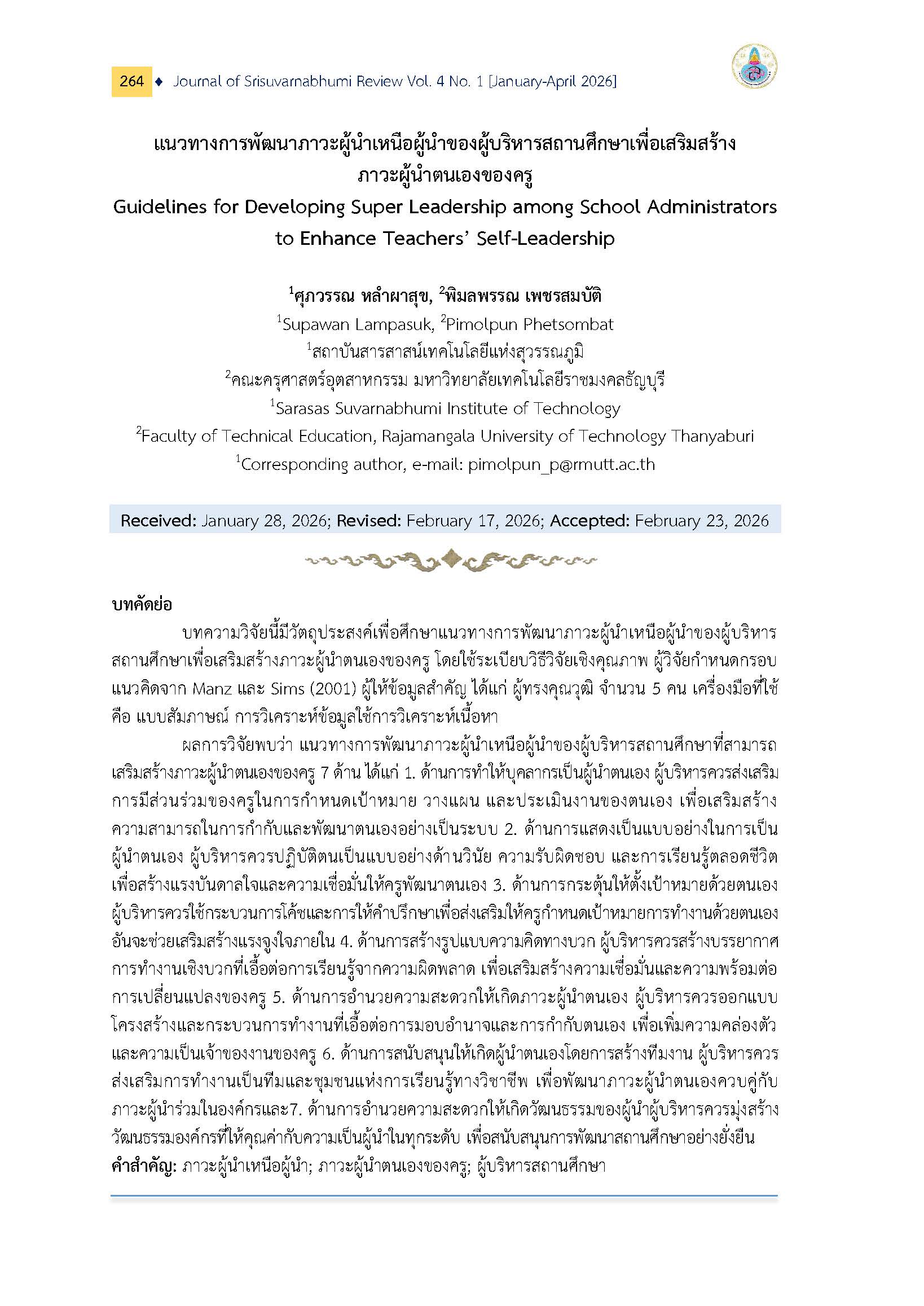
This study aims to explore guidelines for developing super leadership among school administrators in order to enhance teachers’ self-leadership. A qualitative research methodology was employed. The conceptual framework was derived from the theory of super leadership proposed by Manz and Sims (2001). The key informants consisted of five experts selected through purposive sampling. Data were collected using semi-structured interviews, and the data were analyzed through content analysis.
The findings revealed that the development of super leadership among school administrators to enhance teachers’ self-leadership comprises seven key dimensions: 1. Empowering personnel as self-leaders. School administrators should promote teachers’ active participation in goal setting, planning, and self-evaluation processes in order to strengthen their capacity for systematic self-regulation and professional self-development. 2. Modeling self-leadership behaviors. Administrators should serve as role models by demonstrating discipline, responsibility, and lifelong learning, thereby inspiring confidence and motivating teachers to pursue continuous self-improvement. 3. Encouraging self-goal setting. Through coaching and mentoring processes, administrators should support teachers in establishing their own professional goals, which can enhance intrinsic motivation and personal commitment to their work. 4. Fostering positive thinking patterns. Administrators should cultivate a positive working environment that encourages learning from mistakes, thereby strengthening teachers’ confidence and readiness for change. 5. Facilitating structures that enable self-leadership. Administrators should design organizational structures and work processes that promote empowerment and self-management, enhancing teachers’ autonomy, agility, and sense of ownership. 6. Supporting self-leadership through team development. Administrators should encourage teamwork and professional learning communities (PLCs) to develop self-leadership alongside shared leadership within the organization. 7. Cultivating a leadership-oriented culture. Administrators should strive to build an organizational culture that values leadership at all levels, thereby supporting sustainable school development.
Downloads
Article Details

This work is licensed under a Creative Commons Attribution-NonCommercial-NoDerivatives 4.0 International License.
References
สำนักงานเลขาธิการสภาการศึกษา. (2565). รายงานสภาวะการศึกษาไทย. กรุงเทพฯ: สำนักงานเลขาธิการสภาการศึกษา.
Bandura, A. (1986). Social foundations of thought and action: A social cognitive theory. Prentice Hall.
Bush, T. (2020). Theories of educational leadership and management. 5th ed. Sage.
Day, C., & Sammons, P. (2016). Successful school leadership. Education Development Trust.
Deci, E.L., & Ryan, R.M. (2000). The “what” and “why” of goal pursuits: Human needs and the self-determination of behavior. Psychological Inquiry, 11(4): 227–268.
DuFour, R., & Fullan, M. (2013). Cultures built to last: Systemic PLCs at work. Solution Tree.
Harris, A. (2013). Distributed leadership: Friend or foe? Educational Management Administration & Leadership, 41(5): 545–554.
Kolb, D.A. (2015). Experiential learning: Experience as the source of learning and development. (2nd ed.). Pearson Education.
Locke, E.A., & Latham, G.P. (2002). Building a practically useful theory of goal setting and task motivation: A 35-year odyssey. American Psychologist, 57(9): 705–717.
Manz, C.C., & Sims, H.P. (2001). The new super leadership: Leading others to lead themselves. Berrett-Koehler.
Neck, C.P., & Houghton, J.D. (2006). Two decades of self-leadership theory and research. Journal of Managerial Psychology, 21(4): 270–295.
OECD. (2021). Building a high-quality teaching profession: Lessons from around the world. OECD Publishing.
Schein, E.H. (2017). Organizational culture and leadership.5th ed. Wiley.
Seligman, M.E.P. (2011). Flourish: A visionary new understanding of happiness and well-being. Free Press.
Spreitzer, G.M. (1995). Psychological empowerment in the workplace: Dimensions, measurement, and validation. Academy of Management Journal, 38(5): 1442–1465.
Yukl, G. (2013). Leadership in organizations. 8th ed. Pearson.
