
Buddhist Educational Management for Developing Desirable Characteristics of Learners based on Buddhist Principles
Article Sidebar
Main Article Content
Abstract
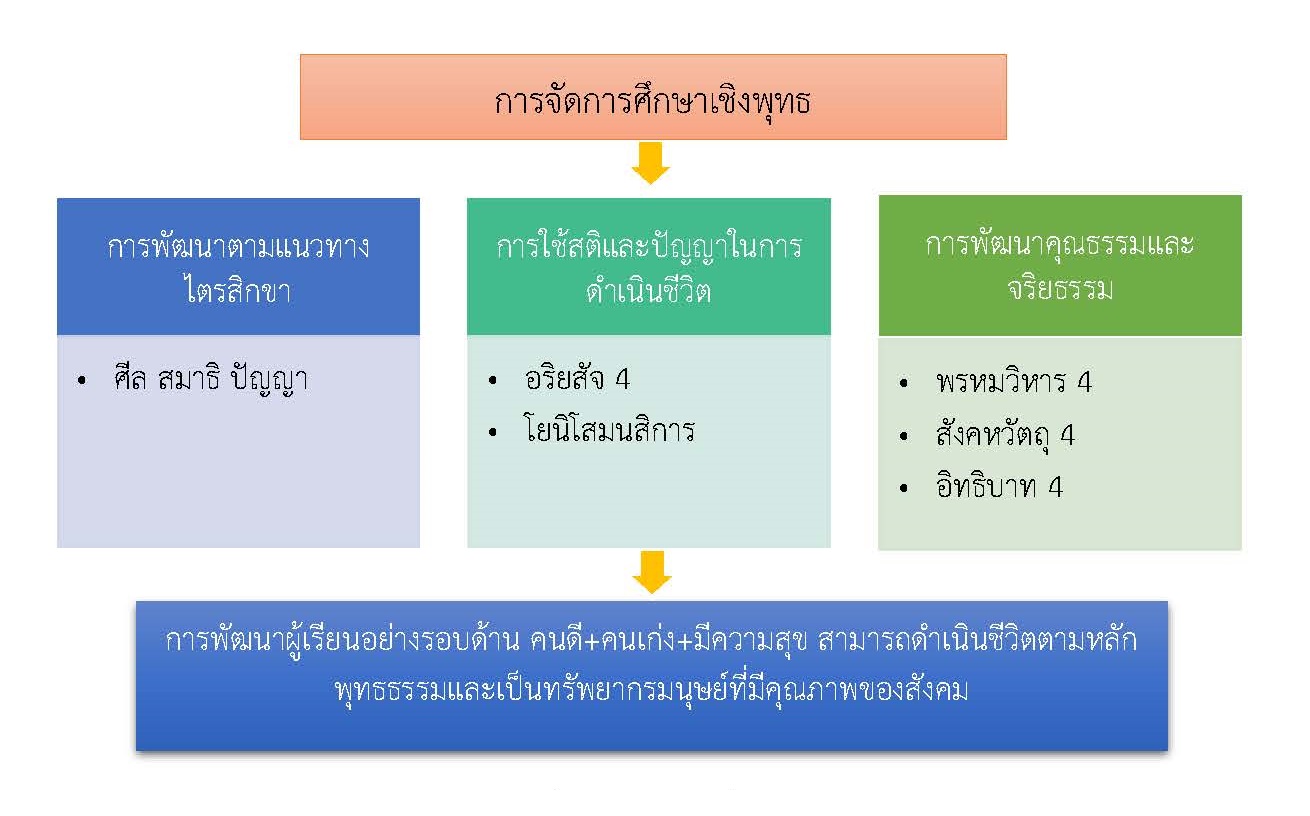
This academic article aims to study Buddhist-oriented education for developing desirable characteristics of learners based on Buddhist principles. The study analyzes approaches to integrating Buddhist teachings into the learning process, student development activities, and educational administration. In the present era, society is rapidly changing in terms of economy, society, and technology, which inevitably affects the values and behaviors of learners. Therefore, educational institutions play an important role in developing learners to become well-rounded individuals with knowledge, intellectual abilities, and moral and ethical qualities Buddhist-oriented education is an important approach that applies Buddhist principles to develop learners’ behavior, mind, and thinking so that they can live appropriately in society with mindfulness and morality as the foundation of their lives. This approach emphasizes holistic human development based on the Threefold Training (Sila, Samadhi, and Panna), together with the Four Bhavana (physical development, moral development, mental development, and wisdom development). These principles aim to cultivate learners in physical, mental, and intellectual aspects In addition, Buddhist-oriented education promotes rational thinking based on Yonisomanasikara (systematic reflection) and experiential learning through activities such as moral camps, meditation practice, and volunteer activities. These practices help nurture discipline, responsibility, compassion, and the ability to think reasonably among learners. As a result, learners can develop into morally good, knowledgeable, and happy individuals who are able to live harmoniously in society in a sustainable manner.
Downloads
Article Details

This work is licensed under a Creative Commons Attribution-NonCommercial-NoDerivatives 4.0 International License.
References
กระทรวงศึกษาธิการ. (2562). คู่มือแนวทางการจัดกิจกรรมเสริมสร้างคุณธรรมในสถานศึกษา. [ออนไลน์]. แหล่งที่มา: www.moe.go.th/jarawporn/principles.doc. [22 มิถุนายน 2562].
พระพรหมคุณาภรณ์ (ป.อ. ปยุตฺโต). (2559). การศึกษากับการพัฒนามนุษย์. กรุงเทพฯ: สำนักพิมพ์ผลิธัมม์.
มหาวิทยาลัยมหาจุฬาลงกรณราชวิทยาลัย. (2561). แนวคิดและรูปแบบการจัดการศึกษาเชิงพุทธ. พระนครศรีอยุธยา: มหาวิทยาลัยมหาจุฬาลงกรณราชวิทยาลัย.
วิชัย วงษ์ใหญ่. (2558). การจัดการศึกษาเพื่อพัฒนาคุณธรรม. พิมพ์ครั้งที่ 3. กรุงเทพฯ: สำนักพิมพ์มหาวิทยาลัยศรีนครินทรวิโรฒ.
สุมน อมรวิวัฒน์. (2554). การพัฒนาผู้เรียนตามแนวพุทธ. พิมพ์ครั้งที่ 2. กรุงเทพฯ: สำนักพิมพ์แห่งจุฬาลงกรณ์มหาวิทยาลัย.
สุทธิพงษ์ ศรีวิชัย. (2567). การสร้างและพัฒนาชุดกิจกรรมการเรียนรู้วิถีพุทธสำหรับนักเรียนระดับชั้นประถมศึกษาปีที่ 4–6. วารสาร มจร สังคมศาสตร์ปริทรรศน์, 13(4): 337–348.
