The Development of Super-Leadership Attributes of Secondary School Administrators under the Office of the Private Education Commission, Bangkok Metropolis
Article Sidebar
Main Article Content
Abstract
This research aimed to: (1) examine principles, concepts, and theories related to super leadership, which emphasizes developing individuals’ self-leadership; (2) analyze and synthesize the characteristics and indicators of super leadership among school administrators; (3) develop and validate an assessment instrument for super leadership characteristics of school administrators; and (4) investigate differences in the opinions of heads of subject groups regarding these characteristics, classified by school size, educational qualification, and work experience.
This study employed a research and development (R&D) design. The sample consisted of two groups: fifteen experts and school administrators, and 245 heads of subject groups from private secondary schools in Bangkok, selected through multi-stage sampling. Research instruments included a semi-structured interview and a five-point Likert-scale questionnaire comprising 24 items across four components. Instrument quality assessment demonstrated acceptable content validity (IOC = 0.67–1.00), high reliability (Cronbach’s alpha = 0.93), and good construct validity confirmed by confirmatory factor analysis (CFA).
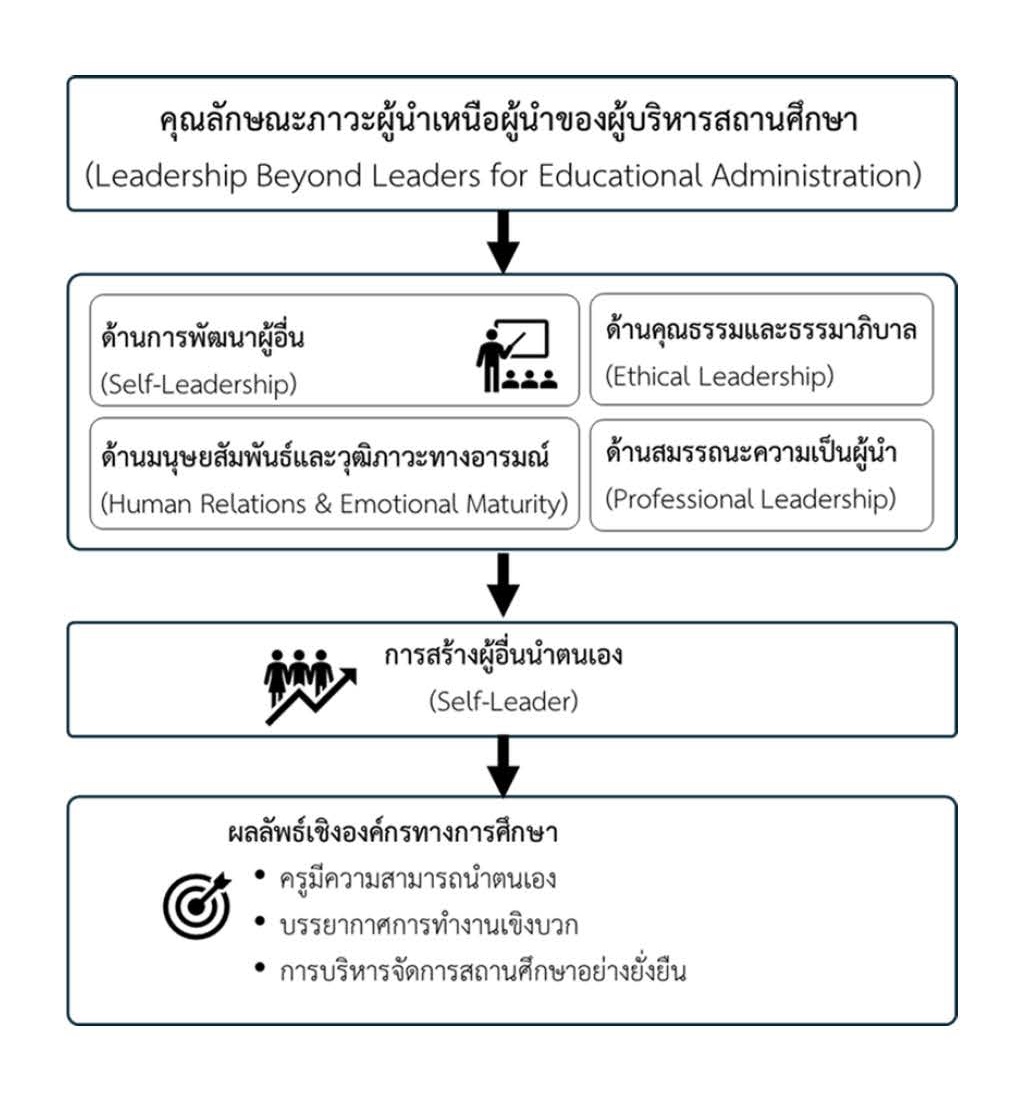
The findings identified four components of super leadership: (1) leadership that develops others’ self-leadership capacity; (2) ethical leadership, morality, and good governance; (3) professional leadership competence; and (4) interpersonal relations and emotional maturity. CFA results indicated a good model fit (Chi-square/df = 1.383, SRMR = 0.043, RMSEA = 0.039, CFI = 0.967, TLI = 0.963). No significant differences were found in opinions across school size, educational qualification, or work experience.
Downloads
Article Details

This work is licensed under a Creative Commons Attribution-NonCommercial-NoDerivatives 4.0 International License.
References
กระทรวงศึกษาธิการ. (2566). นโยบายการศึกษาของกระทรวงศึกษาธิการ ประจำปีงบประมาณ พ.ศ. 2567-2568. ประกาศกระทรวงศึกษาธิการ.
กษมา ชนะวงศ์. (2564). รูปแบบการบริหารจัดการหลักสูตรสถานศึกษาเพื่อส่งเสริมคุณลักษณะในศตวรรษที่ 21 ของนักเรียนโรงเรียนเอกชน. วิทยานิพนธ์การศึกษาดุษฎีบัณฑิต, สาขาวิชาการบริหารการศึกษา, มหาวิทยาลัยนเรศวร.
เกรียงศักดิ์ เจริญวงศ์ศักดิ์. (2561). Super leadership: สุดยอดภาวะผู้นำ. กรุงเทพฯ: ซัคเซส มีเดีย.
จิตนารี, พ. (2564). ภาวะผู้นำเหนือผู้นำของผู้บริหารโรงเรียนมัธยมศึกษา: การประยุกต์ใช้ในบริบทไทย. วารสารการบริหารการศึกษา, 12(1): 45–68.
ชรินทร์ทิพย์ วงศ์ธรรม. (2565). ภาวะผู้นำเหนือผู้นำของผู้บริหารที่ส่งผลต่อประสิทธิผลการบริหารงานโรงเรียน สังกัดสำนักงานเขตพื้นที่การศึกษาประถมศึกษานนทบุรี เขต 1. วารสาร มจร อุบลปริทรรศน์, 8(3): 629–640.
ชานนท์ วรรณา. (2562). แนวทางการพัฒนาทักษะการบริหารของผู้บริหารสถานศึกษา สังกัดสำนักงานเขตพื้นที่การศึกษามัธยมศึกษา เขต 4. วิทยานิพนธ์ศึกษาศาสตรมหาบัณฑิต, มหาวิทยาลัยเทคโนโลยีราชมงคลธัญบุรี.
ฐิติณัฐ ปรุงชัยภูมิ. (2561). ความสัมพันธ์ระหว่างภาวะผู้นำทางวิชาการของผู้บริหารสถานศึกษากับประสิทธิผลการปฏิบัติงานของครู. วิทยานิพนธ์ครุศาสตรมหาบัณฑิต, มหาวิทยาลัยราชภัฏชัยภูมิ.
ณัฐภัทร จินาสุย. (2566). การบริหารสถานศึกษาเพื่อเสริมสร้างคุณธรรมและความโปร่งใสตามกรอบ ITA ระดับ AA. วิทยานิพนธ์การศึกษามหาบัณฑิต, สาขาวิชาการบริหารการศึกษา, มหาวิทยาลัย ศรีนครินทรวิโรฒ.
ธิดาวัลย์ อุ่นกอง. (2560). ภาวะผู้นำตนเอง: แนวคิดการพัฒนาความเป็นผู้บริหารสถานศึกษาในศตวรรษที่ 21. วารสารศึกษาศาสตร์ มหาวิทยาลัยบูรพา, 28(1): 1–13.
สำนักงานเลขาธิการสภาการศึกษา. (2561). มาตรฐานการศึกษาของชาติ พ.ศ.2561. สำนักงานเลขาธิการ สภาพการศึกษา กระทรวงศึกษาธิการ. https://backoffice.onec.go.th/uploads/Book/1651-file.pdf
สุชาติ เสนาสี และคณะ. (2561). องค์ประกอบภาวะผู้นำเหนือผู้นำของผู้บริหารสถานศึกษาขั้นพื้นฐาน. วารสารวิจัยวิชาการ, 6(1): 105–118.
Bass, B.M. & Bruee, J.A. (1994). Improving organization effectiveness through transformational leadership. Thousand Oaks: Sage.
Bass, B. M. (1985). Leadership and performance beyond expectations. New York: Free Press.
Bollen, K. A. (1989). Structural equations with latent variables. New York: Wiley.
Brown, W.B. & Moberg, D.J. (1980). Organization theory and management: A macro approach. New York: John Wiley & Sons.
Bryant, A., & Kazan, A. (2012). Self-leadership. New York: McGraw-Hill.
Creswell, J.W., & Creswell, J. D. (2018). Research design: Qualitative, quantitative, and mixed methods approaches. 5th ed. Thousand Oaks, Sage.
Deci, E.L., & Ryan, R.M. (2008). Self-determination theory. Canadian Psychology, 49(3): 182–185. https://doi.org/10.1037/a0012801
Goleman, D. (2000). Leadership that gets results. Harvard Business Review, 78(2): 78-90.
Greenleaf, R.K. (2002). Servant Leadership: A Journey into the Nature of Legitimate Power and Greatness. NJ: Paulist Press.
Hair, J.F., Black, W.C., Babin, B.J. & Anderson, R.E. (2010). Multivariate Data Analysis. 7th ed. Upper Saddle River. NJ: Prentice Hall.
Krejcie, R. & Morgan, D. 1970. Determining sample sizes for research activities. Educational and Psychological Measurement. 30: 607-610.
Leithwood, K., & Jantzi, D. (2005). Transformational leadership. In B. Davies (Ed.), The essentials of school leadership (pp. 31–43). Sage.
Manz, C.C., & Sims, H.P. (1989). Superleadership: Leading others to lead themselves. Englewood Cliffs, NJ: Prentice Hall.
Manz, C.C., & Sims, H.P. (1992). Superleadership: Leading others to lead themselves. Englewood Cliffs, NJ: Prentice Hall.
Manz, C.C., & Sims, H. P. (2001). The new superleadership. San Francisco: Berrett-Koehler.
Northouse, P.G. (2022). Leadership: Theory and Practice. 9th ed. New York: Sage Publications.
OECD. (2019). OECD future of education and skills: OECD learning compass 2030, a series of concept note. Retrieved from: https://www.oecd.org/education/2030-project/teaching-and-learning/learning/learning-compass-2030/OECD_Learning_Compass_2030_Concept_Note_Series.pdf
UNESCO. (2015). Global Citizenship Education: Topics and Learning Objectives. Paris: UNESCO.
Yukl. G. (2010). Leadership in Organizations. 7th ed. Upper Saddle River, NJ: Pearson Prentice Hall.
