
The Development Model of Digital Competencies for Teachers under Nakhon Si Thammarat Primary Educational Service Area
Article Sidebar
Main Article Content
Abstract
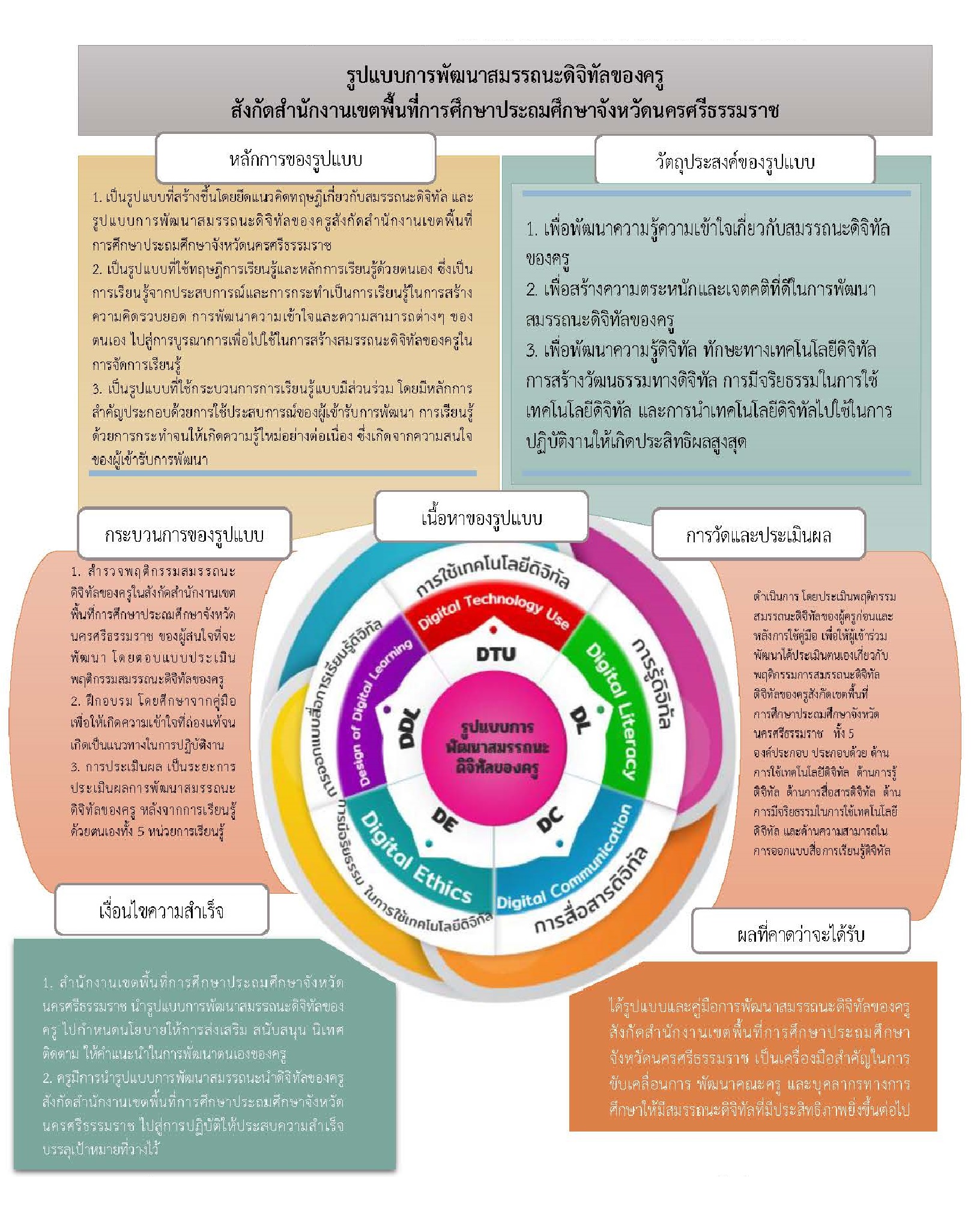
The purposes of this study were (1) to examine the components of digital competence of teachers under the Nakhon Si Thammarat Primary Educational Service Area, (2) to develop a model for enhancing the digital competence of teachers under the Nakhon Si Thammarat Primary Educational Service Area, and (3) to evaluate the developed model for enhancing the digital competence of teachers under the Nakhon Si Thammarat Primary Educational Service Area. A mixed methods research design was employed. The study population consisted of 6,293 teachers under the Nakhon Si Thammarat Primary Educational Service Area. The sample comprised 500 teachers. The research instruments included: (1) a questionnaire with a reliability coefficient of .969, (2) a semi-structured interview form, and (3) an evaluation form. The statistical tools used for data analysis were frequency, percentage, mean, standard deviation, and confirmatory factor analysis (CFA), using statistical software.
The research findings revealed that: 1.The components of digital competence of teachers under the Nakhon Si Thammarat Primary Educational Service Area consisted of 5 main components and 17 sub-components. 2.The digital competence model for teachers under the Nakhon Si Thammarat Primary Educational Service Area comprised 5 main components and 17 sub-components. The order of main components based on factor loadings was: (1) digital ethics, (2) learning media design, (3) digital communication, (4) digital literacy, and (5) digital technology utilization, and 3.The evaluation and validation of the digital competence model for teachers under the Nakhon Si Thammarat Primary Educational Service Area, in terms of accuracy, appropriateness, feasibility, and usefulness, yielded an overall mean score of 4.77, which met the specified evaluation criteria. It can be concluded that the experts and specialists validated the developed model.
Downloads
Article Details

This work is licensed under a Creative Commons Attribution-NonCommercial-NoDerivatives 4.0 International License.
References
กนกอร สมปราชญ์. (2562). ภาวะผู้นำกับคุณภาพการศึกษา. ขอนแก่น: โรงพิมพ์มหาวิทยาลัยขอนแก่น.
จิติมา วรรณศรี. (2564). รูปแบบการพัฒนาภาวะผู้นำของผู้บริหารสถานศึกษายุคดิจิทัล, วารสารสังคมศาสตร์ และมนุษยวิทยาเชิงพุทธ, 6(10): 460-471.
ชูชาติ พุทธลา. (2561). องค์ประกอบของภาวะผู้นำทางดิจิทัลสำหรับผู้บริหารโรงเรียนสังกัดสำนักงานเขตพื้นที่การศึกษาประถมศึกษาจังหวัดหนองบัวลำภู. วิทยานิพนธ์ปริญญาศึกษาศาสตร มหาบัณฑิต, สาขาการบริหารการศึกษา, มหาวิทยาลัยขอนแก่น.
ไชยา ภาวะบุตร. (2563). หลักทฤษฎีและปฏิบัติการบริหารการศึกษา. พิมพ์ครั้งที่ 3. สกลนคร: มหาวิทยาลัยราชภัฏสกลนคร.
จิณณวัตร ปะโคทัง. (2561). ภาวะผู้นำยุคดิจิทัลสำหรับผู้บริหารสถานศึกษามืออาชีพ. อุบลราชธานี: มหาวิทยาลัยราชภัฏอุบลราชธานี.
สำนักงานคณะกรรมการพัฒนาการเศรษฐกิจและสังคมแห่งชาติ. (2562). กรอบสมรรถนะด้านดิจิทัลสำหรับพลเมืองไทย. กรุงเทพฯ: กระทรวงดิจิทัลเพื่อเศรษฐกิจ และสังคม.
สุชาติ ประสิทธิ์รัฐสินธุ์. (2555). อดีต ปัจจุบัน และอนาคตของการวิจัยเชิงคุณภาพ. วารสารการวิจัยการพัฒนาการบริหาร, 5(1): 9-40.
สุกัญญา แช่มช้อย. (2560). ภาวะผู้นำทางเทคโนโลยี: การนำเทคโนโลยีสู่ห้องเรียน และโรงเรียนในศตวรรษที่ 21. วารสารศึกษาศาสตร์ มหาวิทยาลัยนเรศวร, 16(4): 216-224.
Hair, J.F. et al. (2010). Multivariate data analysis. 7th ed. New Jersey: Pearson Educational International.
Kahintapongs, S. (2020). Renewable Energy Policy Development in Thailand. International Journal of Multidisciplinary in Management and Tourism, 4(2): 148-155.
