Development of an Online Supervision Management Model with Distance Learning to Enhance the Learning Capacity of Bilateral System Students in Workplace Experience Training at Khmer Reap Technical College
Article Sidebar
Main Article Content
Abstract
This research article had three objectives: (1) to investigate the problems, needs, and perceptions regarding online supervision integrated with supplementary distance instruction for enhancing the learning competencies of dual vocational education students; (2) to design and develop a model of online supervision integrated with supplementary distance instruction to strengthen the learning competencies of dual vocational education students at Khemarat Technical College; and (3) to evaluate the effectiveness of the proposed model. The target population comprised 125 administrators under the Office of the Vocational Education Commission, 5 administrators of Khemarat Technical College, 25 heads of dual vocational programs, 63 supervising teachers, 63 in-company mentors/trainers, and 760 dual vocational students undertaking work-integrated learning 1,041 participants in total together with 15 subject-matter experts. Research instruments included questionnaires, rating scales, opinion surveys, satisfaction surveys, competency assessment forms, and focus group discussion records.
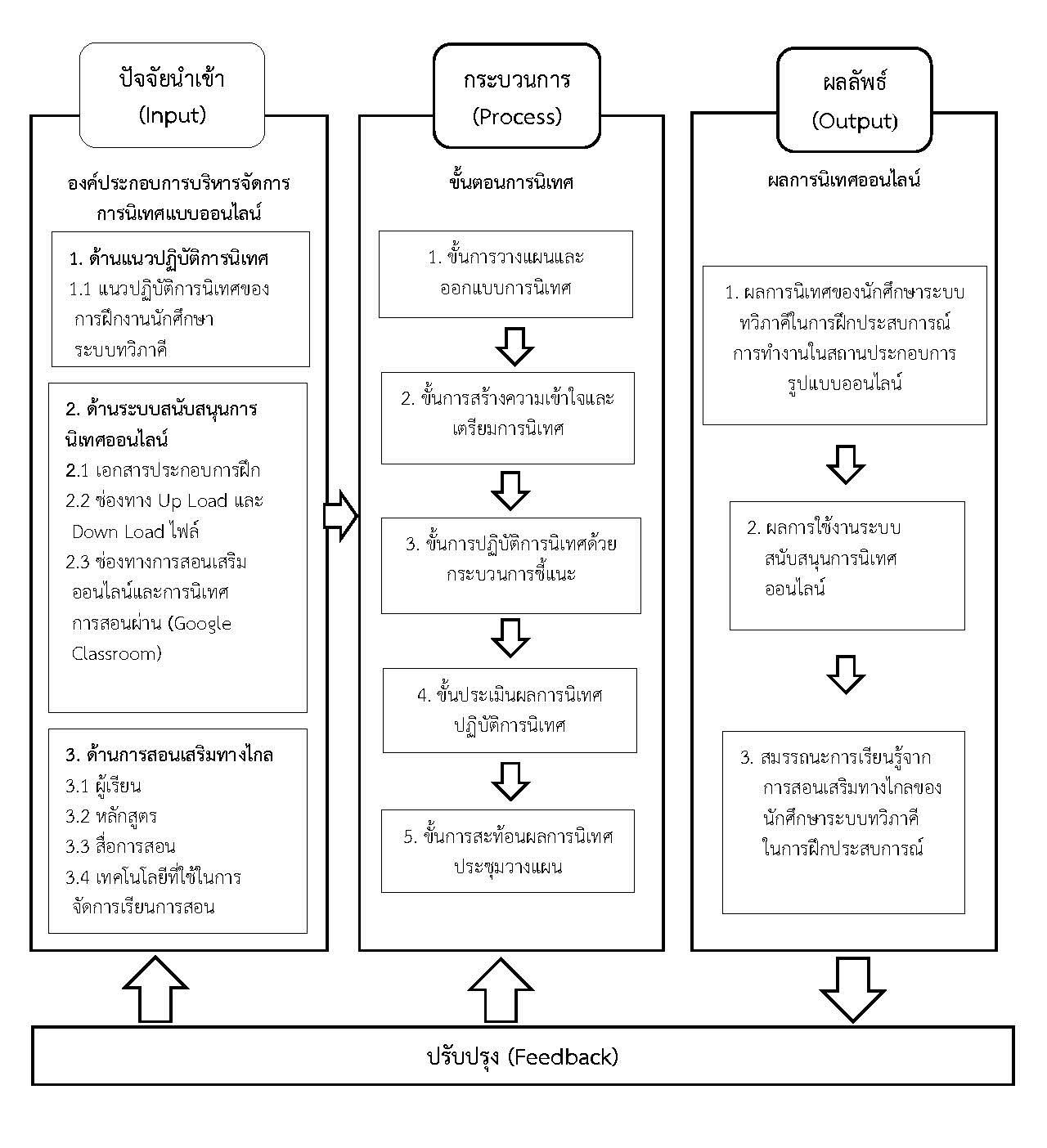
Findings were as follows: 1) Regarding the problems and essential needs of institutions in managing online supervision alongside supplementary distance teaching: the current supervision process features clear steps from advance scheduling, at least monthly supervision, provision of a shared consultation space, to post-activity evaluation. However, technological and communication constraints persist, including the absence of a standard online system for monitoring and assessment, inconvenience in using paper-based internship logbooks, discontinuous coordination, and unstable internet access in remote areas, necessitating ad hoc communication channels. The synthesized management model for online supervision integrated with supplementary distance teaching comprises four dimensions: (1) Inputs supervisor guidelines, an online support system, and supplementary distance instruction; (2) Process five stages: planning, orientation/clarification, guided implementation (coaching), evaluation, and reflection; (3) Outputs supervision quality, an operational online support system, and students’ learning competencies; and (4) Feedback for continuous improvement. The model is expected to increase monitoring efficiency, better connect learning with real work, and elevate students’ readiness for the labor market. 2) For the design and development of the management model: (1) the model’s correctness and suitability were at a high level; (2) the appropriateness of the core components and the specified learning competencies was at a high level; and (3) the suitability of the integrated supervision–distance-teaching process was also at a high level. Overall, the model was deemed ready for use with only minor refinements recommended, and 3) concerning the effectiveness evaluation of the model: satisfaction with both the processes and the utility of the model was at a high level; likewise, students’ learning competencies after receiving supplementary distance instruction were at a high level. Validation of the model’s core components and supervision processes indicated high appropriateness, supporting practical application to enhance the quality of work-integrated training and align learners’ skills with the needs of employers.
Downloads
Article Details

This work is licensed under a Creative Commons Attribution-NonCommercial-NoDerivatives 4.0 International License.
References
กาญจนา ศรีเพชร. (2565). การพัฒนารูปแบบการบริหารจัดการการนิเทศแบบออนไลน์ในสถานศึกษาระดับมัธยมศึกษา. วิทยานิพนธ์มหาบัณฑิต, มหาวิทยาลัยราชภัฏนครปฐม.
ธาริณี เพ็งสวัสดิ์. (2564). การพัฒนารูปแบบการเรียนเสริมทางไกลโดยใช้สื่อดิจิทัลเพื่อส่งเสริมสมรรถนะการเรียนรู้ของนักเรียนระดับมัธยมศึกษา. วิทยานิพนธ์มหาบัณฑิต, มหาวิทยาลัยราชภัฏสงขลา.
นิษฐ์ฐา พีระชัยภาวงศ์, ชินกฤต ศรีสุข, พลพิพัฒน์ วัฒนเศรษฐานุกุล และวราภรณ์ ไทยมา. การนิเทศรูปแบบออนไลน์ผสมผสานกระบวนการคิดเชิงออกแบบเพื่อพัฒนาการจัดการเรียนการสอนภาษาอังกฤษเพื่อการสื่อสารของครูสังกัดสำนักงานเขตพื้นที่การศึกษามัธยมศึกษากรุงเทพมหานคร เขต 2. วารสารเสฏฐวิทย์ปริทัศน์, 2567, 4(3), 1-11.
พัชรินทร์ ละอองคำ. (2564). การพัฒนารูปแบบการเรียนเสริมทางไกลโดยใช้เทคโนโลยีสารสนเทศสำหรับนักเรียนสายอาชีพ. วิทยานิพนธ์ครุศาสตรมหาบัณฑิต, มหาวิทยาลัยเทคโนโลยีราชมงคลล้านนา.
ศูนย์อาชีวศึกษาทวิภาคี. (2563). แนวปฏิบัติการจัดการอาชีวศึกษาระบบทวิภาคี ตามประกาศคณะกรรมการ อาชีวศึกษา เรื่องมาตรฐานการจัดการศึกษาระบบทวิภาคี พ.ศ.2563. กรุงเทพฯ: สำนักงานคณะกรรมการอาชีวศึกษา กระทรวงศึกษาธิการ.
สุนิสา พันธุ์ศรี. (2565). การนิเทศแบบออนไลน์ร่วมกับการเรียนเสริมทางไกลในระบบทวิภาคีเพื่อพัฒนาสมรรถนะนักศึกษา. วิทยานิพนธ์ครุศาสตรมหาบัณฑิต, มหาวิทยาลัยเทคโนโลยีราชมงคลธัญบุรี.
อุษณีย์ อินทรกำแหง. (2565). การจัดการเรียนการสอนเสริมทางไกลผ่านระบบ E-Learning เพื่อพัฒนาสมรรถนะการเรียนรู้ของนักเรียนมัธยมศึกษา. วิทยานิพนธ์ครุศาสตรมหาบัณฑิต, มหาวิทยาลัย ศรีนครินทรวิโรฒ.
Chitrlada Burapharat and Supat Chupradit OpenEdition. (n.d.). Chapter 3. Vocational and cooperative education in Thailand. In IrasceVoc, Vocational Education in Thailand: Current structure.
OECD. (2021). Vocational Education and Training in Thailand. OECD Reviews of Vocational Education and Training. OECD Publishing.
Rizvi, M., & Elliott, B. (2020). Navigating remote mentoring in education: Virtual coaching models and impacts. Australian Journal of Teacher Education, 45(3): 25-39. https:// doi.org/10.14221/ajte.2020v45n3.3
Wittaya Worapun, (2022). Teacher perceptions toward professional learning community in developing 21st century skills of students in Thailand. Journal of Educational Issues, 8(1): 60-79.
