
The Future Scenarios of Information Technology Management of Buddhist Universities in the Next Decade
Article Sidebar
Main Article Content
Abstract
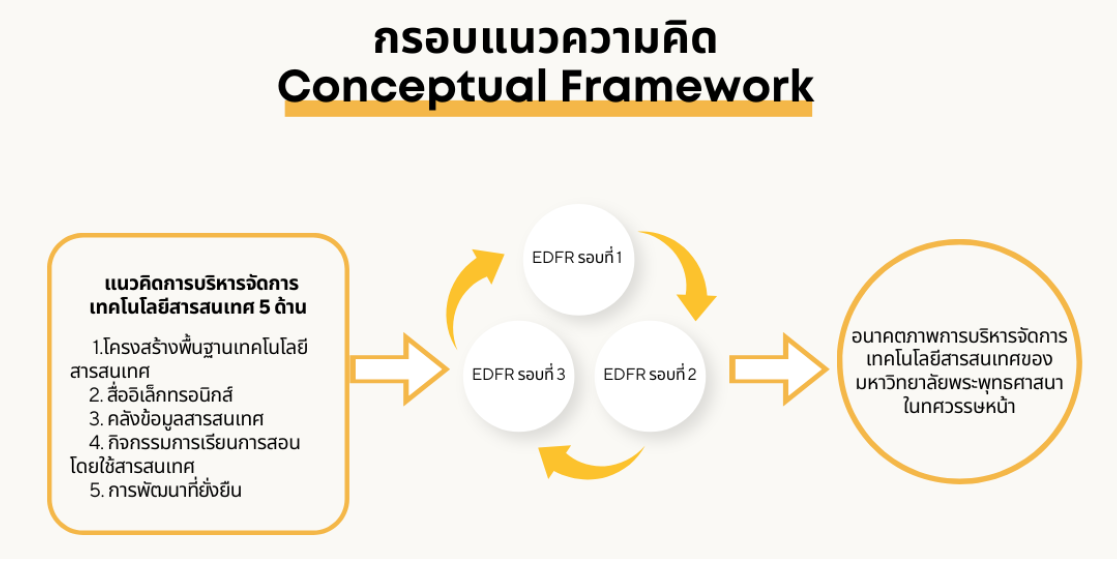
This research article aimed to explore the direction and trends in information technology management in Buddhist universities over the next decade (B.E. 2569–2578), using the Ethnographic Delphi Future Research (EDFR) methodology. This approach enabled 20 experts to participate and share their insights through three rounds of data collection: in-depth interviews, questionnaire surveys, and consensus validation on key issues. The data analysis revealed future perspectives in five major dimensions of information technology management: 1. Information Technology Infrastructure-The fundamental foundation for organizational IT operations, encompassing hardware, software, network systems, and services that support efficient data processing, storage, and exchange. 2. Electronic Media-Media that utilize electronic technologies to create, store, and disseminate content, typically in digital formats accessible through various electronic devices. 3. Information Repositories-Systems that store digital academic outputs, including research and scholarly works by faculty, researchers, students, and staff. 4. Information-Based Teaching and Learning Activities-Aimed at enhancing learners’ digital skills, promoting self-directed learning, and increasing instructional effectiveness. 5. Sustainable Development-Development that addresses the needs of the present without compromising the ability of future generations, ensuring a balanced approach across economic, social, and environmental dimensions.
The findings from the three-round analysis revealed consensus among the experts on fifteen key points. These included: (1) the necessity for sufficient internet network systems; (2) systematic server and cloud management; (3) appropriate information systems to support Buddhist studies; (4) robust data security; (5) effective online learning platforms (e.g., E-Learning, LMS); (6) integration of Artificial Intelligence (AI) in education; (7) development of digital literacy for monastic personnel; (8) implementation of the “Smart Buddhist University” initiative; (9) accessible electronic media for monks, students, faculty, and the general public; (10) use of AR/VR for virtual religious learning environments; (11) expanded digital Buddhist literature collections; (12) easy-to-use online search systems; (13) guidance from expert staff and AI-based recommendations; the role of teachers in clarifying and expanding information for better understanding; (14) a commitment to sustainable use of university resources (15) Universities should simultaneously promote moral values and the principles of the Sustainable Development Goals (SDGs).
Downloads
Article Details

This work is licensed under a Creative Commons Attribution-NonCommercial-NoDerivatives 4.0 International License.
References
กมลรัตน์ กิจรุ่งไพศาล (2566). เทคโนโลยีการสื่อสารความเป็นจริงเสมือนและความรอบรู้ทางดิจิทัลของคนไทย. ดุษฎีนิพนธ์ปริญญานิเทศศาสตรดุษฎีบัณฑิต, สาขาวิชานิเทศศาสตร์, คณะนิเทศศาสตร์, จุฬาลงกรณ์มหาวิทยาลัย.
เกียรติศักดิ์ บัณฑิต. (2562). การใช้สื่ออิเล็กทรอนิกส์ในการจัดการเรียนการสอนของครูในโรงเรียนกลุ่มเครือข่ายรัษฏาเรืองวิทย์ สังกัดสำนักงานเขตพื้นที่การศึกษาประถมศึกษาตรัง เขต 2. สารนิพนธ์ ปริญญามหาบัณฑิต, มหาวิทยาลัยสุโขทัยธรรมาธิราช. [ออนไลน์]. แหล่งที่มา: https://ir.stou.ac.th [15 กรกฎาคม 2568].
ภัทรสุดา ยะบุญวัน. (2564). การพัฒนากิจกรรมการเรียนรู้ เรื่อง การประยุกต์ใช้เทคโนโลยีดิจิทัลสำหรับการเรียนการสอนด้วยสื่ออินโฟกราฟิกที่ส่งผลต่อการรู้ดิจิทัลของนักศึกษาวิชาชีพครู คณะศึกษาศาสตร์ มหาวิทยาลัยศิลปากร. วิทยานิพนธ์ปริญญามหาบัณฑิต, ภาควิชาเทคโนโลยีการศึกษา, บัณฑิตวิทยาลัย, มหาวิทยาลัยศิลปากร.
อนันต์ วรธิติพงศ์. (2560). อนาคตภาพดิจิทัลเพื่อการศึกษาสำหรับการศึกษาขั้นพื้นฐาน. วิทยานิพนธ์ปริญญาศึกษาปรัชญาดุษฎีบัณฑิต, คณะครุศาสตร์อุตสาหกรรม, บัณฑิตวิทยาลัย, มหาวิทยาลัย เทคโนโลยีพระจอมเกล้าพระนครเหนือ.
David Gurr. The Impact of Information and Communication Technology on the Work of School Principals. [Online]. Retrieved from: http://technologysource.org/article [25 April 2019].
Kostoska, O., & Kocarev, L. (2019). A Novel ICT Framework for Sustainable Development Goals. [Online]. Retrieved from: https://www.mdpi.com/2071-1050/11/7/1961 [15 July 2025].
