Digital Leadership and Innovative Organization
Article Sidebar
Main Article Content
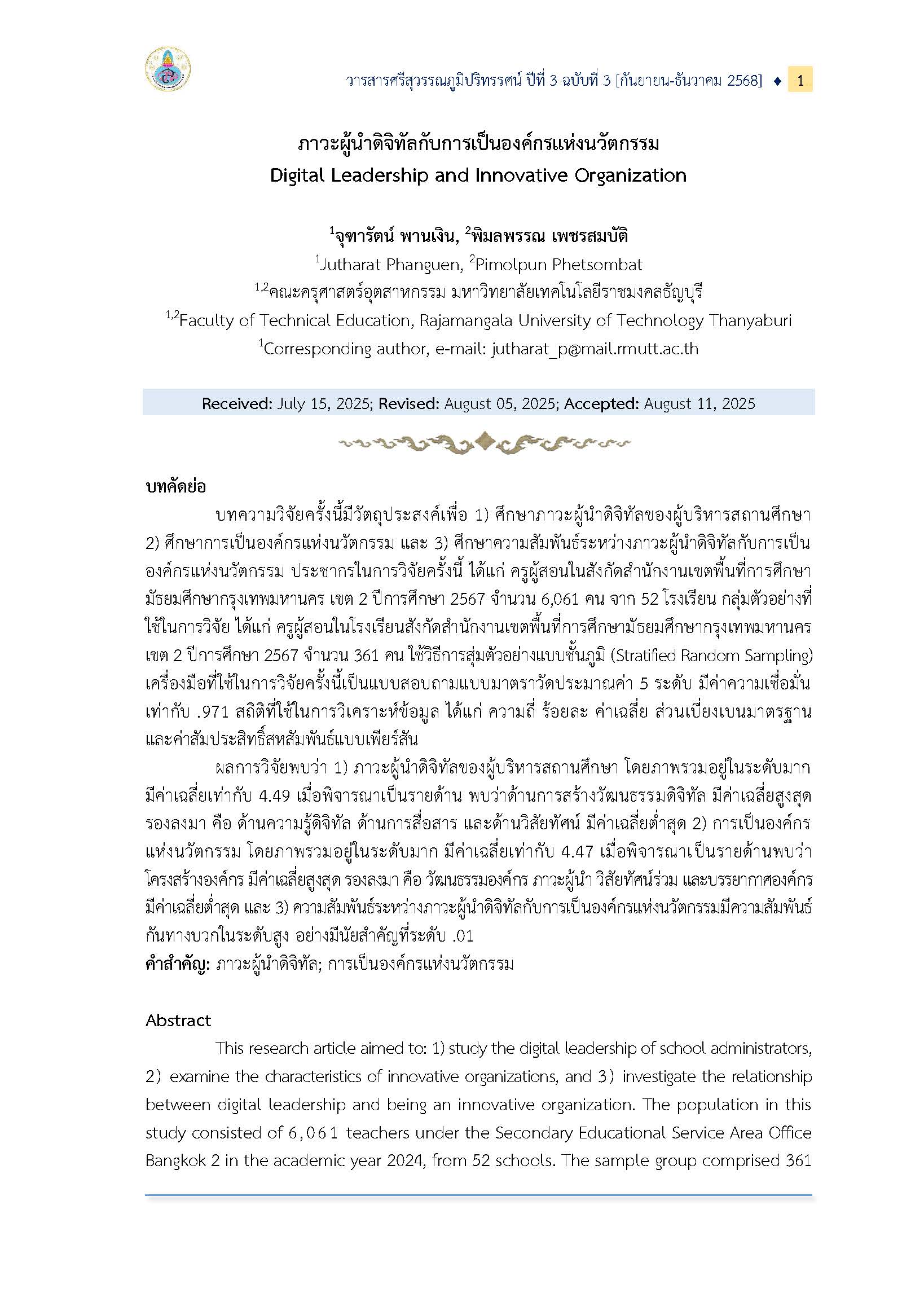
Abstract
This research article aimed to: 1) study the digital leadership of school administrators, 2) examine the characteristics of innovative organizations, and 3) investigate the relationship between digital leadership and being an innovative organization. The population in this study consisted of 6,061 teachers under the Secondary Educational Service Area Office Bangkok 2 in the academic year 2024, from 52 schools. The sample group comprised 361 teachers selected using stratified random sampling. The research instrument was a five-point Likert scale questionnaire with a reliability coefficient of .971. Data were analyzed using frequency, percentage, mean, standard deviation, and Pearson's correlation coefficient.
The research findings revealed that: 1) the overall digital leadership of school administrators was at a high level, with a mean score of 4.49. Considering individual aspects, digital culture had the highest mean, followed by digital knowledge, communication, and vision, respectively. 2) The overall level of being an innovative organization was also high, with a mean score of 4.47. In terms of specific aspects, organizational structure had the highest mean, followed by organizational culture, leadership, shared vision, and organizational climate, which had the lowest mean. 3) The relationship between digital leadership and being an innovative organization was found to be positively correlated at a high level, with statistical significance at the .01 level.
Downloads
Article Details

This work is licensed under a Creative Commons Attribution-NonCommercial-NoDerivatives 4.0 International License.
References
ขวัญชนก แสงท่านั่ง. (2563). รูปแบบการพัฒนาสถานศึกษาสู่องค์กรแห่งนวัตกรรมสำหรับสถานศึกษาขั้นพื้นฐาน. วิทยานิพนธ์ปริญญาดุษฎีบัณฑิต, มหาวิทยาลัยราชภัฏกำแพงเพชร.
ณัฐปภัสร์ สกุลพัฒน์รดา. (2564). การศึกษาการเป็นองค์กรนวัตกรรมทางการศึกษาของโรงเรียนมัธยมศึกษาที่ได้รับรางวัลคุณภาพแห่งสำนักงานคณะกรรมการการศึกษาขั้นพื้นฐาน. ปริญญานิพนธ์ดุษฎีบัณฑิต, มหาวิทยาลัยศรีนครินทรวิโรฒ.
ดาวรุวรรณ ถวิลการ. (2564). ภาวะผู้นำดิจิทัล. ขอนแก่น: มหาวิทยาลัยขอนแก่น.
ทศพล สุวรรณราช. (2564). ภาวะผู้นำดิจิทัลของผู้บริหารสถานศึกษา สังกัดสำนักงานเขตพื้นที่การศึกษามัธยมศึกษานนทบุรี. วารสารมนุษยศาสตร์และสังคมศาสตร์ มหาวิทยาลัยราชพฤกษ์, 7(3):160-161.
ภูรีรัตน์ สุกใส. (2565). ความสัมพันธ์ระหว่างภาวะผู้นำดิจิทัลของผู้บริหารสถานศึกษากับความเป็นองค์กรแห่งนวัตกรรมของสถานศึกษาระดับมัธยมศึกษาในจังหวัดอุตรดิตถ์. สารนิพนธ์ปริญญามหาบัณฑิต, มหาวิทยาลัยนเรศวร.
ลัทธวรรณ วงษ์โพย. (2566). ภาวะผู้นำดิจิทัลของผู้บริหารสถานศึกษา สังกัดสำนักงานเขตพื้นที่การศึกษามัธยมศึกษากาฬสินธุ์. วิทยานิพนธ์ปริญญามหาบัณฑิต, มหาวิทยาลัยมหามกุฏราชวิทยาลัย.
สำนักงานเขตพื้นที่การศึกษามัธยมศึกษากรุงเทพมหานคร เขต 2. (2566). นโยบายและจุดเน้นปีงบประมาณ พ.ศ. 2566-2567. เอกสารลำดับที่ 3 /2566. กรุงเทพฯ: สำนักงานฯ.
สำนักงานคณะกรรมการดิจิทัลเพื่อเศรษฐกิจและสังคมแห่งชาติ. (2561). นโยบายและแผนระดับชาติว่าด้วยการพัฒนาดิจิทัลเพื่อเศรษฐกิจและสังคม พ.ศ. 2561-2580. กรุงเทพฯ: สำนักงานฯ.
สุชญา โกมลวานิช. (2563). องค์ประกอบของภาวะผู้นำดิจิทัลของผู้บริหารสถานศึกษา สังกัดสำนักงาน เขตพื้นที่การศึกษามัธยมศึกษา เขต 23. การประชุมวิชาการเสนอผลงานวิจัยระดับบัณฑิตศึกษาแห่งชาติครั้งที่ 21. ขอนแก่น: มหาวิทยาลัยขอนแก่น.
อภิชัย คำอาจ และเจริญวิชญ์ สมพงษ์ธรรม. (2566). ความสัมพันธ์ระหว่างภาวะผู้นำการในยุคดิจิทัลของผู้บริหารสถานศึกษากับโรงเรียนแห่งนวัตกรรม สังกัดสำนักงานเขตพื้นที่การศึกษาประถมศึกษา ยโสธร เขต 1. วิทยานิพนธ์ปริญญามหาบัณฑิต, มหาวิทยาลัยราชธานี.
Sheninger, E.C. (2014). Digital leadership: changing paradigms for changing times. 1st Edition. Publisher by Corwin.
