Social Return on Investment (SROI) from Organizing the Royal Trophy Buffalo Beauty Contest
Article Sidebar
Main Article Content
Abstract
This research aimed to assess the Social Return on Investment (SROI) of organizing the Royal Trophy Buffalo Contest in Udon Thani Province using the six-step SROI framework of Nicholls et al. The research design was a mixed-methods model. The sample used in the research consisted of 30 individuals and groups directly involved in organizing the Buffalo Contest (in-depth interviews and observation). Purposive sampling was used, while some used snowball sampling to reach key contextual stakeholders. In addition, quantitative data were collected from 436 tourists using accidental sampling and the sample size was calculated using Yamane's formula at a 95% confidence level. The instruments used were structured questionnaires, semi-structured interviews, focus group discussions, and field observations. Descriptive statistics was used for quantitative data analysis, and content analysis was used for qualitative data analysis.
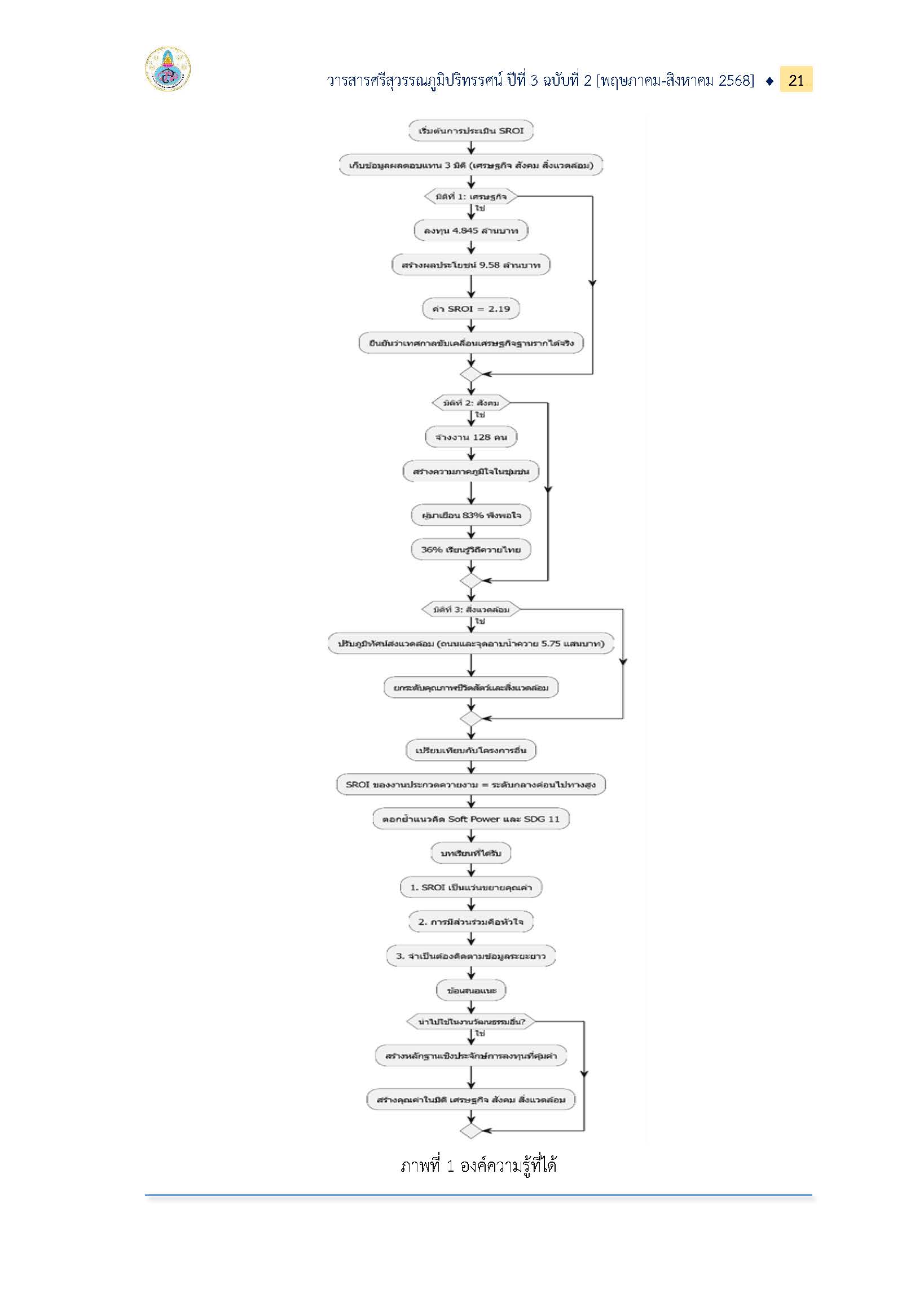
The results of the research found that: The Provincial Administrative Organization’s investment budget of 4,845,000 baht created total benefits of 10,628,000 baht, covering (1) Economy: 9,585,000 baht in revenue from buffalo trading, tourism, and surrounding businesses; (2) Society: 469,000 baht in cultural capital and community pride, with 83% of tourists very satisfied and 36% stating that they learned about the Thai buffalo way of life; and (3) Environment: 575,000 baht in infrastructure and landscape improvement value for animal welfare, resulting in an SROI ratio of 2.19, meaning that every 1 baht invested creates 2.19 baht in value. This result indicates that local cultural activities can be a soft power mechanism that is in line with SDG 11 to enhance the grassroots economy and preserve local cultural identity. Policy recommendations are that local administrative agencies should integrate the SROI framework as a tool to measure value-for-money before approving budgets for cultural activities, and event organizers should increase knowledge transfer activities to sustainably expand social and environmental value.
Downloads
Article Details

This work is licensed under a Creative Commons Attribution-NonCommercial-NoDerivatives 4.0 International License.
References
คงศักดิ์ ตุ้ยสืบ และต่อศักดิ์ โกษาวัง. (2568). การประเมินผลตอบแทนทางสังคมจากการลงทุน (SROI) ของโครงการการยกระดับผลิตภัณฑ์ท้องถิ่นสู่เชิงพาณิชย์ เพื่อการพัฒนาศักยภาพการแข่งขันของชุมชนตำบลเขื่อนผาก อำเภอพร้าว จังหวัดเชียงใหม่. Trends of Humanities and Social Sciences Research, 13(1), 123-140.
ใจบุญ แย้มยิ้ม. (2565). การสร้างสรรค์เทศกาลศิลปะการแสดงพื้นบ้าน ด้วยการมีส่วนร่วมของชุมชนเพื่อยกระดับเศรษฐกิจฐานราก อำเภอบางเสาธง จังหวัดสมุทรปราการ. ศิลปศาสตร์ปริทัศน์, 17(2), 150-174.
ณัฏฐ์กฤษณ์ สิงโตทอง, ถนัด ยันต์ทอง, ในตะวัน กำหอม และกฤษดา นิยมทอง. (2568). คอสเพลย์: การแสดงอัตลักษณ์ในสังคมพหุวัฒนธรรมกับการบูรณาการองค์ความรู้เพื่อการสอนกลุ่มสาระสังคมศึกษา ศาสนาและวัฒนธรรม โรงเรียนโพธิสารพิทยากร เขตตลิ่งชัน กรุงเทพมหานคร. วารสารสังคมศึกษา ศาสนาและวัฒนธรรม, 6(1), 88-99.
ดวงฤทธิ์ เบ็ญจาธิ และกุลชัย รุ่งเรือง. (2566). การขับเคลื่อน Soft Power: อัตลักษณ์ท้องถิ่นภาคใต้เพื่อส่งเสริมการท่องเที่ยวจังหวัดชุมพร. วารสารสันติศึกษาปริทรรศน์ มจร, 11(5), 1922-1935.
นภาพร หงส์ภักดี และสืบพงศ์ หงส์ภักดี. (2566). การประเมินผลตอบแทนทางสังคมจากการลงทุนสำหรับโครงการพัฒนาผู้ประกอบการทางวัฒนธรรมด้านภูมิปัญญาการทำเทียนในพื้นที่ย่านเมืองเก่าจังหวัดอุบลราชธานี. วารสารมนุษยศาสตร์และสังคมศาสตร์ มหาวิทยาลัยนครพนม, 13(3), 149-167.
พูนศักดิ์ กมล. (2568). ศึกษาแนวคิด Soft Powerพลังละมุนในปรากฏการณ์ความขัดแย้ง. วารสารสังคมศึกษา ศาสนาและวัฒนธรรม, 6(1), 125-134.
Birkenkötter, H. (2023). Make cities and human settlements inclusive, safe, resilient, and sustainable. Oxford University Press. https://doi.org/10.1093/law/9780192885173.003.0012.
Fang, Y., Jiao, W., Feng, L., Liu, J., & Zhang, X. (2021). A comprehensive evaluation of urban cultural soft power for the Silk Road Economic Belt. Critical Arts, 35(2), 100–115. https://doi.org/10.1080/02560046.2021.1919163.
Haas, P. M., & Ivanovskis, N. (2022). Prospects for implementing the SDGs. Current Opinion in Environmental Sustainability, 56, 101-176.
Kumar, S., & Banke-Thomas, A. (2016). Social return on investment (SROI): An innovative approach to sustainable development goals for sexual and reproductive health programming in sub-Saharan Africa. African Journal of Reproductive Health, 20(3), 85–93.
Nicholls, A., Nicholls, J., & Paton, R. (2015). Measuring social impact. In Social finance (pp. 253-281). Oxford University Press.
Swartz, D. L. (n.d.). Cultural Capital. https://doi.org/10.1093/obo/9780199756384-0209.
Watson, K. J., Evans, J., Karvonen, A., & Whitley, T. (2016). Capturing the social value of buildings: The promise of Social Return on Investment (SROI). Building and Environment, 103, 289-301.
Yigit, S. (2024). Soft power. In Soft power (pp. 163-178). IGI Global. https://doi.org/10.4018/979-8-3693-2444-8.ch011.
