
The Participation of the Public, Private and Civil Society Sectors in Building The Phra Buddha Pussayakhiri Sri Suwanabhum and Developing Place of Civilization to Connect Tourism Dhavaravati of Mueang U-Thong Suphan Buri Province
Article Sidebar
Main Article Content
Abstract
This research aimed to study the factors contributing of participation", the participation process, and strategies to promote participation among the government, private sector, and civil society in the construction of the Phra Buddha Pussayakhiri Sri Suvarnabhum and the development of the linked tourist area of the Dvaravati civilization in U Thong district, Suphan Buri province. A mixed-methods research approach was employed, combining qualitative and quantitative research. Data was collected using questionnaires from a sample of 214 individuals selected using by Taro Yamane's formula and stratified sampling. The response rate was 97.66%. In-depth interviews were conducted with nine key informants, and a focus group discussion was held with five experts. Quantitative data was analyzed using basic statistics, while data from interviews and focus group discussions were analyzed using inductive analysis.
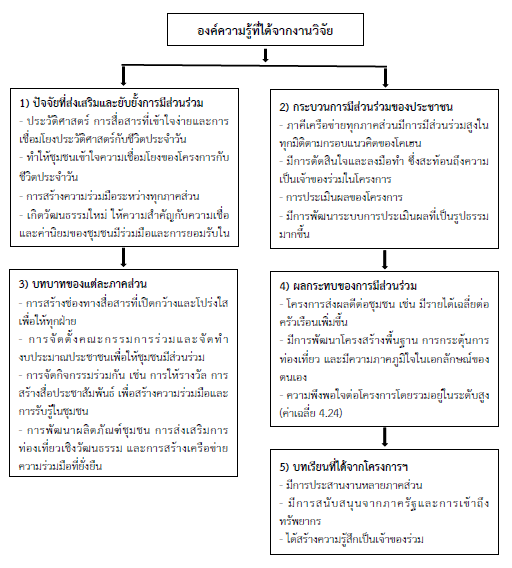
The findings were as follows: 1. Factors contributing to participation: Three key factors were found to drive the project's success: 1) history, related to easy-to-understand communication and linking history to daily life; 2) economy, related to building cooperation among all sectors; and 3) culture, related to valuing community beliefs and values. 2. The participation process of network partners found that: All sectors are highly involved in all dimensions according to Cohen's framework, especially in decision-making and implementation, reflecting shared ownership of the project. However, evaluation still lacks a formal system. A more concrete evaluation system should be developed. 3. Guidelines for promoting participation of network partners. The study results are divided into 2 areas: 1) the results of the impact and satisfaction of the community towards the project, most of them saw that there is an increase in average household income, infrastructure development, tourism stimulation, pride in identity and overall satisfaction with the project, with an average of 4.24, which is at a high level. 2) Suggestions for promoting participation should be implemented as follows: (1) Create open and transparent communication channels. (2) Establish a joint committee and prepare a public budget; (3) organize joint activities such as giving awards and creating public relations materials; and (4) develop community products, promote cultural tourism, and create a cooperation network.
Downloads
Article Details

This work is licensed under a Creative Commons Attribution-NonCommercial-NoDerivatives 4.0 International License.
References
เขมชาติ เทพไชย. (2542). โบราณคดีและประวัติศาสตร์เมืองสุพรรณบุรี. สำนักงานโบราณคดีและพิพิธภัณฑสถานแห่งชาติที่ 2 สุพรรณบุรี. ปทุมธานี: ห้างหุ้นส่วนจำกัด สารรังสรรค์.
จุติพร มาเพิ่มผล. (2566). ปัจจัยที่มีผลต่อการมีส่วนร่วมของประชาชนในการพัฒนาท้องถิ่นขององค์การบริหารส่วนตำบลทุ่งควายกิน อำเภอแกลง จังหวัดระยอง. รัฐประศาสนศาสตรมหาบัณฑิต, วิทยาลัยการบริหารรัฐกิจ, มหาวิทยาลัยบูรพา.
ชิน อยู่ดี.(2509). เรื่องก่อนประวัติศาสตร์ที่อำเภออู่ทอง โบราณวิทยาเรื่องเมืองอู่ทอง. กรุงเทพฯ: กรมศิลปากร.
ธานินทร์ ศิลป์จารุ. (2563). การวิจัยและวิเคราะห์ข้อมูลทางสถิติด้วย SPSS และ AMOS. พิมพ์ครั้งที่ 18. นนทบุรี: เอส.อาร์ พริ้นติ้ง.
นลินี ตรัสบวร และไตรรัตน์ จารุทัศน์. (2563). ศึกษาผลกระทบต่อชุมชนและสิ่งแวดล้อมของโครงการรูปแบบผสม กรณีศึกษา โครงการ ไอคอนสยาม, วิสซ์ดอม วัน-โอ-วัน และสามย่านมิตรทาวน์. สาระศาสตร์: วารสารสถาปัตยกรรมและการออกแบบ, 3(4): 935-948.
ปรัชญา เวสารัชช์. (2528). การมีส่วนร่วมของประชาชนในกิจกรรมเพื่อพัฒนาชนบท. กรุงเทพฯ: สถาบัน ไทยคดีศึกษา มหาวิทยาลัยธรรมศาสตร์.
บริษัทรัชดาหินอ่อน จำกัด. (2566). โครงการแกะสลักพระใหญ่บนหน้าผาเขาทำเทียม สมเด็จพระพุทธ-ปุษยคีรีศรีสุวรรณภูมิ. อำเภออู่ทอง จังหวัดสุพรรณบุรี (ภาพสไลด์).
บุญชม ศรีสะอาด. (2565). การวิจัยเบื้องต้นฉบับปรับปรุงใหม่. พิมพ์ครั้งที่ 9. กรุงเทพฯ: สุวีริยาสาส์น.
เมตต์ เมตต์การุณ์จิต. (2553). การบริหารจัดการศึกษาแบบมีส่วนร่วม: ประชาชน องค์กรปกครองส่วนท้องถิ่น และราชการ. พิมพ์ครั้งที่ 2. กรุงเทพฯ: บุ๊คพอยท์.
วันชัย วัฒนศัพท์. (2553). คนไทยไม่ทอดทิ้งกัน: คู่มือการจัดการสร้างความปรองดองในระบบบริการสาธารณสุข. ขอนแก่น: ศิริภัณฑ์ ออฟเซ็ท.
หนังสือเฉลิมพระเกียรติพระบาทสมเด็จพระเจ้าอยู่หัว. (2542). วัฒนธรรม พัฒนาการทางประวัติศาสตร์ เอกลักษณ์และภูมิปัญญา จังหวัดสุพรรณบุรี. กรุงเทพฯ: โรงพิมพ์คุรุสภาลาดพร้าว.
อุบลวรรณา ภวกานันท์ และศรัณย์ กอสนาน. (2565). “รูปแบบการมีส่วนร่วมในการสนับสนุนการปรับตัว ทางสังคมของผู้สูงอายุโดยองค์กรเครือข่าย” ภายใต้แผนงานวิจัย เรื่อง โครงการบูรณาการศาสตร์และศิลป์: นวัตกรรมศิลปะการละครพุทธเกสตอลท์ เพื่อเสริมสร้างการปรับตัวทางสังคมผู้สูงอายุ. กรุงเทพฯ: สำนักงานปลัดกระทรวงการอุดมศึกษา วิทยาศาสตร์ วิจัยและนวัตกรรมและสำนักงานการวิจัยแห่งชาติ.
Arnstein, Sherry R. (1969). A Ladder of Citizen Participation. Journal of the American Planning Association, 35(4): 216-224.
Berkley G.E. (1975). The Craft of Public Administration. Boston: Allyn and Bacon
Cohen, J.M., & Uphoff, N.T. (1981). Rural Development Participation: Concept and Measure for Project Design Implementation and Evaluation: Rural Development committee Center for international Studies. New York: Cornell University Press.
Cohen, J.M., & Uphoff, N.T. (1977). Rural Development Participation Concepts and Measures for Project Design, Implementation and Evaluation. Published by the Rural Development Committee Center for International Studies Cornell University.
William, E. (1976). Electoral Participation in a Low Stimulus Election. Rural Development, 4(1): 111-124.
