DEVELOPMENT OF THE CREATIVE BUDDHIST ARTS LEARNING CENTER; UNDER THE CHIANG RAI ART CITY STRATEGY
Keywords:
Learning in Buddhist Art, Chiang Rai and the City of Art, Learning through ArtAbstract
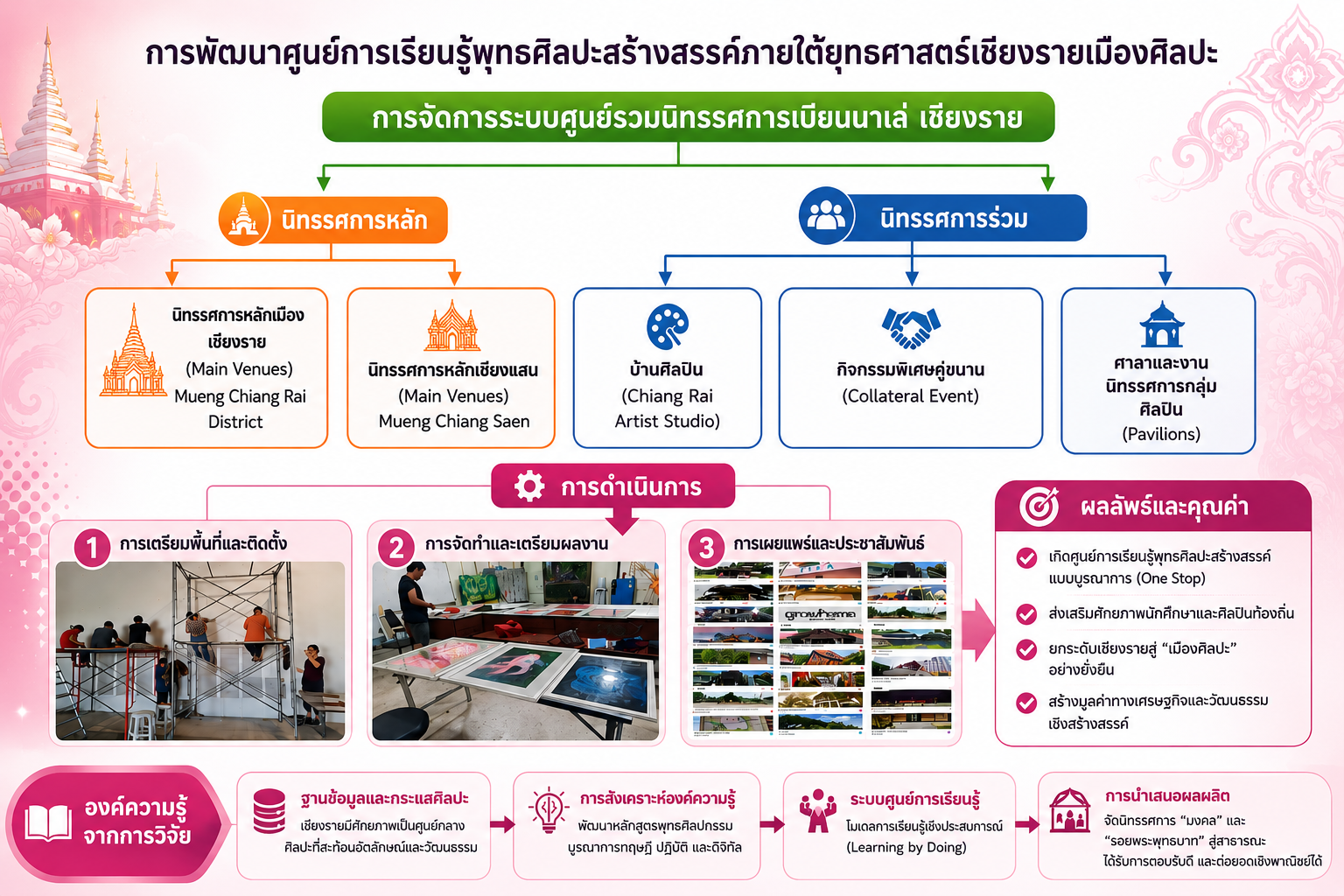
The objectives of this research were to 1) study and compile data on the general trends and movements in the art society within Chiang Rai Province under the “Chiang Rai City of Art” strategy for 2024; 2) synthesize and plan the management of knowledge related to “Buddhist Art” through a pilot teaching model in the Buddhist Art Curriculum for the 2024 academic year; 3) create a learning center system and an experimental teaching model focusing on preparing and building experiential skills; and 4) present the outcomes from the integrated learning center system through the organization of the Buddhist Art exhibitions, “Mongkhon” and “The Footprints of Buddha.” This study employed Participatory Action Research (PAR). The key informants consisted of 20 individuals, including instructors, local artists, and students, selected through purposive sampling. The research instruments included semi - structured interviews and participant observation. Data were analyzed using content analysis.
The research results were found as follows;
1) Data and Trends: The promotion of art under the “Chiang Rai: The City of Art, 2024” strategy shows strong potential for the province to grow into a major national art center, particularly reflecting religious and cultural identities.
2) Knowledge Synthesis and Planning: The Buddhist Art Program, developed for the 2024 academic year, successfully integrated theory with practice, incorporating digital technology for contemporary knowledge transmission.
3) Learning Center System: An Experiential Learning Center model was established, utilizing a “Learning by Doing” approach to effectively build professional skills.
4) Outcome Presentation: Student works were successfully presented through the “Mongkhon” and “Footprint of the Buddha” exhibitions. These events, reflecting local Buddhist beliefs, received positive community feedback and demonstrated commercial viability.
Downloads
References
กัญจิรา วิจิตรวัชรารักษ์ และนภารัตน์ กิตติรัตนมงคล. (2565). กลยุทธ์การพัฒนากิจกรรมและเส้นทางท่องเที่ยวเชิงพุทธศาสนา ยุคทวารวดีในเขตจังหวัดนครปฐม. วารสารมานุษยวิทยาเชิงพุทธ, 7(12), 617 - 633. https://so04.tci-thaijo.org/index.php/JSBA/article/view/262418
คณะศิลปกรรมศาสตร์ มหาวิทยาลัยขอนแก่น. (2566). คู่มือนักศึกษาระดับปริญญาตรี ปีการศึกษา 2566. มหาวิทยาลัยขอนแก่น. สืบค้นเมื่อ 17 ตุลาคม 2567, จาก https://l1nq.com/pmy9bs3
ชยาภรณ์ สุขประเสริฐ. (2559). พุทธศิลป์: ถิ่นไทย ศิลปกรรมเพื่อพระพุทธศาสนา. วารสารพุทธอาเซียนศึกษา, 1(2), 59 - 74. http://www.asc.mcu.ac.th/wp-content/uploads/2016/02/001.-2-.paper_2-59-74.pdf
ประทีป ชุมพล. (2539). จิตรกรรมฝาผนังภาคกลาง: ศึกษากรณีความสัมพันธ์กับวรรณคดีและอิทธิพลที่มีต่อความเชื่อประเพณีและวัฒนธรรม. (รายงานการวิจัย). กรุงเทพฯ: สำนักงานคณะกรรมการวิจัยแห่งชาติ.
ปรีชาวุฒิ อภิระติง. (2561). ประติมานวิทยาของพระพุทธไสยาสน์ในศิลปะทวารวดีอีสาน. วารสารศิลปกรรมศาสตร์ มหาวิทยาลัยขอนแก่น, 10(2), 373 - 409. https://so02.tci-thaijo.org/index.php/fakku/article/view/167033
พระพรหมคุณาภรณ์ (ป.อ. ปยุตฺโต). (2550). การจัดการทรัพยากรทางโบราณคดีในงานพัฒนาชุมชน. กรุงเทพฯ: โครงการหนังสือโบราณคดีชุมชน.
วัชรีวรรณ หิรัญพลาวัสถ์. (2566). การพัฒนาผลิตภัณฑ์ของที่ระลึกตุ๊กตาดินเผาจากศิลปะสมัยทวารวดี. วารสารดีไซน์เอคโค, 4(1), 21 - 28. https://so02.tci-thaijo.org/index.php/jdecho/article/view/262999
วิทูรย์ สิมะโชคดี. (2555). TQM คู่มือพัฒนาองค์กรสู่ความเป็นเลิศ (พิมพ์ครั้งที่ 6). กรุงเทพฯ: สมาคมส่งเสริมเทคโนโลยี (ไทย - ญี่ปุ่น).
สำนักงานศิลปวัฒนธรรมร่วมสมัย. (2566). มหกรรมศิลปะร่วมสมัยนานาชาติ Thailand Biennale, Chiang Rai 2023. สืบค้นเมื่อ 15 ตุลาคม 2567, จาก https://thailandbiennale.org/
สำนักงานส่งเสริมเศรษฐกิจสร้างสรรค์ (องค์การมหาชน). (2563). รายงานการศึกษาการพัฒนาอุตสาหกรรมสร้างสรรค์ สาขาทัศนศิลป์ ปี 2563. ศูนย์ข้อมูลเศรษฐกิจสร้างสรรค์ (TCDC Resource Center). สืบค้นเมื่อ 16 ตุลามค 2567, จาก http://resource.tcdc.or.th/ebook/CEA.Visual.Arts.Report.pdf
สำนักงานส่งเสริมเศรษฐกิจสร้างสรรค์. (2566). ศูนย์สร้างสรรค์งานออกแบบ (TCDC). สืบค้นเมื่อ 12 ตุลาคม 2567, จาก https://www.google.com/search?q=https://www.cea.or.th/th/tcdc
สุรางค์ โค้วตระกูล. (2553). จิตวิทยาการศึกษา (พิมพ์ครั้งที่ 9). กรุงเทพฯ: สำนักพิมพ์จุฬาลงกรณ์มหาวิทยาลัย.
อัศวิณีย์ หวานจริง. (2556). สุนทรียะในบริบททางสังคมและผลปรากฏจากสภาวะแวดล้อม ของศิลปกรรมกระจกบนผนังอุโบสถ วัดมณีจันทร์ อำเภอพุทไธสง จังหวัดบุรีรัมย์. วารสารวิจิตรศิลป์ มหาวิทยาลัยเชียงใหม่, 4(1), 125 - 202. https://so02.tci-thaijo.org/index.php/fineartsJournal/article/view/77654
Kolb, D. A. (1984). Experiential Learning: Experience as the Source of Learning and Development. Prentice-Hall. https://www.researchgate.net/publication/235701029_Experiential_Learning_Experience_As_The_Source_Of_Learning_And_Development
UNESCO. (2023). 55 New Cities Join the UNESCO Creative Cities Network on World Cities Day. https://www.unesco.org/en/articles/55-new-cities-join-unesco-creative-cities-network-world-cities-day
Downloads
Published
How to Cite
Issue
Section
License
Copyright (c) 2026 Journal of Buddhist Educational Innovation

This work is licensed under a Creative Commons Attribution-NonCommercial-NoDerivatives 4.0 International License.
This article is published under a Creative Commons Attribution-NonCommercial-NoDerivatives 4.0 International License (CC BY-NC-ND 4.0), which allows others to share the article with proper attribution to the authors and prohibits commercial use or modification. For any other reuse or republication, permission from the journal and the authors is required.