APPLICATION OF STRATEGIC FOREIGN LANGUAGES FOR PROMOTING “TRAT: A LIVABLE PROVINCE” VIA CREATIVE SOCIAL MEDIA
Keywords:
Foreign Language, Creative Communication, Social Media, Trat Province, PromotionAbstract
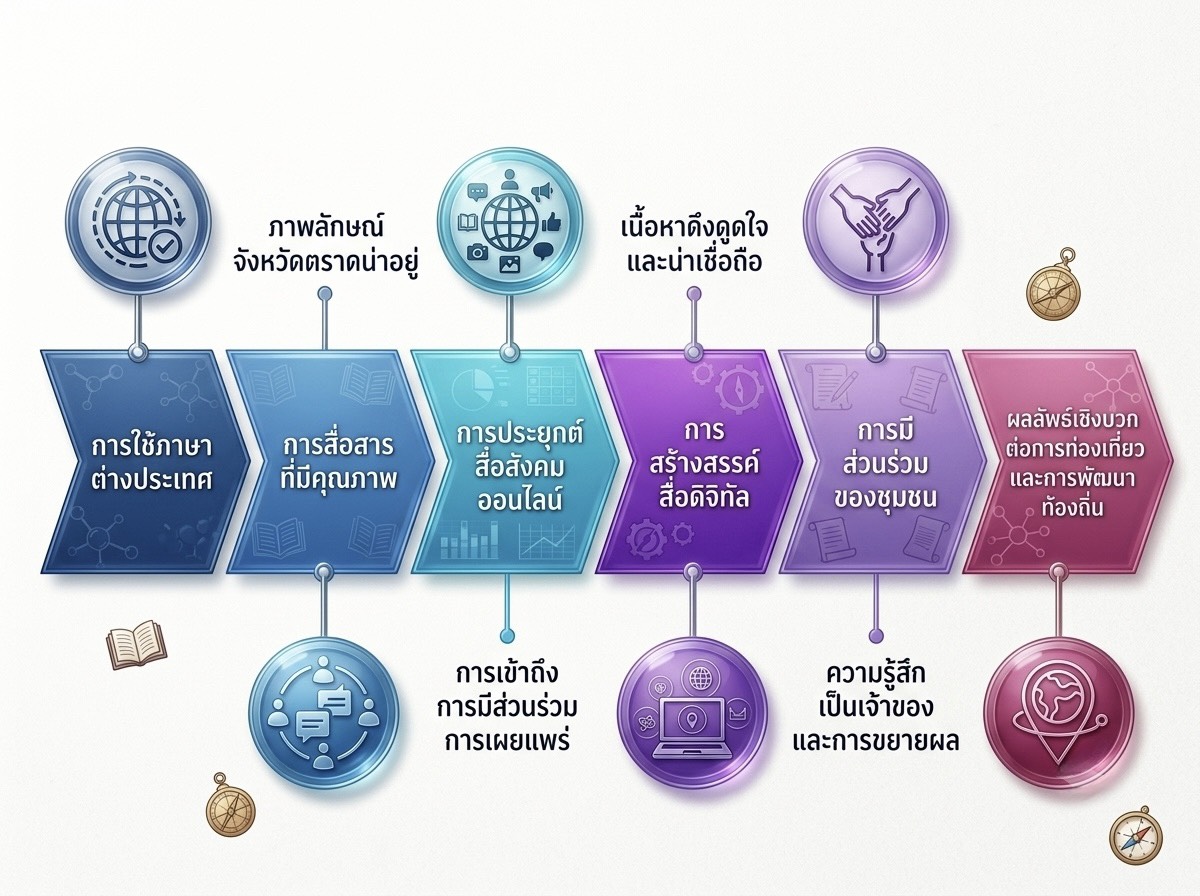
The purpose of this article was to present foreign language communication serves as a vital mechanism for driving creative economies and promoting place - based tourism in the 21st century. Trat Province, endowed with rich natural and cultural resources, offers high potential for international promotion. This study aims to analyze strategies for applying foreign languages namely English, Chinese, Japanese, Korean, and German to creatively promote Trat Province through social media communication. The research was conducted through four main stages: (1) analyzing language selection and message design strategies appropriate to specific audiences; (2) selecting suitable digital media such as videos, infographics, and storytelling posts; (3) fostering audience engagement via platforms including Facebook, TikTok, and YouTube; and (4) evaluating the impacts on destination image and tourist behavior.
The study found that:
The integration of accurate and contextually appropriate foreign language use with creative social media content significantly enhances the image of Trat Province, increasing its credibility and appeal on the international stage. The participation of youth and local communities in content creation fosters a strong sense of ownership and contributes to sustainable tourism promotion.
The study recommends that governmental and educational institutions integrate foreign language learning with digital communication skills to strengthen creative communication among youth. Establishing a “Creative Media Network for Trat” is further proposed as a strategic initiative to advance sustainable local development through multilingual digital engagement.
Downloads
References
ปาริชาติ ศิริธร. (2564). การสื่อสารการตลาดผ่านสื่อสังคมออนไลน์. กรุงเทพฯ: สำนักพิมพ์มหาวิทยาลัยธรรมศาสตร์.
พรทิพย์ อัจฉริยกุล. (2543). งานวิจัยทางภาษาและวรรณกรรม. กรุงเทพฯ: จุฬาลงกรณ์มหาวิทยาลัย.
วิไลวรรณ วัฒนศิริธรรม. (2562). ภาษาต่างประเทศกับการพัฒนาการศึกษา. กรุงเทพฯ: จุฬาลงกรณ์มหาวิทยาลัย.
สุเมธ เขียวสด. (2563). การจัดการท่องเที่ยวโดยชุมชนแบบโฮมสเตย์กับคุณภาพชีวิตของคนในชุมชน: กรณีศึกษา ชุมชนตำบลเกาะช้างใต้ อําเภอเกาะช้าง จังหวัดตราด. (การค้นคว้าอิสระศิลปศาสตรมหาบัณฑิต สาขาวิชาเศรษฐศาสตร์การเมือง). บัณฑิตวิทยาลัย: มหาวิทยาลัยเชียงใหม่.
สุพัตรา มโนมัยพิบูลย์. (2550). การใช้ภาษาไทยเชิงสร้างสรรค์. กรุงเทพฯ: สำนักพิมพ์มหาวิทยาลัย ธรรมศาสตร์.
สุภัทรา ศรีประสาร. (2563). การสอนภาษาต่างประเทศในศตวรรษที่ 21. กรุงเทพฯ: สำนักพิมพ์มหาวิทยาลัยศรีนครินทรวิโรฒ.
Bass, B. M., & Riggio, R.E. (2006). Transformational leadership (2nd ed.). Psychology Press.
Byram, M. (2021). Teaching and Assessing Intercultural Communicative Competence: Revisited. Multilingual Matters.
Goetsch, D. L., & Davis, S. B. (2014). Quality Management for Organizational Excellence: Introduction to Total Quality. Pearson Higher Ed.
Kaplan, A. M., & Haenlein, M. (2020). Social Media: Back to the Roots and Back to the Future. Business Horizons, 63(1), 53 - 64. https://www.researchgate.net/publication/263388197_Social_media_back_to_the_roots_and_back_to_the_future
Kapoor, K., Tamilmani, K., Rana, N. P., Patil, P., Dwivedi, Y. K., & Nerur, S. (2022). Advances in Social Media Research: Past, Present and Future. Information Systems Frontiers, 24(1), 1 - 28. https://www.researchgate.net/publication/320882912_Advances_in_Social_Media_Research_Past_Present_and_Future
Pike, S., & Page, S. J. (2014). Destination Marketing Organizations and Destination Marketing: A Narrative Analysis of the Literature. Tourism Management, 41, 202 - 227. https://www.researchgate.net/publication/259121969_Destination_Marketing_Organizations_and_Destination_Marketing_A_Narrative_Analysis_of_the_Literature
Tidd, J., & Bessant, J. (2021). Managing Innovation: Integrating Technological, Market and Organizational Change (7th ed.). Wiley.
Torrance, E. P. (2562). Creativity: Its Measurement and Development. New York: Scholastic Press.
United Nations Educational, Scientific and Cultural Organization. (2018). Global Language Education Framework. UNESCO.
Downloads
Published
How to Cite
Issue
Section
License
Copyright (c) 2026 Journal of Buddhist Educational Innovation

This work is licensed under a Creative Commons Attribution-NonCommercial-NoDerivatives 4.0 International License.
This article is published under a Creative Commons Attribution-NonCommercial-NoDerivatives 4.0 International License (CC BY-NC-ND 4.0), which allows others to share the article with proper attribution to the authors and prohibits commercial use or modification. For any other reuse or republication, permission from the journal and the authors is required.