GUIDELINE ON THE INTEGRATED ENGLISH LANGUAGE LEARNING APPROACH INCORPORATING LOCAL WISDOM THROUGH COMMUNITY ENTERPRISES: A CASE STUDY OF TRATTRAKARNKHUN SCHOOL, TRAT PROVINCE
Keywords:
English Language Learning Management, Integration, Local Wisdom, Community EnterpriseAbstract
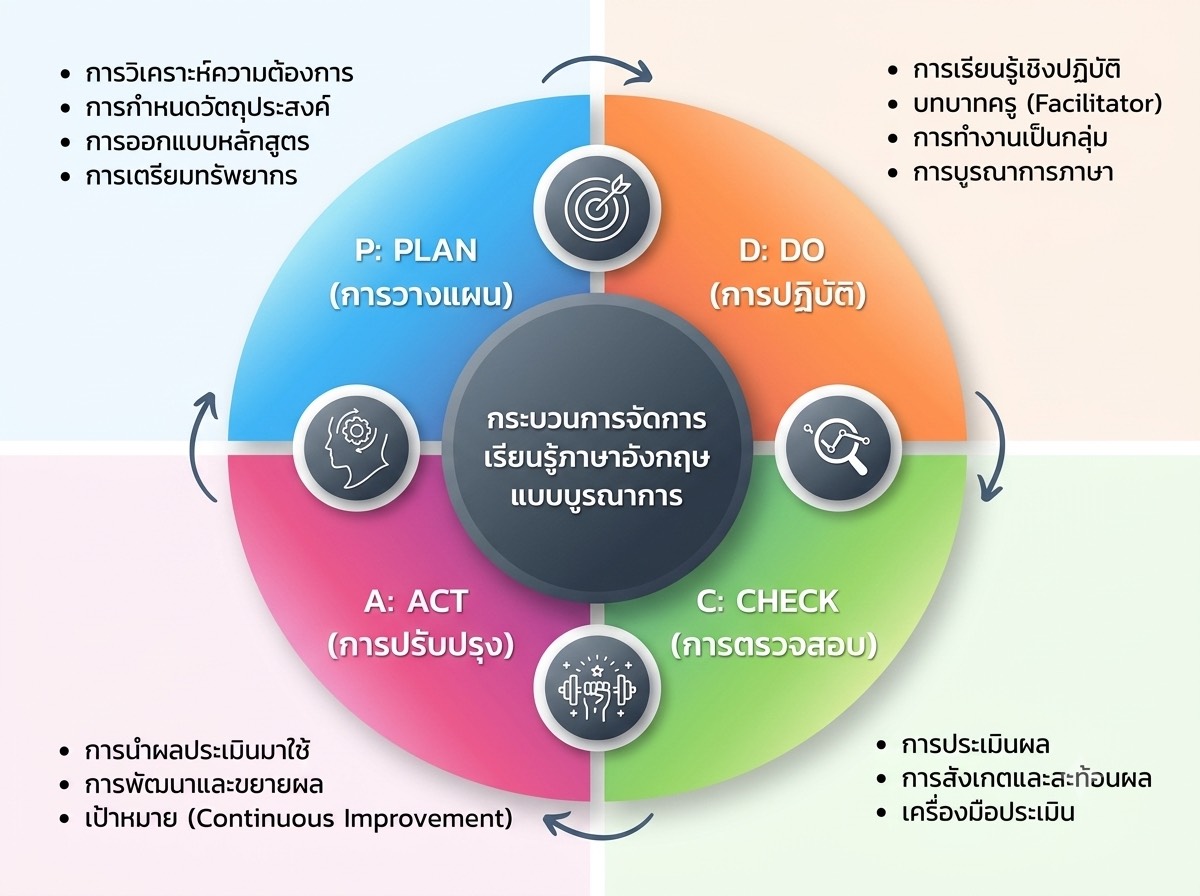
The purpose of this article is to present an integrated approach to English language learning that combines local wisdom and community enterprises. This model aims to develop learners’ communicative competence while connecting knowledge across disciplines and real - life experiences. This approach moves beyond rote memorization or grammar - focused instruction by emphasizing practical engagement, social interaction, and meaningful contexts. Incorporating local wisdom allows learners to appreciate cultural values, strengthen their sense of identity, and apply knowledge in relevant ways. At the same time, community enterprises provide authentic contexts that link education to local economic and social sustainability. The case of the Baan Thammachat Lang community in Trat Province and its ‘Dye Fusion Camp’ illustrates how experiential learning activities can integrate language with multiple domains. Activities such as tie - dye fabric making, environmental conservation, and the creation of local products enable learners to practice English in authentic settings while fostering creativity, teamwork, and problem - solving skills. The process is guided by a continuous cycle of planning, implementation, evaluation, and improvement, ensuring that learning remains dynamic and responsive to learners’ needs. In conclusion, this integrated model of English language learning supports not only academic development but also the preservation of cultural identity and the strengthening of community ties. It creates meaningful learning experiences that are deeply connected to learners’ everyday lives, while equipping them with essential competencies for the challenges of the 21st century.
Downloads
References
ชลธิรา สัตยาวัฒนา. (2552). ภูมิปัญญาท้องถิ่นกับการศึกษาไทย. กรุงเทพฯ: สำนักพิมพ์จุฬาลงกรณ์มหาวิทยาลัย.
ปรัชญาของเศรษฐกิจพอเพียง. (2542). พระบรมราโชวาทในพระบาทสมเด็จพระเจ้าอยู่หัวภูมิพลอดุลยเดชมหาราช. กรุงเทพฯ: สำนักนายกรัฐมนตรี.
ผู้จัดการออนไลน์. (2566). วิสาหกิจชุมชนบ้านธรรมชาติล่างต่อยอดเศรษฐกิจท้องถิ่น. สืบค้นเมื่อ 15 กรกฎาคม 2569, จาก https://www.manager.co.th
มติชนออนไลน์. (2566). กิจกรรมฐานเรียนรู้เพื่อชุมชนบ้านธรรมชาติล่าง. สืบค้นเมื่อ 15 กรกฎาคม 2569, จาก https://www.matichon.co.th
สำนักงานเลขาธิการสภาการศึกษา. (2561). รายงานการศึกษาแนวทางการพัฒนาหลักสูตรฐานสมรรถนะ. กรุงเทพฯ: กระทรวงศึกษาธิการ.
สำนักงานเลขาธิการสภาการศึกษา. (2562). รายงานการพัฒนาทักษะภาษาอังกฤษของผู้เรียนไทย. กรุงเทพฯ: พริกหวานกราฟฟิค.
สำนักงานเลขาธิการสภาการศึกษา. (2565). ทักษะแห่งอนาคตกับการพัฒนาผู้เรียนไทย. กรุงเทพฯ: พริกหวานกราฟฟิค.
สำนักงานส่งเสริมวิสาหกิจขนาดกลางและขนาดย่อม. (2561). รายงานสถานการณ์วิสาหกิจชุมชนในประเทศไทย. กรุงเทพฯ: สำนักงานส่งเสริมวิสาหกิจขนาดกลางและขนาดย่อม.
สุวิทย์ วิบูลย์เศรษฐ์. (2540). ภูมิปัญญาท้องถิ่น: ความหมาย ความสำคัญ และการนำไปใช้. กรุงเทพฯ: ศูนย์มานุษยวิทยาสิรินธร.
Bangkok Insight. (2566). ชุมชนบ้านธรรมชาติล่างนำภูมิปัญญาและทรัพยากรท้องถิ่นสู่การท่องเที่ยว. สืบค้นเมื่อ 15 กรกฎาคม 2569, จาก https://www.thebangkokinsight.com
Beane, J. A. (1997). Curriculum Iintegration: Designing the Core of Democratic Education. Teachers College Press.
Chambers, R. (1997). Whose Reality Counts? Putting the First Last. Intermediate Technology Publications.
Chomsky, N. (1965). Aspects of the Theory of Syntax. MIT Press.
CPF Worldwide. (2023). บ้านธรรมชาติล่าง จัดชุมชนสร้างรายได้จากท่องเที่ยว. สืบค้นเมื่อ 15 กรกฎาคม 2569, จาก https://www.cpfworldwide.com
Crystal, D. (2012). English as a Global Language (2nd ed.). Cambridge University Press, 212
Deming, W. E. (2000). Out of the Crisis. MIT Press.
Dewey, J. (1938). Experience and Education. Macmillan.
Drake, S. M., & Reid, J. L. (2018). Integrated Curriculum as an Effective Way to Teach 21st Century Capabilities. Asia Pacific Journal of Educational Research, 1(1), 31 - 50. https://doi.org/10.30777/APJER.2018.1.1.03
Fadel, C. (2018). Four - Dimensional Education: The Competencies Learners Need to Succeed. Center for Curriculum Redesign.
Fogarty, R. (1991). The Mindful School: How to Integrate the Curricula. Skylight Publishing.
Harmer, J. (2015). The Practice of English Language Teaching (5th ed.). Pearson, 446
Hymes, D. (1972). On Communicative Competence. In J. B. Pride & J. Holmes (Eds.), Sociolinguistics (pp. 269 - 293).
Kolb, D. A. (2014). Experiential Learning: Experience as the Source of Learning and Development. Pearson FT Press.
Krashen, S. (1982). Principles and Practice in Second Language Acquisition. Pergamon.
OECD. (2018). The Future of Education and Skills: Education 2030. OECD Publishing.
Putnam, R. D. (2000). Bowling Alone: The Collapse and Revival of American Community. Simon & Schuster.
Richards, J. C., & Rodgers, T. S. (2014). Approaches and Methods in Language Teaching (3rd ed.). Cambridge University Press.
Trilling, B., & Fadel, C. (2009). 21st Century Skills: Learning for Life in Our Times. Jossey-Bass.
UNESCO. (2017). Local Knowledge, Global Goals. UNESCO Publishing.
UNESCO. (2003). Convention for the Safeguarding of the Intangible Cultural Heritage. UNESCO.
Vygotsky, L. S. (1978). Mind in Society: The Development of Higher Psychological Processes. Harvard University Press.
World Bank. (2018). Community - Driven Development: An Approach to Sustainable Development. World Bank Group.
Downloads
Published
How to Cite
Issue
Section
License
Copyright (c) 2026 Journal of Buddhist Educational Innovation

This work is licensed under a Creative Commons Attribution-NonCommercial-NoDerivatives 4.0 International License.
This article is published under a Creative Commons Attribution-NonCommercial-NoDerivatives 4.0 International License (CC BY-NC-ND 4.0), which allows others to share the article with proper attribution to the authors and prohibits commercial use or modification. For any other reuse or republication, permission from the journal and the authors is required.