THE ROLE OF SCHOOL ADMINISTRATORS IN ESTABLISHING AN ETHICAL ORGANIZATIONAL CULTURE
Keywords:
School Administrator, Ethical Organization Culture, SWOT Analysis, LeadershipAbstract
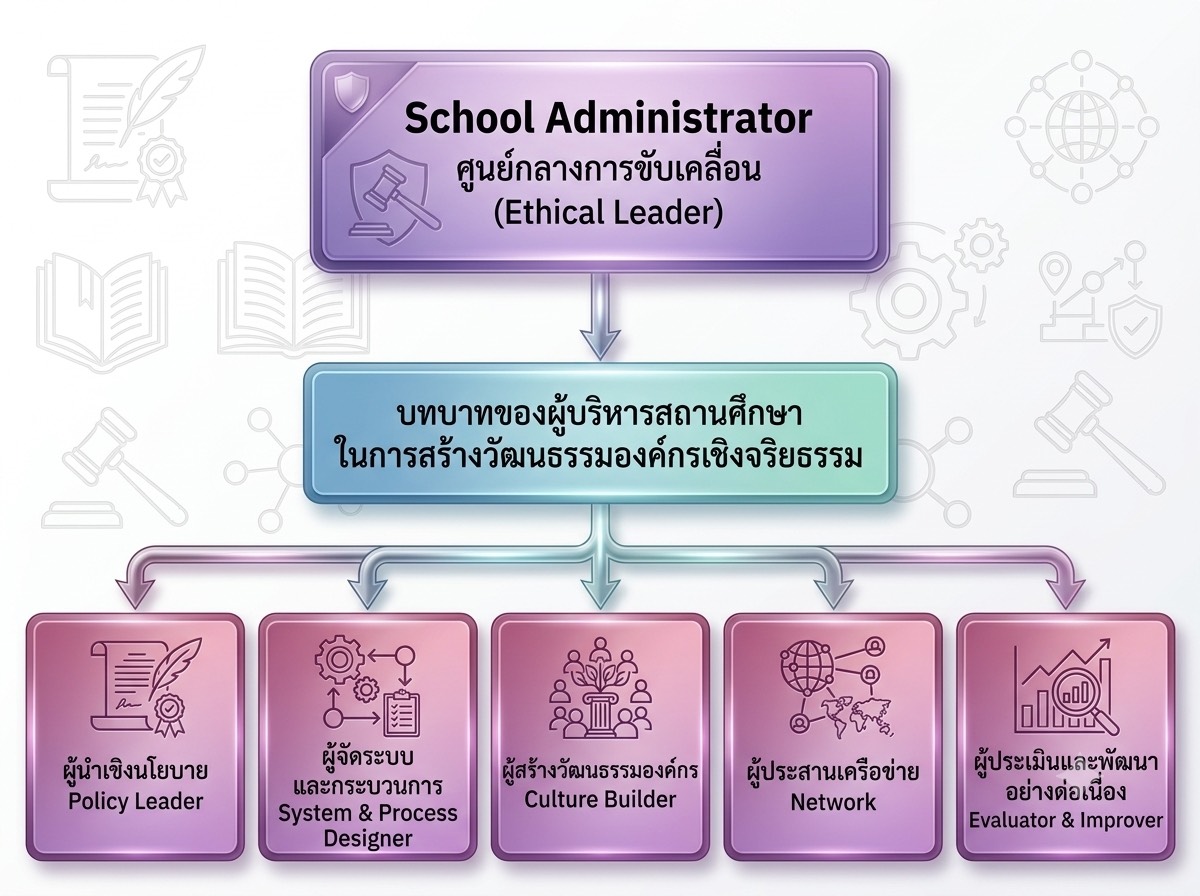
This article aims to examine the role of school administrators in establishing an ethical organizational culture by employing SWOT analysis (Strengths, Weaknesses, Opportunities, Threats) as a framework for strategic assessment. The findings reveal that schools possess strengths in implementing programs and activities aligned with national policies, such as Buddhist-based schools, moral camps, and religious events, while also receiving continuous support from teachers and parents. However, limitations remain in evaluation systems that emphasize quantitative outcomes over actual behavioral change, along with resource constraints. In terms of opportunities, the broader social context and state educational policies facilitate collaboration with local communities and the use of digital technologies to foster ethical values. Conversely, challenges persist in the form of online media influence, consumerist culture, and policy discontinuity, which hinder sustainability. The analysis identifies five key roles of school administrators in cultivating an ethical organizational culture: (1) Policy Leader, setting visions and ethical directions; (2) System Designer, developing learning and assessment systems; (3) Culture Builder, embedding ethics as shared organizational values; (4) Network Connector, fostering partnerships with communities; and (5) Evaluator and Improver, utilizing data for continuous development. In conclusion, establishing an ethical organizational culture requires policy-oriented leadership, systematic management practices, and broad stakeholder engagement. The application of SWOT analysis enables school administrators to comprehensively recognize both potential and limitations, thereby advancing schools toward becoming ethical organizations that nurture desirable learner qualities in accordance with educational standards and societal needs.
Downloads
References
กนกอร สมปราชญ์. (2560). ภาวะผู้นำและ ภาวะผู้นำการเรียนรู้สำหรับผู้บริหารสถานศึกษา. ขอนแก่น: โรงพิมพ์คลังนานาวิทยา.
ภารดี อนันต์นาวี. (2553). หลักการ แนวคิด ทฤษฎีทางการบริหารการศึกษา (พิมพ์ครั้งที่ 3). ชลบุรี: มนตรี.
มูลนิธิยุวสถิรคุณ. (2560). คู่มือจัดกิจกรรมการพัฒนาโรงเรียนคุณธรรม. นนทบุรี: สหมิตรพริ้นติ้งแอนด์พับลิสซิ่ง.
ราชกิจจานุเบกษา. (2562). พระราชบัญญัติการศึกษาแห่งชาติ พ.ศ. 2562 (ฉบับที่ 4) พ.ศ. 2562. เล่ม 136 ตอน 57 ก. 49 - 53. 1 พฤษภาคม 2562.
รุ่งชัชดาพร เวหะชาติ. (2560). คุณธรรม จริยธรรมสำหรับผู้บริหารมืออาชีพ. สงขลา: นำศิลป์โฆษณา.
โรงเรียนส.ไทยเสรีอุตสาหกรรม 2. (2568). แผนปฏิบัติการประจำปีงบประมาณ 2568 โรงเรียนส.ไทยเสรีอุตสาหกรรม 2 สำนักงานเขตพื้นที่การศึกษาประถมศึกษาจันทบุรี เขต 2. จันทบุรี: โรงเรียนส.ไทยเสรีอุตสาหกรรม 2.
วรภัทร ภู่เจริญ. (2547). บริหารงาน บริหารใจ. กรุงเทพฯ: อริยชน.
สมเด็จพระพุทธโฆษาจารย์ (ป.อ. ปยุตฺโต). (2568). ภาวะผู้นำ (พิมพ์ครั้งที่ 47). กรุงเทพฯ: มูลนิธิพุทธธรรม.
สมหมาย อ่ำดอนกลอย. (2556). บทบาทผู้บริหารสถานศึกษาในศตวรรษที่ 21. วารสารบัณฑิตศึกษา มหาวิทยาลัยราชภัฏพิบูลสงคราม, 7(1), 1 - 7. https://so01.tci-thaijo.org/index.php/GraduatePSRU/article/view/55490/46087
สำนักงานเขตพื้นที่การศึกษาประถมศึกษาจันทบุรี เขต 2. (2568). รายงานผลแผนปฏิบัติราชการประจำปีงบประมาณ พ.ศ. 2567. จันทบุรี: สำนักงานเขตพื้นที่การศึกษาประถมศึกษาจันทบุรี เขต 2.
สำนักงานเลขาธิการสภาการศึกษา. (2560). แผนการศึกษาแห่งชาติ พ.ศ. 2560 - 2579. กรุงเทพฯ: บริษัท พริกหวานกราฟฟิค จำกัด.
Chermack, T. J. (2011). Scenario Planning in Organizations: How to Create, Use, and Assess Scenarios. Berrett-Koehler Publishers.
Chik, W. M. H. (2020). Ethical Leadership in Educational Administration: A Review. International Journal of Academic Research in Business and Social Sciences, 10(9), 1140 - 1153. https://doi.org/10.6007/IJARBSS/v10-i9/8024
Gürel, E., & Tat, M. (2017). SWOT Analysis: A theoretical Review. Journal of International Social Research, 10(51), 994 - 1006. https://www.researchgate.net/publication/319367788_SWOT_ANALYSIS_A_THEORETICAL_REVIEW
Hall, D. L. (2009). Balancing Accountability and Ethics: A Case Study of a Principal's Leadership Practices (ERIC ED512859). ERIC. https://eric.ed.gov/?id=ED512859
Helms, M. M., & Nixon, J. (2010). Exploring SWOT analysis - where are we now? Journal of Strategy and Management, 3(3), 215-251. https://doi.org/10.1108/17554251011064837
Panagiotou, G. (2003). Bringing SWOT into focus. Business Strategy Review, 14(2), 8 - 10. https://doi.org/10.1111/1467-8616.00253
Senge, P. M. (1990). The Fifth Discipline: The Art and Practice of the Learning Organization. Doubleday.
Valentin, E. K. (2001). SWOT Analysis from a Resource-based View. Journal of Marketing Theory and Practice, 9(2), 54 - 69. https://doi.org/10.1080/10696679.2001.11501899
Yee, B., & Yee, D. (2021). International Perspectives on Ethical Educational Leadership. Springer. https://doi.org/10.1007/978-3-031-70839-8
Downloads
Published
How to Cite
Issue
Section
License
Copyright (c) 2026 Journal of Buddhist Educational Innovation

This work is licensed under a Creative Commons Attribution-NonCommercial-NoDerivatives 4.0 International License.
This article is published under a Creative Commons Attribution-NonCommercial-NoDerivatives 4.0 International License (CC BY-NC-ND 4.0), which allows others to share the article with proper attribution to the authors and prohibits commercial use or modification. For any other reuse or republication, permission from the journal and the authors is required.