APPLICATION OF ARTIFICIAL INTELLIGENCE (AI) IN TEACHING AND LEARNING IN THE DIGITAL ERA OF THE 21ST CENTURY
Keywords:
Artificial Intelligence, Digital Learning, Personalized Learning, 21st Century Skills, Educational InnovationAbstract
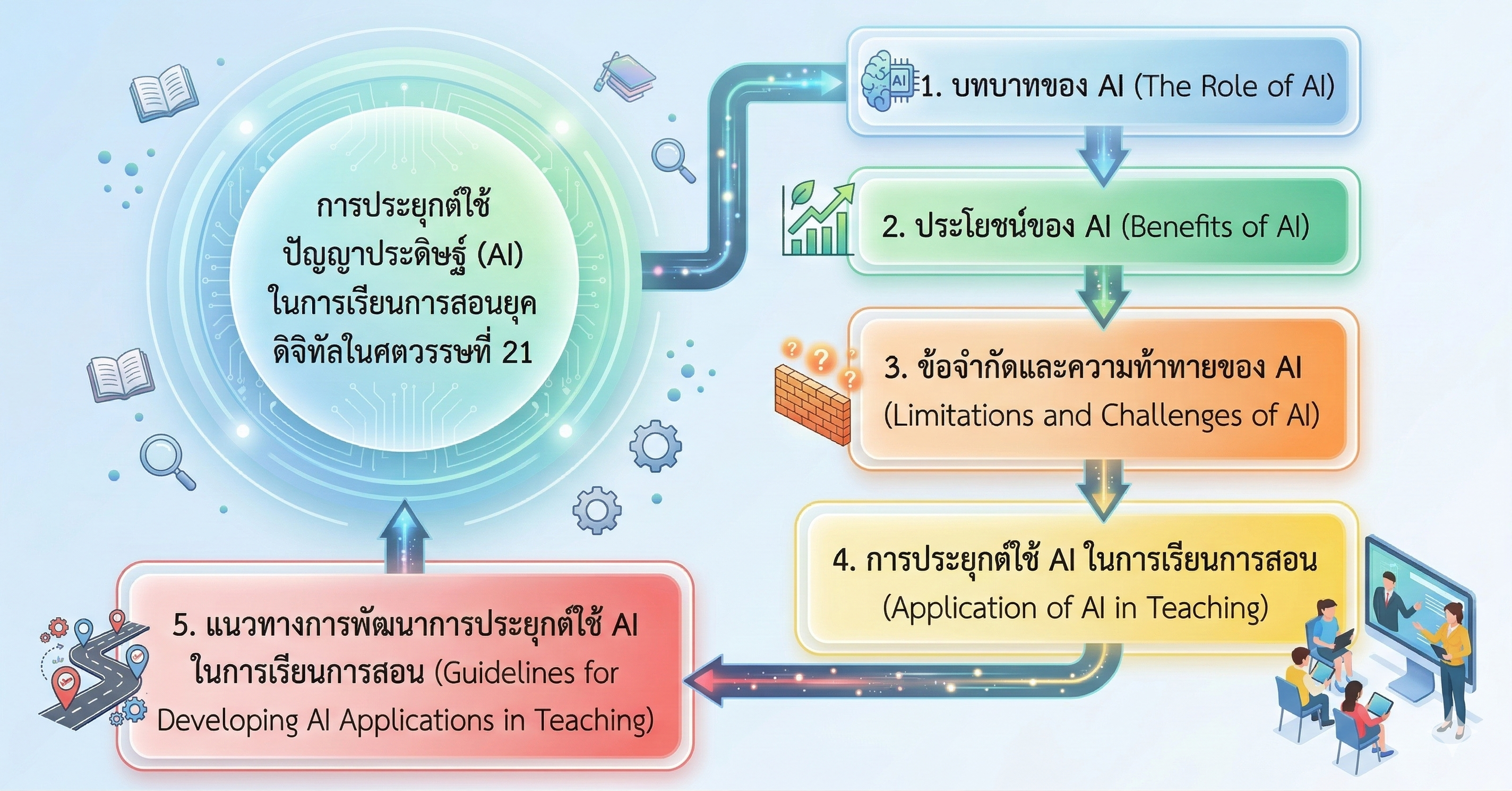
The purpose of this article was to analyze and synthesize key concepts regarding the application of Artificial Intelligence (AI) in digital - age teaching and learning in the 21st century. The paper presented definitions, roles, benefits, limitations, and strategic approaches for integrating AI into educational systems appropriately and sustainably. A documentary analysis method was employed, drawing upon international research studies and global policy reports. The findings indicated that AI had significant potential to support personalized learning, provide real - time feedback, analyze learner data, and enhance 21st century skills effectively. However, the implementation of AI in education faced several challenges, including the digital divide, ethical concerns, data privacy issues, and the readiness of teachers and technological infrastructure. Therefore, the successful integration of AI required clear policy frameworks, capacity building for educators and learners, and a balanced approach that harmonized technological advancement with human values. Such efforts would contribute to creating flexible, equitable, and sustainable learning systems aligned with the rapidly changing global society.
Downloads
References
ศิริชัย กาญจนวาสี. (2566). การพัฒนาครูไทยกับการใช้เทคโนโลยี AI อย่างสร้างสรรค์และยั่งยืน. กรุงเทพฯ: จุฬาลงกรณ์มหาวิทยาลัย.
สำนักงานเลขาธิการสภาการศึกษา. (2567). รายงานนโยบายการศึกษาไทยในยุคดิจิทัล. กรุงเทพฯ: สำนักงานเลขาธิการสภาการศึกษา.
Dringó - Horváth, I., Rajki, Z., & Nagy, J. T. (2025). University Teachers’ Digital Competence and AI Literacy: Moderating Role of Gender, Age, Experience, and Discipline. Education Sciences, 15(7), 868. https://doi.org/10.3390/educsci15070868
Holmes, W., Bialik, M., & Fadel, C. (2019). Artificial Intelligence in Education: Promises and Implications for Teaching and Learning. Boston, MA: Center for Curriculum Redesign.
Luckin, R., George, K., & Cukurova, M. (2022). AI for School Teachers. CRC Press.
Mollick, E. R., & Mollick, L. (2023). Assigning AI: Seven Approaches for Students, with Prompts (Wharton School Research Paper). Wharton School of the University of Pennsylvania. https://ssrn.com/abstract=4475995
Russell, S., & Norvig, P. (2021). Artificial Intelligence: A Modern Approach (4th ed.). Hoboken, NJ: Pearson.
UNESCO. (2021). AI and education: Guidance for Policy - Makers. United Nations Educational, Scientific and Cultural Organization. https:// unesdoc. unesco. org/ark:/48223/pf0000376709
UNESCO. (2024). AI and Education: Guidance for Policy Makers. Paris: UNESCO Publishing.
Williamson, B., & Eynon, R. (2020). Historical Threads, Missing Links, and Future Directions in AI in Education. Learning, Media and Technology, 45(3), 223 - 235.
Xie, H., Chu, H. C., Hwang, G. J., & Wang, C. C. (2019). Trends and Development in Technology - Enhanced Adaptive/Personalized Learning: A Systematic Review of Journal Publications from 2007 to 2017. Computers & Education, 140, 103599. https://doi.org/10.1016/j.compedu.2019.103599
Zawacki - Richter, O., Marín, V. I., Bond, M., & Gouverneur, F. (2019). Systematic Review of Research on Artificial Intelligence Applications in Higher Education - Where are the Educators?. International Journal of Educational Technology in Higher Education, 16(39), 1 - 27. https:// doi.org/ 10.1186/ s41239-019-0171-0
Downloads
Published
How to Cite
Issue
Section
License
Copyright (c) 2026 Journal of Buddhist Educational Innovation

This work is licensed under a Creative Commons Attribution-NonCommercial-NoDerivatives 4.0 International License.
This article is published under a Creative Commons Attribution-NonCommercial-NoDerivatives 4.0 International License (CC BY-NC-ND 4.0), which allows others to share the article with proper attribution to the authors and prohibits commercial use or modification. For any other reuse or republication, permission from the journal and the authors is required.