ACTIVE LEARNING MANAGEMENT USING COMMUNITY - BASED APPROACHES ACCORDING TO THE QUALITY CYCLE UNDER THE EDUCATION SANDBOX: A CASE STUDY OF WAT BURAPA PITTAYARAM SCHOOL, CHANTHABURI PROVINCE
Keywords:
Active Learning Management, Community - Based Approach, Quality Cycle, Education SandboxAbstract
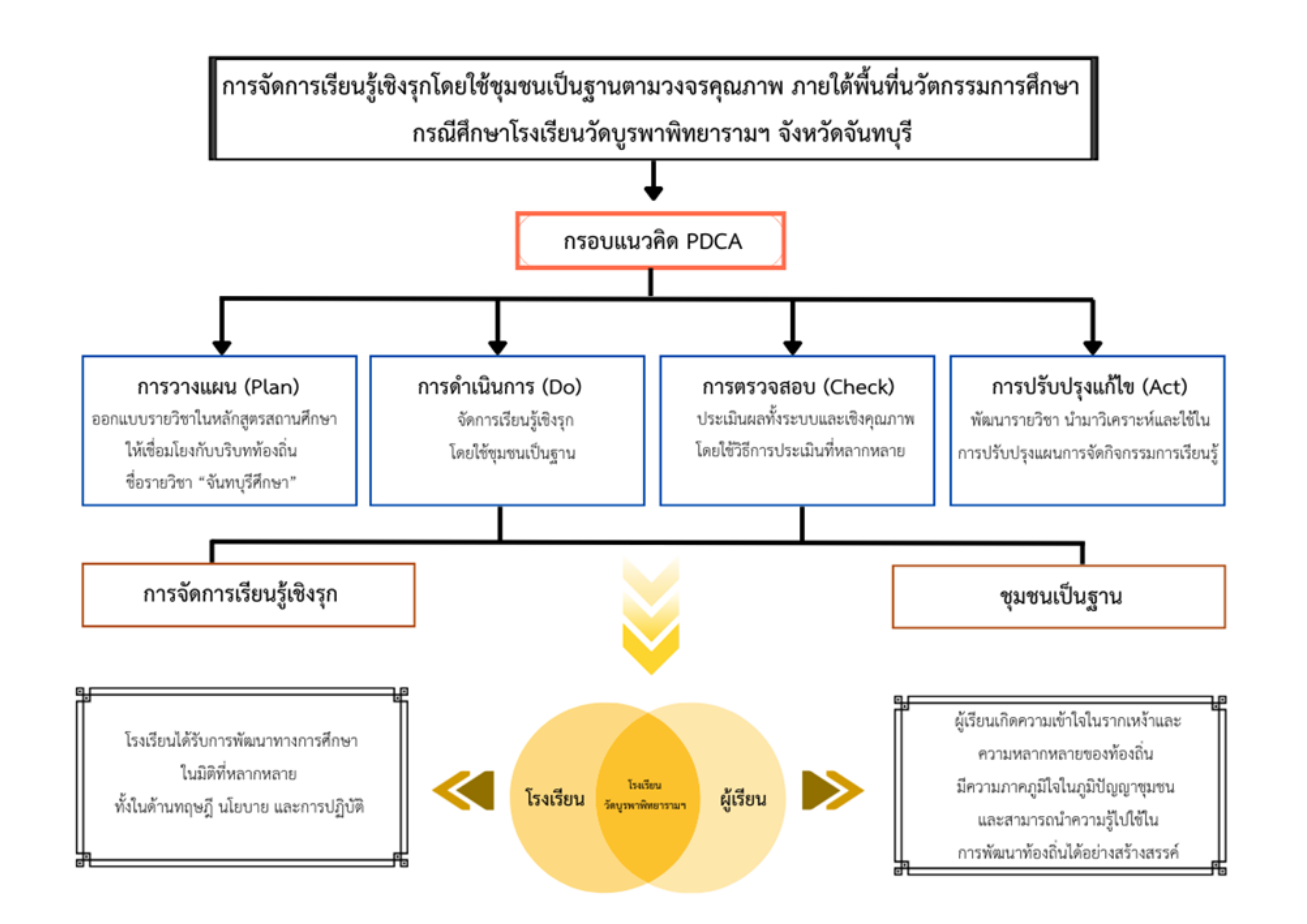
The purpose of this article was to present and analyze the process of community - based approaches management, guided by the Deming Cycle (PDCA) within the framework of Thailand's Educational Sandbox initiative. It featured a case study of Wat Burapa Pittayaram School in Chanthaburi Province, an opportunity - expansion school that has successfully fostered strong collaboration with its local community. The school has systematically applied the PDCA quality cycle to design and implement an active learning framework that is intrinsically linked to the local context. The process was structured as follows Designing curriculum courses that are deeply connected to the local environment and wisdom (Plan), Implementing community-based approaches activities where students engage directly with real-world situations (Do), Evaluating learning outcomes through diverse and authentic assessment methods (Check), and Continuously refining the courses and improving learning activity plans based on evaluation feedback (Act). The implementation of this model has yielded significant positive outcomes. Learners have demonstrated marked development in 21st century skills, and the community has become a robust and active partner in educational management, which directly aligns with the foundational objectives of the Educational Sandbox initiative. This article, therefore, highlights the success of integrating active learning principles with local wisdom through a systematic quality cycle. It posits this approach as a replicable best practice for other educational institutions seeking to innovate within the Educational Sandbox and beyond.
Downloads
References
กระทรวงศึกษาธิการ. (2560). แผนการศึกษาแห่งชาติ พ.ศ. 2560 - 2579. กรุงเทพฯ: กระทรวงศึกษาธิการ.
นิภาวรรณ เจริญลักษณ์, นริศรา กรุดนาค และเริงวิชญ์ นิลโคตร. (2568). พัฒนาแหล่งเรียนรู้ชุมชนภูมิปัญญาส้มโอนครชัยศรีบนฐานอัตลักษณ์เกาะลัดอีแท่น อำเภอสามพราน จังหวัดนครปฐม. วารสารปราชญ์ประชาคม, 3(4), 208 - 224.
ราชกิจจานุเบกษา. (2562). พระราชบัญญัติพื้นที่นวัตกรรมการศึกษา พ.ศ. 2562. เล่ม 136 ตอนที่ 56 ก. หน้า 202 - 220. 30 เมษายน 2562.
สำนักงานกองทุนสนับสนุนการสร้างเสริมสุขภาพ. (2561). เศรษฐกิจพอเพียงกับการพัฒนาที่ยั่งยืน. กรุงเทพฯ: สำนักงานกองทุนสนับสนุนการสร้างเสริมสุขภาพ.
สำนักงานเขตพื้นที่การศึกษาประถมศึกษาจันทบุรี เขต 1. (2567). แผนปฏิบัติการประจำปีงบประมาณ พ.ศ. 2567. จันทบุรี: สำนักงานเขตพื้นที่การศึกษาประถมศึกษาจันทบุรี เขต 1.
สำนักงานเลขาธิการสภาการศึกษา. (2562). การศึกษาไทยในศตวรรษที่ 21. กรุงเทพฯ: สำนักงานเลขาธิการสภาการศึกษา.
สำนักงานสถิติจังหวัดจันทบุรี. (2566). รายงานสถานการณ์ทางเศรษฐกิจและสังคมจังหวัดจันทบุรี ปี 2566. กรุงเทพฯ: สำนักงานสถิติแห่งชาติ.
Chambers, R. (1997). Whose Eeality Counts? Putting the First Last. Intermediate Technology Publications.
Deming, W. E. (1986). Out of the Crisis. MIT Press.
Freire, P. (1970). Pedagogy of the Oppressed. Herder and Herder.
Kolb, D. A. (1984). Experiential learning: Experience as the Source of Learning and Development. Prentice - Hall.
Piaget, J. (1972). Psychology and Epistemology: Towards a Theory of Knowledge. Viking Press.
Putnam, R. D. (1993). Making Democracy Work: Civic Traditions in Modern Italy. Princeton University Press.
Trilling, B., & Fadel, C. (2009). 21st Century Skills: Learning for Life in Our Times. Jossey - Bass.
Vygotsky, L. S. (1978). Mind in Society: The Development of Higher Psychological Processes. Harvard University Press.
Downloads
Published
How to Cite
Issue
Section
License
Copyright (c) 2025 Journal of Buddhist Educational Innovation

This work is licensed under a Creative Commons Attribution-NonCommercial-NoDerivatives 4.0 International License.
This article is published under a Creative Commons Attribution-NonCommercial-NoDerivatives 4.0 International License (CC BY-NC-ND 4.0), which allows others to share the article with proper attribution to the authors and prohibits commercial use or modification. For any other reuse or republication, permission from the journal and the authors is required.