LEARNING ECOSYSTEM WITHIN SCHOOLS TO FOSTER STUDENTS' GROWTH MINDSET
Keywords:
Learning Ecosystem, School, Growth Mindset, StudentsAbstract
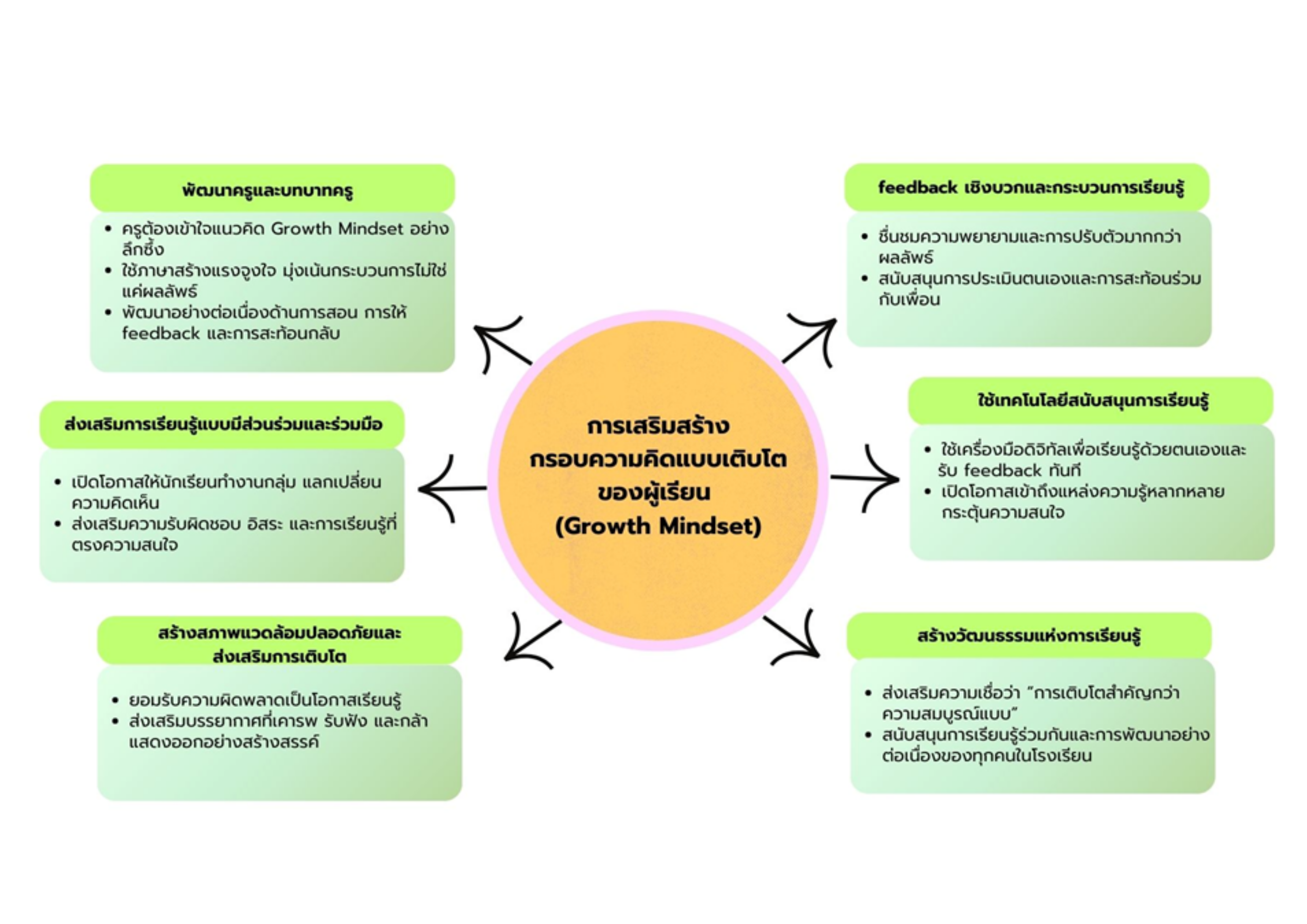
The purpose of this article was to study and analyze the learning ecosystem within educational institutions, focusing on the elements that influence the development of a growth mindset among 21st century learners. It also proposes approaches for designing and fostering learning environments that encourage positive attitudes toward learning. A learning ecosystem was conceptualized as an interconnected structure that integrated learners, learning resources, processes, technologies, and educational environments to promote participatory, flexible, and continuous learning with learners at the center. The growth mindset refered to the belief that individuals’ abilities can be developed through effort, learning from mistakes, and openness to constructive feedback. Such a mindset was considered an essential competency enabling learners to effectively confront challenges and adapt to rapidly changing contexts. The proposed designed of a school - based learning ecosystem to foster growth mindset encompasses teacher development and evolving teacher roles, participatory learning, safe and supportive environments, positive feedback, technology integration, and the cultivation of a learning culture. The analysis revealed that promoting learners’ growth mindset requires a holistic and interconnected learning ecosystem that supports proactive learning, thereby enabling continuous development and equipping learners to face the challenges of the future with resilience.
Downloads
References
จักรพงษ์ วรรณขันธ์ และวิยะดา วรรณขันธ์. (2567). กรอบความคิดแบบเติบโตสู่ความสำเร็จในชีวิตและ การทำงาน. Journal of Integration Social Sciences and Development, 4(2), 37 - 42.
นริศนา ใจคง และสิริกานต์ แก้วคงทอง. (2564). นิเวศการเรียนรู้ : เรื่องเก่าบนวิถีใหม่. วารสารการศึกษาไทย (OBEC Journal), 18(3), 64 - 69.
พรนภา ทองวิจิตต์ และอังคณา ตุงคะสมิต. (2566). การพัฒนากรอบความคิดแบบเติบโตของนักเรียนชั้นประถมศึกษาปีที่ 5 โดยใช้การจัดการเรียนรู้เพื่อเสริมสร้างกรอบความคิดแบบเติบโต ในรายวิชา ส15101 สังคมศึกษา โรงเรียนชุมชนบ้านศีรษะละเลิง จังหวัดนครราชสีมา. วารสารราชพฤษ์, 21(2), 95 - 111.
ภูมิภควัธจ์ ภูมพงศ์คชศร. (2567). รูปแบบการบริหารจัดการระบบนิเวศการเรียนรู้สู่การพัฒนาการจัดการศึกษาของสถานศึกษานำร่องเพื่อความยั่งยืนในพื้นที่นวัตกรรมการศึกษา. Journal of Multidisciplinary in Humanities and Social Sciences, 7(5), 3038 - 3055.
วิชัย วงษ์ใหญ่ และมารุต พัฒผล. (2562). การจัดการเรียนรู้เพื่อเสริมสร้างกระบวนการทางความคิดเพื่อ การเติบโต. วารสารศึกษาศาสตร์ (สิกขา), 6(1), 52 - 67.
ศศินันท์ เศรษฐวัฒน์บดี และคณะ. (2566). การศึกษาระบบนิเวศการเรียนรู้ของสถานศึกษาในจังหวัดปทุมธานี. วารสารการศึกษา คณะครุศาสตร์ มหาวิทยาลัยราชภัฏนครสวรรค์, 6(1), 102 - 113.
สำนักงานเลขาธิการสภาการศึกษา. (2565). การจัดระบบนิเวศการเรียนรู้ที่เอื้อต่อการพัฒนาศักยภาพของคนไทย 4.0. กลุ่มพัฒนานโยบายด้านการมีส่วนร่วมและการเพิ่มโอกาสทางการศึกษา สำนักมาตรฐานการศึกษาและพัฒนาการเรียนรู้ สำนักงานเลขาธิการสภาการศึกษา: บริิษััท เอส.บีี.เค. การพิมพ์ จำกัด
Boaler, J. (2013). Ability and Mathematics: The Mindset Revolution that is Reshapingeducation. FORUM, 55(1), 14 - 152.
Dweck, C. S. (2006). Mindset: The New Psychology of Success. Random House.
Downes, S. (2010). Learning Networks and Connective Knowledge. National Research Council Canada.
Duckworth, A. (2016). Grit: The Power of Passion and Perseverance. Scribner/Simon & Schuster.
Harrell, T. S. (2020). What is a Learning Ecosystem? Training Industry. Retrieved from https://elibrary.ksp.or.th/index.php?id_article=294&lvl=cmspage&pageid=4
OECD. (2018). The Future of Education and Skills: Education 2030. OECD Publishing.
Ritchhart, R. (2015). Creating Cultures of Thinking: The 8 Forces We must Master to Truly Transform Our Schools. Jossey - Bass.
UNESCO. (2021). Making Lifelong Learning a Reality: A Handbook. UNESCO Publishing.
Yeager, D. S., & Walton, G. M. (2011). Social - Psychological Interventions in Education: They’re not Magic. Review of Educational Research, 81(2), 267 - 301.
Yu, J., Kreijkes, E., & Salmela-Aro, K. (2022). Students’ Growth Mindset: Relation to Teacher Beliefs, Teaching Practices, and School Climate. Learning and Instruction, 80, 101512. https://doi.org/10.1016/j.learninstruc.2022.101616
Treviño, L. K., Hartman, L. P., & Brown, M. (2000). Moral Person and Moral Manager: How Executives Develop a Reputation for Ethical Leadership. California Management Review, 42(4), 128 - 142.
UNESCO. (2020). Education in a Post - COVID World: Nine Ideas for Public Action. Paris, France: UNESCO. https://unesdoc.unesco.org/ark:/48223/pf0000373717
Downloads
Published
How to Cite
Issue
Section
License
Copyright (c) 2025 Journal of Buddhist Educational Innovation

This work is licensed under a Creative Commons Attribution-NonCommercial-NoDerivatives 4.0 International License.
This article is published under a Creative Commons Attribution-NonCommercial-NoDerivatives 4.0 International License (CC BY-NC-ND 4.0), which allows others to share the article with proper attribution to the authors and prohibits commercial use or modification. For any other reuse or republication, permission from the journal and the authors is required.