APPROACHES TO APPLYING THE KAHOOT! PROGRAM BY FACILITATORS IN THE DIGITAL ERA
Keywords:
Kahoot!, Participatory Learning, Culture, Facilitator, Educational TechnologyAbstract
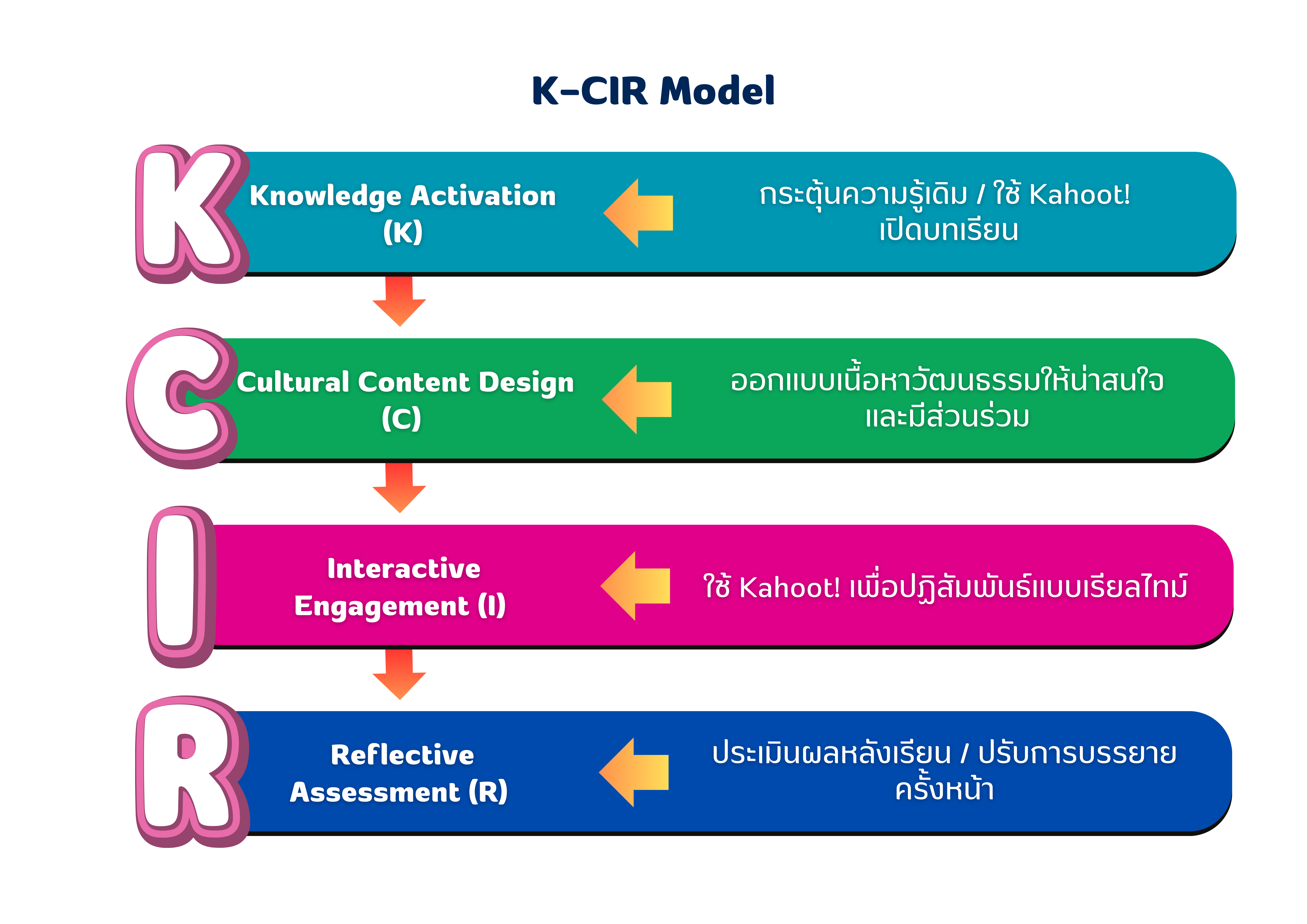
The purpose of this article was to present an approach to applying the Kahoot! platform to enhance participatory learning in cultural lectures. It emphasize shifting the role of cultural facilitators from traditional one - way transmitters of knowledge to designers of interactive learning processes suitable for learners in the digital era (2000 - present), whose behaviors are rapidly evolving in terms of interests, technological engagement, and demand for interactivity. Kahoot! serves as a digital tool that promotes learner participation and can be integrated before, during, and after lectures to stimulate interest, assess understanding, and review content in an enjoyable, game-based format that motivates learners. Drawing on relevant theories and practical insights, the author proposed the K - CIR Model, comprising four components: Knowledge Activation, Cultural Content Design, Interactive Engagement, and Reflective Assessment. This conceptual framework offered a systematic method for fostering meaningful and engaging cultural learning experiences across diverse contexts.
The findings suggested that applying Kahoot! in cultural education not only increases learner engagement but also supports facilitators in adopting interactive methods and strengthening their digital literacy. This article contributed to the development of instructional strategies by integrating digital tools with cultural content, highlighting the potential of Kahoot! to promote cultural awareness, learner motivation, and educational innovation in the contemporary era.
Downloads
References
จาภา เพชรเจริญ และวรสิทธิ์ เจริญศิลป์. (2561). การประเมินการใช้ Kahoot Program ในการจัดการเรียนการสอนผ่านเครือข่ายการสอนทางไกล Telemedicine. Journal of Faculty of Education Pibulsongkram Rajabhat University, 5(2), 162 - 175.
ทิศนา แขมมณี. (2557). ศาสตร์การสอน: องค์ความรู้เพื่อการจัดกระบวนการเรียนรู้ที่มีประสิทธิภาพ (พิมพ์ครั้งที่ 18). กรุงเทพฯ: สำนักพิมพ์จุฬาลงกรณ์มหาวิทยาลัย.
Licorish, S. A., Owen, H. E., Daniel, B., & George, J. L. (2018). Students’ Perception of Kahoot!’s Influence on Teaching and Learning. Research and Practice in Technology Enhanced Learning, 13(1), 1 - 23.
Plump, C. M., & LaRosa, J. (2017). Using Kahoot! in the Classroom to Create Engagement and Active Learning: A Game - Based Technology Solution for ELearning Novices. Management Teaching Review, 2(2), 151 - 158.
Wang, A. I. (2015). The Wear Out Effect of a Game - Based Student Response System. Computers & Education, 82(1), 217 - 227.
Wichadee, S., & Pattanapichet, F. (2018). Enhancement of Performance and Motivation Through Application of Digital Games in an English Language Class. Teaching English with Technology, 18(1), 77 - 92.
Downloads
Published
How to Cite
Issue
Section
License
Copyright (c) 2025 Journal of Buddhist Educational Innovation

This work is licensed under a Creative Commons Attribution-NonCommercial-NoDerivatives 4.0 International License.
This article is published under a Creative Commons Attribution-NonCommercial-NoDerivatives 4.0 International License (CC BY-NC-ND 4.0), which allows others to share the article with proper attribution to the authors and prohibits commercial use or modification. For any other reuse or republication, permission from the journal and the authors is required.