Marketing Factors Brand Heritage and the Commercial Potential of Savon de Marseille Soap in Thailand
คำสำคัญ:
brand heritage, perceived value, consumer trust, commercial potential, Savon de Marseilleบทคัดย่อ
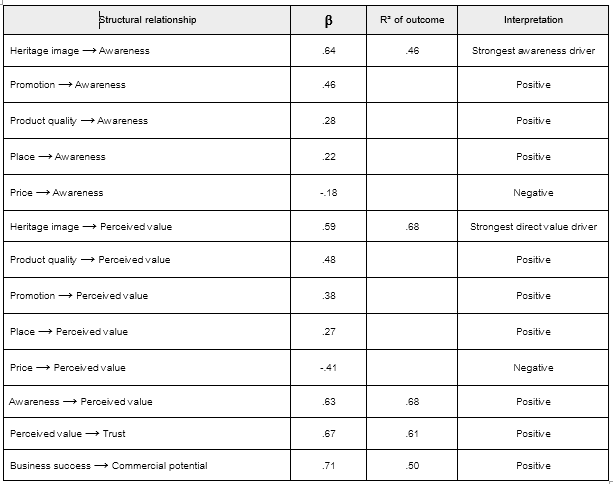
This study aimed to (1) assess the commercial potential of Savon de Marseille soap in Thailand, (2) examine consumer awareness, perceived value, trust, and perceived business success, and (3) test the structural relationships linking marketing factors, consumer responses, and commercial potential. A quantitative survey was administered to 400 Thai consumers aged 20 years or older who had purchased or considered purchasing premium soap or skincare products in Bangkok, surrounding provinces, and major economic cities. Data were analyzed using descriptive statistics, Pearson correlations, and structural equation modeling. Commercial potential was moderate(M = 3.35, SD = 0.69), whereas perceived business success was moderate-to-low (M = 2.82, SD = 0.83). Heritage image and brand credibility received the highest marketing-factor rating (CM = 3.58, SD = 0.66) and exerted the strongest positive effects on awareness (β = .64) and perceived value (β = .59). Price negatively affected awareness (β = -.18) and perceived value (β = -.41). The full model fitted the empirical data well (χ² = 236.48, df = 192, χ²/df = 1.23, RMSEA = .032, CFI = .98, TLI = .97), and business success positively influenced commercial potential (β = .71; R² = .50). The findings show that heritage can build value and trust, but converting favorable attitudes into loyalty and willingness to pay a premium remains the central market gap. Managers should therefore combine verifiable authenticity cues with accessible-premium pricing and trial experiences.
เอกสารอ้างอิง
Buaman, P., & Phuengsuktechasit, P. (2011). Influence of country of origin on Thai consumer attitude and purchase intention toward skincare products [Master’s thesis, Mälardalen University].
Cooper, H., Miller, D., & Merrilees, B. (2015). Restoring luxury corporate heritage brands: From crisis to ascendency. Journal of Brand Management, 22(5), 448–466.
Kotler, P., & Keller, K. L. (2016). Marketing management (15th global ed.). Pearson.
Morgan, R. M., & Hunt, S. D. (1994). The commitment–trust theory of relationship marketing. Journal of Marketing, 58(3), 20–38. https://doi.org/10.1177/002224299405800302
Paul, J. (2015). Masstige marketing redefined and mapped: Introducing a pyramid model and MMS measure. Marketing Intelligence & Planning, 33(5), 691–706. https://doi.org/10.1108/MIP-02-2014-0028
Rindell, A., & Santos, F. P. (2021). What makes a corporate heritage brand authentic for consumers? A semiotic approach. Journal of Brand Management, 28(5), 522–533.
Urde, M., Greyser, S. A., & Balmer, J. M. T. (2007). Corporate brands with a heritage. Journal of Brand Management, 15(1), 4–19. https://doi.org/10.1057/palgrave.bm.2550106
Zeithaml, V. A. (1988). Consumer perceptions of price, quality, and value: A means-end model and synthesis of evidence. Journal of Marketing, 52(3), 2–22. https://doi.org/10.1177/002224298805200302
ดาวน์โหลด
เผยแพร่แล้ว
รูปแบบการอ้างอิง
ฉบับ
ประเภทบทความ
สัญญาอนุญาต
ลิขสิทธิ์ (c) 2026 คณะวิทยาการจัดการ มหาวิทยาลัยราชภัฏบ้านสมเด็จเจ้าพระยา

อนุญาตภายใต้เงื่อนไข Creative Commons Attribution-NonCommercial-NoDerivatives 4.0 International License.
บทความที่ได้รับการตีพิมพ์เป็นลิขสิทธิ์ของคณะวิทยาการจัดการ มหาวิทยาลัยราชภัฏบ้านสมเด็จเจ้าพระยา