
A Needs Analysis of English Language Learning for Dental Students in Bangkok and Nearby Provinces
Article Sidebar
Main Article Content
บทคัดย่อ
This study investigated (1) the scope of content required for an English for Dental Purposes (EDP) course, (2) students’ prioritized learning needs, and (3) their opinions on assessing learning outcomes. Using a quantitative survey, 238 participants selected by purposive sampling from a total population of 587 students. Eligible participants were those who had completed a basic English course and had not previously enrolled in any dental English course. Data were analysed using mean (M), standard deviation (SD), and the Priority Needs Index (PNIModified).
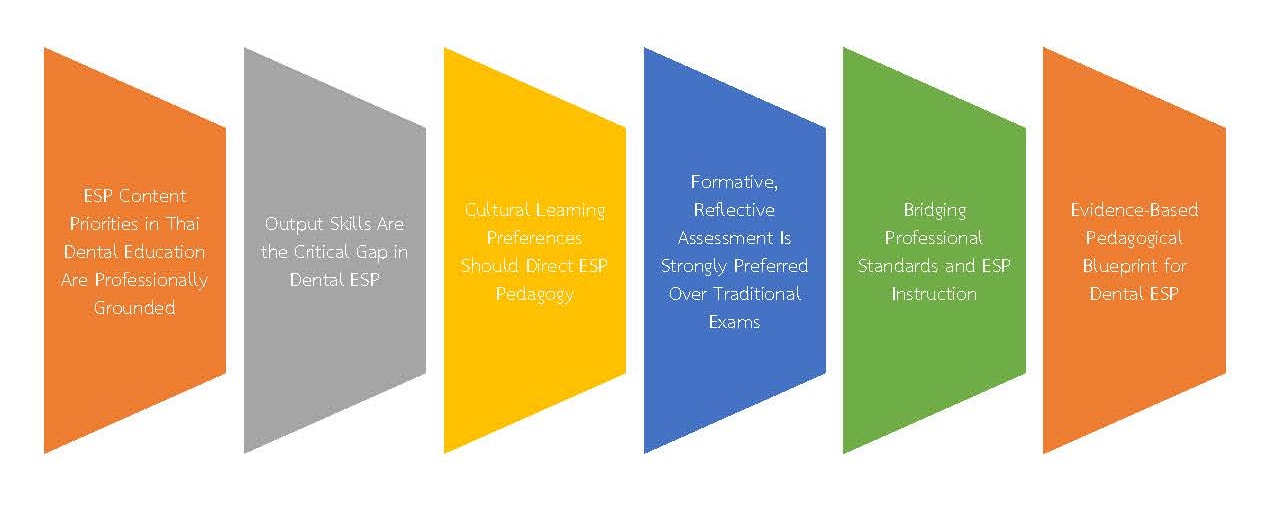
Results showed that students prioritised clinically relevant EDP content, particularly oral anatomy (M = 4.69, SD = 0.57), types of teeth and functions (M = 4.63, SD = 0.72), oral examinations and ethics (M = 4.61, SD = 0.61), and cross-cultural communication (M = 4.61, SD = 0.69). Writing skills presented the largest learning gap (PNIModified = 0.67), especially in clinical documentation (0.77), followed by speaking (0.56) and vocabulary (0.54). Students preferred formative and reflective assessment methods, favoring self-evaluation (M = 4.61) and peer assessment (M = 4.57) over formal testing (M = 4.41).
Downloads
Article Details

อนุญาตภายใต้เงื่อนไข Creative Commons Attribution-NonCommercial-NoDerivatives 4.0 International License.
เอกสารอ้างอิง
Anthony, L. (2018). Introducing English for specific purposes. Routledge.
Apridayani, P., & Thoch, G.I. (2023). Self-assessment in enhancing EFL writing performance and self-regulation. Asian-Pacific Journal of Second and Foreign Language Education, 8(1), 10-26.
Basturkmen, H. (2022). Developing courses in English for specific purposes (2nd ed.). Palgrave Macmillan.
Boonsuk, Y., & Ambele, E. (2021). Towards integrating lingua franca in Thai EFL: Insights from Thai tertiary learners. International Journal of Instruction, 14(3), 17–38.
Chung, S., Hsieh, P.-H., & Wu, S.-M. (2021). The effect of self-assessment on writing self-efficacy among EFL students. Language Learning Journal, 49(4), 512–530.
Cronbach, L.J. (1951). Coefficient alpha and the internal structure of tests. Psychometrika, 16, 297–334.
Department of Employment. (2025). Statistical yearbook Thailand for comprehensive historical labor and migration. [Online]. Retrieved from: https://www.nso.go.th/public/e-book/Statistical-Yearbook/SYB-2025/121/
Dudley-Evans, T., & St. John, M. (1998). Developments in ESP: A multi-disciplinary approach. Cambridge University Press.
Fuangtharnthip, P., Jaitui, K., Pachimsawat, P., Bhattarai, B., Manopatanakul, S., & Kasetsuwan, S. (2022). Cultural dimensions of dental students in a Thai university. Science, Engineering and Health Studies, 16, 1–9. https://li01.tci-thaijo.org/index.php/sehs
Hofstede, G. (2011). Dimensionalizing cultures: The Hofstede model in context. Online Readings in Psychology and Culture, 2(1), 1–26.
Hutchinson, T., & Waters, A. (1987). English for specific purposes: A learning-centred approach. Cambridge University Press.
Kasikorn Research Center. (2024). The number of foreign tourists travelling to Thailand continues to grow, reaching 9.37 million in the first quarter of 2024. [Online]. Retrieved from: https://www.kasikornresearch.com/en/analysis/k-social-media/Pages/Inter-Tourism-info62-FB-2024-04-11.aspx
Nakkampan, M.R.N. (2018). Needs analysis of the academic English language skills: A case study of dentists in Ayutthaya province of Thailand (Master’s thesis). Thammasat University.
Otngam, P. (2022). Needs in English skills of medical students at a university in central Thailand (Master’s thesis, Language Institute, Thammasat University).
Piamsai, C. (2017). An investigation of Thai learners’ needs of English language use for intensive English course development. Pasaa Paritat Journal, 32(1), 63–97.
Pitukwong, K., Boonbongkotrat, N., Phusri, N., & Phengsuai, P. (2023). Examining the efficacy of digital peer feedback systems in enhancing EFL students’ writing skills: An investigation of feedback quality and impact in online environments. Journal of Asian Language Teaching and Learning, 4(3), 11–24.
Ponciano, S.I., Jr. (2015). Building the ASEAN Economic Community: Progression and progress. In ASEAN@50 Volume 3: Integrative chapters. Economic Research Institute for ASEAN and East Asia (ERIA). [Online]. Retrieved from: https://www.eria.org/3.3.ASEAN_50_Vol_3_Integrative_Chapters_3.pdf
Prompan, J., & Piamsai, C. (2024). The effects of peer feedback and self-regulated learning on Thai EFL students’ writing ability and self-regulation. LEARN Journal: Language Education and Acquisition Research Network, 17(1), 100–132.
Rahman, M. (2015). English for specific purposes (ESP): A holistic review. Universal Journal of Educational Research, 3(1), 24–31.
Reeve, J., & Cheon, S.H. (2021). Autonomy-supportive teaching: Its malleability, benefits, and potential to improve educational practice. Educational Psychologist, 56(1), 54–77. https://doi.org/10.1080/00461520.2020.1862657
Robinson, P. (1991). ESP today: A practitioner’s guide. Prentice Hall.
Rongsaat, W. (1985). English for doctors. Chulalongkorn University Language Institute.
Supunya, N. (2023). A systematic review on ESP teachers: Current focus, collaboration, and sustainability. rEFLections, 30(2), 287–317.
Thai Dental Council. (2022). Dental education standards in Thailand. Thai Dental Council.
Watanapokakul, S., & Sitajalabhorn, W. (2023). A needs analysis for English as a foreign language instruction for Thai senior secondary school students with hearing impairment. rEFLections, 30(2), 428–467. https://doi.org/10.61508/refl.v30i2.267417
Wongwanich, S. (2019). Needs assessment research (4th ed.). Chulalongkorn University Press.
