
THE Professional Competence, and Work Motivation on the Job Performance Effectiveness of Accountants in Bangkok
Article Sidebar
Main Article Content
Abstract
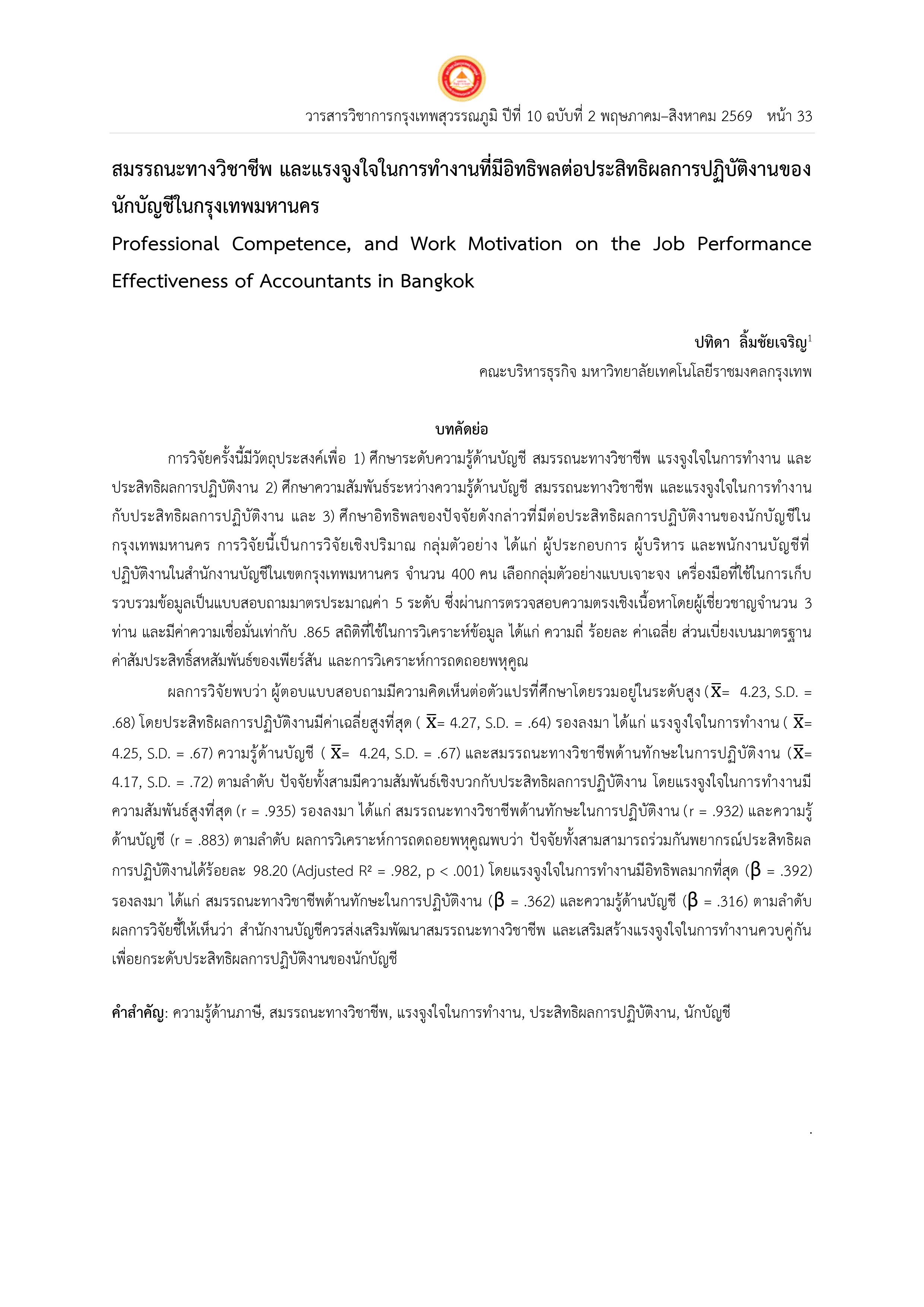
This study aimed to: (1) examine the levels of tax knowledge, professional competence, work motivation, and work performance effectiveness; (2) investigate the relationships between tax knowledge, professional competence, work motivation, and work performance effectiveness; and (3) examine the influence of these factors on the work performance effectiveness of accountants in Bangkok. This quantitative study involved 400 business owners, executives, and accounting personnel working in accounting firms in Bangkok, selected through purposive sampling. Data were collected using a five-point Likert-scale questionnaire. The instrument was reviewed for content validity by three experts and achieved a reliability coefficient of .865. The data were analyzed using frequency, percentage, mean, standard deviation, Pearson’s correlation coefficient, and multiple regression analysis.
The findings revealed that the overall score for the variables under investigation was high (M = 4.23, SD = .68). Work performance effectiveness had the highest mean score (M = 4.27, SD = .64), followed by work motivation (M = 4.25, SD = .67), tax knowledge (M = 4.24, SD = .67), and professional competence in work-related skills (M = 4.17, SD = .72), respectively. All three factors were positively correlated with work performance effectiveness. Work motivation demonstrated the strongest correlation (r = .935), followed by professional competence in work-related skills (r = .932) and tax knowledge (r = .883), respectively. The multiple regression analysis indicated that the three factors jointly explained 98.20% of the variance in work performance effectiveness (adjusted R² = .982, p < .001). Work motivation was the strongest predictor (β = .392), followed by professional competence in work-related skills (β = .362) and tax knowledge (β = .316), respectively. These findings suggest that accounting firms should simultaneously enhance accountants’ tax knowledge and professional competence while strengthening their work motivation to improve work performance effectiveness.
Article Details

This work is licensed under a Creative Commons Attribution-NonCommercial-NoDerivatives 4.0 International License.
This article is published under a Creative Commons Attribution-NonCommercial-NoDerivatives 4.0 International License (CC BY-NC-ND 4.0), which allows others to share the article with proper attribution to the authors and prohibits commercial use or modification. For any other reuse or republication, permission from the journal and the authors is required.References
Appelbaum, E., Bailey, T., Berg, P., Kalleberg, A. L., & Bailey, T. A. (2000). Manufacturing advantage: Why
high-performance work systems pay off (pp. 129-165). ILR Press: Ithaca, NY.
Becker, G. S. (1964). Human Capital: A Theoretical and Empirical Analysis, with Special Reference to
Education, by Gary S. Becker.. (Vol. 1). London.
Cerasoli, C. P., Nicklin, J. M., & Ford, M. T. (2014). Intrinsic motivation and extrinsic incentives jointly predict
performance: a 40-year meta-analysis. Psychological bulletin, 140(4), 980.
Gagné, M., & Deci, E. L. (2005). Self‐determination theory and work motivation. Journal of Organizational
behavior, 26(4), 331-362.
JAIKHAM, W. ., & Bosakoranut, S. (2025). Factors Influenced to Job Performance of Regional Revenue Office
Auditors in Bangkok Metropolis. Journal of MCU Phetchaburi Review, 8(3), 262–271. retrieved from
https://so03.tci-thaijo.org/index.php/JPR/article/view/292885
Kaveekhamkom, R., Tawanthiang, P., & Nukchop, P. (2020). สมรรถนะของผู้สอบบัญชีภาษีอากรที่ส่งผลต่อ
ประสิทธิภาพในการทำงาน. วารสารบริหารธุรกิจศรีนครินทรวิโรฒ: Srinakharinwirot Business
Journal, 11(1), 102–116. Retrieved from
https://ejournals.swu.ac.th/index.php/MBASBJ/article/view/13149
Koehorst, M. M., van Deursen, A. J., Van Dijk, J. A., & De Haan, J. (2021). A systematic literature review of
organizational factors influencing 21st-century skills. Sage Open, 11(4), 21582440211067251.
Podsakoff, P. M., MacKenzie, S. B., Lee, J. Y., & Podsakoff, N. P. (2003). Common method biases in behavioral
research: a critical review of the literature and recommended remedies. Journal of applied
psychology, 88(5), 879.
Ryan, R. M., & Deci, E. L. (2000). Self-determination theory and the facilitation of intrinsic motivation, social
development, and well-being. American psychologist, 55(1), 68.
Tuncdogan, A., Dogan, I. C., & Barca, M. (2023). The size of the fight in the dog: The role of teams’ active
human capital resources within the human capital-task performance relationship. Strategic
Organization, 21(2), 380-399.
