
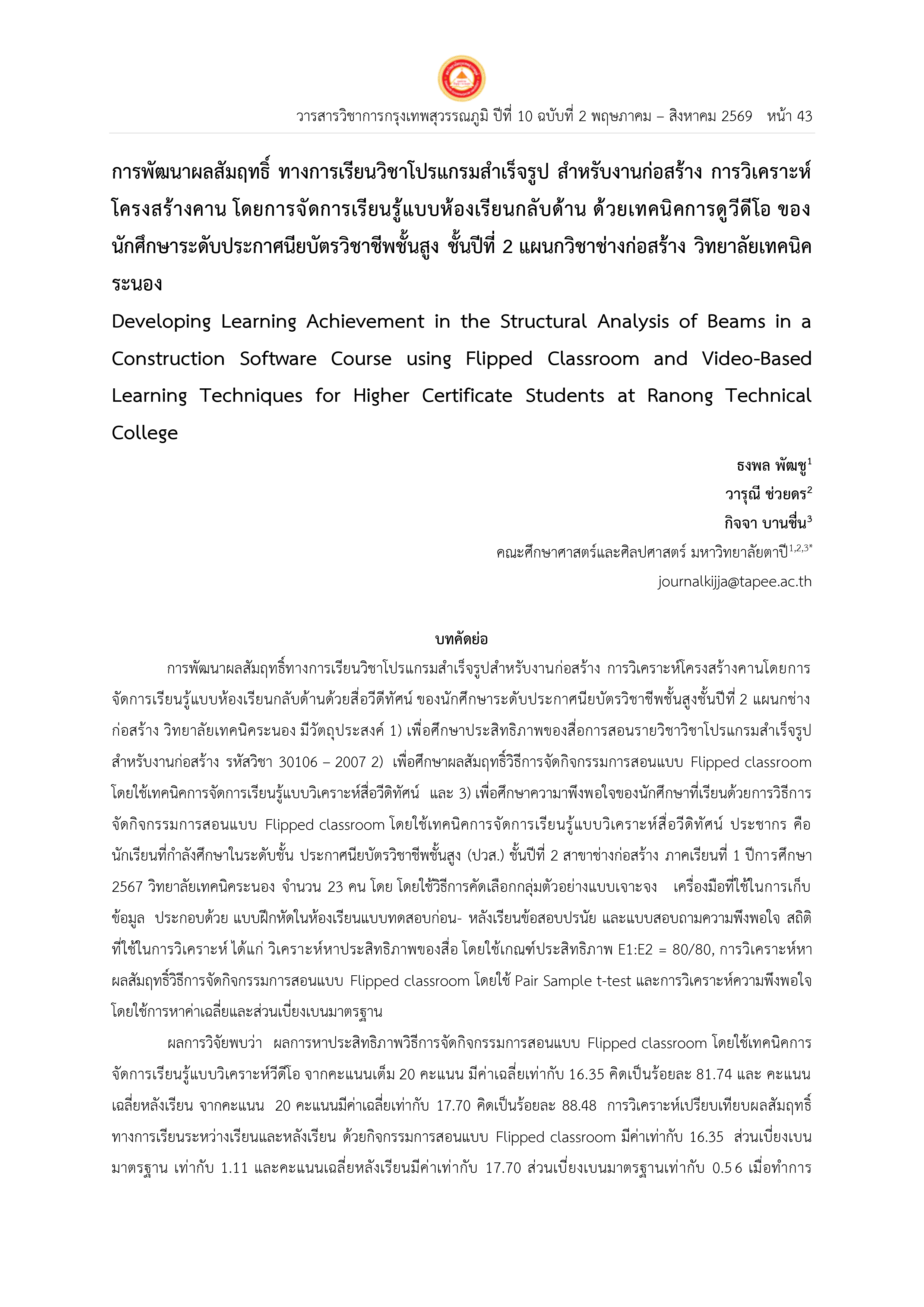
THE Developing Learning Achievement in the Structural Analysis of Beams in a Construction Software Course using Flipped Classroom and Video-Based Learning Techniques for Higher Certificate Students at Ranong Technical College
Article Sidebar
Main Article Content
Abstract
This study aimed to: (1) evaluate the efficiency of instructional media developed for the course Application Software for Construction (Course Code 30106–2007); (2) investigate the learning achievement of students through the Flipped Classroom instructional approach using video-based analytical learning techniques; and (3) examine students’ satisfaction with learning through the Flipped Classroom approach using video-based analytical learning techniques. The population consisted of 23 second-year Higher Vocational Certificate (Diploma) students in the Construction Technology Program enrolled in the first semester of the 2024 academic year at Ranong Technical College. The participants were selected using purposive sampling. The research instruments included classroom exercises, pre-test and post-test multiple-choice achievement tests, and a student satisfaction questionnaire. The data were analyzed using instructional media efficiency based on the E1/E2 criterion (80/80), a paired samples t-test to compare learning achievement before and after the intervention, and descriptive statistics, including mean and standard deviation, to analyze student satisfaction.
The findings revealed that the instructional media and Flipped Classroom learning activities achieved an efficiency score of 81.74/88.48, exceeding the predetermined criterion of 80/80. The average process score (E1) was 16.35 out of 20 points (81.74%), while the average post-learning score (E2) was 17.70 out of 20 points (88.48%). The comparison of learning achievement indicated that the mean pre-learning score was 16.35 (SD = 1.11), whereas the mean post-learning score was 17.70 (SD = 0.56). The paired samples t-test demonstrated that the post-learning achievement was significantly higher than the pre-learning achievement at the .05 level of statistical significance. Furthermore, students’ satisfaction with the Flipped Classroom learning approach using video-based analytical learning techniques was found to be at the highest level.
Keywords : Flipped Classroom, Video-Based Learning, Learning Achievement
Article Details

This work is licensed under a Creative Commons Attribution-NonCommercial-NoDerivatives 4.0 International License.
This article is published under a Creative Commons Attribution-NonCommercial-NoDerivatives 4.0 International License (CC BY-NC-ND 4.0), which allows others to share the article with proper attribution to the authors and prohibits commercial use or modification. For any other reuse or republication, permission from the journal and the authors is required.References
กิตติพงษ์พุ่มพวง, และคณะ. (2563). การศึกษารูปแบบการจัดการเรียนรู้แบบห้องเรียนกลับด้าน(Flipped Classroom)
ร่วมกับการใช้โปรแกรมสำเร็จรูปในรายวิชาการวิเคราะห์โครงสร้าง. รายงานการวิจัย.คณะศึกษาศาสตร์
มหาวิทยาลัยนเรศวร.
ทศพร ทศแสนสิน,(2558) ผลของการใช้ซอฟต์แวร์การจัดการห้องเรียนกลับด้าน ผ่านระบบปฏิบัติการแอนดรอยด์
(Android)บนแอปพลิเคชั่นอุปกรณ์แท็บเล็ตที่มีต่อความยึดมั่นผูกพันในการเรียน. สาขาวิชาสารสนเทศ
การแพทย์วิทยาลัยเทคโนโลยีสารสนเทศและการสื่อสารมหาวิทยาลัยรังสิต.
ธนพัฒน์ทองมา. (2565). ผลการจัดกิจกรรมการเรียนรู้แบบห้องเรียนกลับด้านโดยใช้วีดิทัศน์แบบมีปฏิสัมพันธ์บนเว็บที่มีต่อ
ผลสัมฤทธิ์ทางการเรียนเรื่องภาคตัดกรวย ของนักเรียนชั้นมัธยมศึกษาปีที่4 ที่มีระดับความสามารถทางการ
เรียนแตกต่างกัน. รายงานการวิจัยคณะครุศาสตร์จุฬาลงกรณ์มหาวิทยาลัย.
นครินทร์สุกใส. (2561). ผลการจัดการเรียนการสอนโดยใช้ห้องเรียนกลับด้านร่วมกับเกมมิฟิเคชันที่มีต่อความสามารถใน
การประยุกต์ความรู้ทางคอมพิวเตอร์ของนักเรียนมัธยมศึกษาตอนปลาย. ภาควิชาหลักสูตรและการสอน
คณะครุศาสตร์จุฬาลงกรณ์มหาวิทยาลัย.
นิตยา ดกกลาง. (2560). การพัฒนาบทเรียนคอมพิวเตอร์ช่วยสอน วิชาการออกแบบและพัฒนาโปรแกรมระดับ
ประกาศนียบัตรวิชาชีพชั้นสูงโดยใช้วิธีการสอนแบบห้องเรียนกลับด้าน. สาขาวิชา เทคโนโลยีคอมพิวเตอร์
ภาควิชาคอมพิวเตอร์ศึกษาบัณฑิตวิทยาลัยมหาวิทยาลัยเทคโนโลยีพระ จอมเกล้าพระนครเหนือ.
เบญจพร สุคนธร. (2561). แนวทางการใช้ห้องเรียนกลับด้านในการเรียนการสอนวิชาเคมีสำหรับนักเรียนมัธยมศึกษาตอน
ปลายที่มีผลสัมฤทธิ์ทางการเรียนต่ำภาควิชาหลักสูตรและการสอน คณะครุศาสตร์จุฬาลงกรณ์
มหาวิทยาลัย.
ภาณุวัฒน์สงแสง. (2563). การพัฒนาผลสัมฤทธิ์ทางการเรียนและการคิดวิเคราะห์โดยใช้การจัดการเรียนรู้แบบห้องเรียน
กลับด้านร่วมกับการวิเคราะห์วิดีโอ. [วิทยานิพนธ์ปริญญามหาบัณฑิตไม่ได้ตีพิมพ์].มหาวิทยาลัยทักษิณ.
รักถิ่นเหลาหา และ กิตติพงษ์ชินสุข.(2561). การพัฒนารูปแบบการเรียนรู้แบบห้องเรียนกลับทาง โดยใช้ทฤษฎีการ
เชื่อมโยง การเรียนรู้ร่วมกับห้องเรียนเสมือนจริงเพื่อพัฒนาทักษะการคิดอย่างมีวิจารณญาณสำ หรับ
นักศึกษาในระดับอุดมศึกษา. มหาวิทยาลัยราชภัฏมหาสารคาม.
วรท บุญสิงห์,ประสิทธิ์ประมงอุดมรัตน์,ศักดา กัตเวทวารักษ์และฆนากานต์มาศโอสถ. (2566). การจัดการเรียนการสอน
แบบห้องเรียนกลับด้านร่วมกับการเรียนแบบร่วมมือและแบบโครงงานในการวิเคราะห์โครงสร้างด้วยวิธีการ
กระจายโมเมนต์ภาควิชาครุศาสตร์โยธา. คณะครุศาสตร์อุตสาหกรรม มหาวิทยาลัยเทคโนโลยีพระจอมเกล้า
พระนครเหนือจ.กรุงเทพมหานคร.
Bergmann, J., & Sams, A. (2012). Flip your classroom: Reach every student in every class every day.
International Society for Technology in Education.
