
THE The Integration of Generative AI Technology with Buddhist Principles Learning for Lower Secondary School Students
Article Sidebar
Main Article Content
Abstract
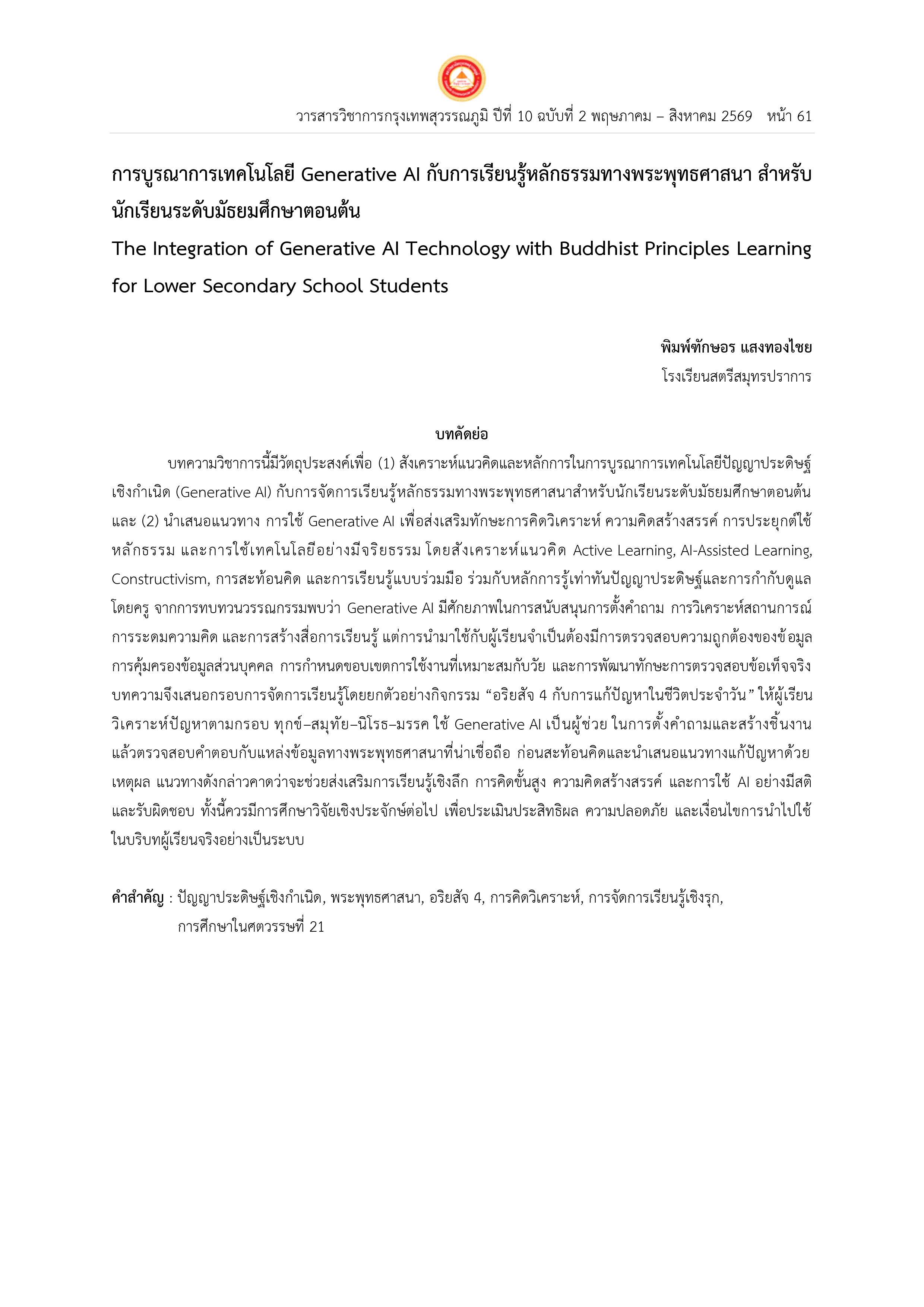
This academic article aims to study the integration of Generative AI technology with the learning management of Buddhist principles in order to develop analytical thinking and creative thinking skills among lower secondary school students in the context of 21st-century learning. The approach emphasizes enabling learners to engage in deep learning, think rationally, and appropriately apply Buddhist principles in their daily lives within a digital society where artificial intelligence technology plays an increasingly significant role in modern education. The learning management approach employed Active Learning in combination with AI-Assisted Learning and the Constructivist approach. Generative AI technologies, such as ChatGPT and digital media creation tools, were utilized as supportive learning tools in the Social Studies, Religion, and Culture subject, particularly in the topic of Buddhist principles for Grade 7 students. Learning activities were designed to provide students with opportunities to search for information, pose analytical questions, discuss moral issues, create creative works, and reflect on their own learning. Examples of activities included creating illustrations of Buddhist principles, Dhamma posters, digital storytelling related to Buddhist teachings, and Buddhist-themed songs. The activities emphasized ethical technology use and digital media literacy.
The findings revealed that integrating Generative AI technology into the learning of Buddhist principles significantly enhanced students’ analytical thinking skills. Students were able to connect Buddhist teachings with real-life situations more reasonably, express their opinions confidently, and demonstrate greater creativity in producing moral and ethical works. Furthermore, the integration increased students’ motivation and interest in learning, as they actively participated in classroom activities and learned through technologies relevant to their daily lives. In addition, teachers were able to develop modern and effective learning innovations suitable for learners in the digital era. Therefore, the integration of Generative AI technology into the learning of Buddhist principles serves as an important approach to developing learners’ knowledge, morality, higher-order thinking skills, and the ability to use technology creatively and ethically. This ultimately contributes to the sustainable development of learners’ quality in accordance with 21st-century education.
Article Details

This work is licensed under a Creative Commons Attribution-NonCommercial-NoDerivatives 4.0 International License.
This article is published under a Creative Commons Attribution-NonCommercial-NoDerivatives 4.0 International License (CC BY-NC-ND 4.0), which allows others to share the article with proper attribution to the authors and prohibits commercial use or modification. For any other reuse or republication, permission from the journal and the authors is required.References
Bloom, B. S. (1956). Taxonomy of educational objectives: The classification of educational goals.
Longmans, Green and Company.
Bonwell, C. C., & Eison, J. A. (1991). Active learning: Creating excitement in the classroom. George
Washington University.
Chan, C. K. Y., & Hu, W. (2023). Students’ voices on generative AI: Perceptions, benefits, and challenges in
higher education. International Journal of Educational Technology in Higher Education, 20, 43.
https://doi.org/10.1186/s41239-023-00411-8
Kasneci, E., Sessler, K., Küchemann, S., Bannert, M., Dementieva, D., Fischer, F., Gasser, U., Groh, G.,
Günnemann, S., Hüllermeier, E., Krusche, S., Kutyniok, G., Michaeli, T., Nerdel, C., Pfeffer, J., Poquet,
O., Sailer, M., Schmidt, A., Seidel, T., Stadler, M., Weller, J., Kuhn, J., & Kasneci, G. (2023). ChatGPT
for good? On opportunities and challenges of large language models for education. Learning and
Individual Differences, 103, 102274. https://doi.org/10.1016/j.lindif.2023.102274
Piaget, J., & Inhelder, B. (1972). The psychology of the child. Basic Books.
Tlili, A., Shehata, B., Adarkwah, M. A., Bozkurt, A., Hickey, D. T., Huang, R., & Agyemang, B. (2023). What if the
devil is my guardian angel: ChatGPT as a case study of using chatbots in education. Smart Learning
Environments, 10, 15. https://doi.org/10.1186/s40561-023-00237-x
UNESCO. (2023). Guidance for generative AI in education and research. UNESCO.
Vygotsky, L. S. (1978). Mind in society: The development of higher psychological processes. Harvard
University Press.
กระทรวงศึกษาธิการ. (2551). หลักสูตรแกนกลางการศึกษาขั้นพื้นฐาน พุทธศักราช 2551. กระทรวงศึกษาธิการ.
ทิศนา แขมมณี.(2564). ศาสตร์การสอน: องค์ความรู้เพื่อการจัดกระบวนการเรียนรู้ที่มีประสิทธิภาพ. (พิมพ์ครั้งที่25).
สำนักพิมพ์แห่งจุฬาลงกรณ์มหาวิทยาลัย.
