
A A PERFORMANCE APPRAISAL OF TEACHERS AND SCHOOL ADMINISTRATORS UNDER KHON KAEN PROVINCIAL ADMINISTRATIVE ORGANIZATION
Article Sidebar
Main Article Content
Abstract
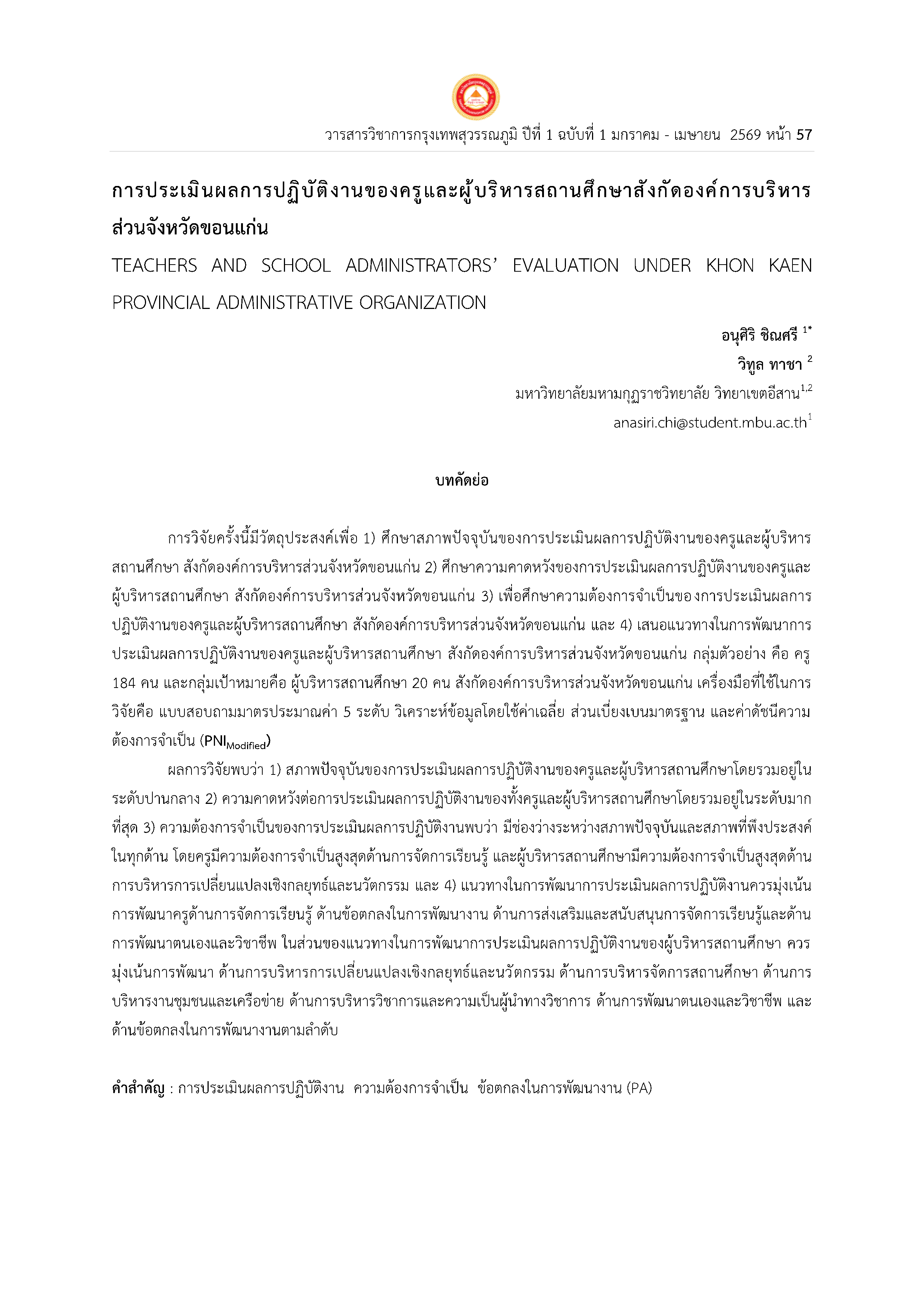
This research aimed to 1) examine the current state of performance evaluation of teachers and school administrators under Khon Kaen Provincial Administrative Organization; 2) investigate the desirable expectations for performance evaluation of teachers and school administrators under Khon Kaen Provincial Administrative Organization; 3) determine the needs assessment for desirable performance evaluation of teachers and school administrators under Khon Kaen Provincial Administrative Organization; and 4) propose guidelines for developing performance evaluation of teachers and school administrators under Khon Kaen Provincial Administrative Organization. The sample consisted of 184 teachers, while the target group comprised 20 school administrators under Khon Kaen Provincial Administrative Organization. The research instrument was a five-level rating scale questionnaire. Data were analyzed using mean, standard deviation, and the Modified Priority Needs Index (PNI Modified).
The research findings revealed that the current state of performance evaluation of teachers and school administrators was, overall, at a high level, whereas the desirable conditions were rated at a high to highest level. This resulted in a gap between the current and desirable conditions across all dimensions. The overall Modified Priority Needs Index for teachers was 0.358, and for school administrators was 0.439, reflecting an urgent need for development — particularly in the areas of learning management, performance agreement (PA) development, and learning support promotion for teachers, as well as strategic change management and innovation, school administration, and self and professional development for school administrators.
The proposed guidelines for developing performance evaluation of teachers and school administrators should emphasize enhancing learning management competency through the use of information and assessment results to improve instruction, systematically implementing performance agreements (PA), promoting data utilization for learner development, and establishing educational collaborative networks. For school administrators, the focus should be placed on developing transformational leadership, integrating innovation and digital technology into administration, strengthening student care and support systems, and pursuing continuous self-development.
Article Details

This work is licensed under a Creative Commons Attribution-NonCommercial-NoDerivatives 4.0 International License.
This article is published under a Creative Commons Attribution-NonCommercial-NoDerivatives 4.0 International License (CC BY-NC-ND 4.0), which allows others to share the article with proper attribution to the authors and prohibits commercial use or modification. For any other reuse or republication, permission from the journal and the authors is required.References
กระทรวงศึกษาธิการ. (2564). นโยบายและจุดเน้นของกระทรวงศึกษาธิการ ประจำปีงบประมาณ พ.ศ. 2566. กรุงเทพฯ: กระทรวงศึกษาธิการ.พระราชบัญญัติการศึกษาแห่งชาติ. สืบค้นเมื่อ 1 ตุลาคม 2567, จาก https://www.moe.go.th/moe/nipa/ed_law/p.r.g.edu1.pdf.
ชุติมา แสงสุวรรณ และ สมชาย ใจดี. (2565). ความท้าทายในการนำนโยบายการประเมินผลการปฏิบัติงานครูแนวใหม่ไปสู่ การปฏิบัติในประเทศไทย. วารสารบริหารการศึกษา, 15(2), 45–60.
ทิพกัญญา ไชยปัญหา, วาโร เพ็งสวัสดิ์, & อภิสิทธิ์ สมศรีสุข. (2567). การประเมินความต้องกาจำเป็นและแนวทางการพัฒนา
ภาวะผู้นำครูในโรงเรียน (ตามระบบ วPA) สังกัดสำนักงานเขตพื้นที่การศึกษาประถมศึกษานครพนม เขต 2 วารสารวิชาการและวิจัย มหาวิทยาลัยภาคตะวันออกเฉียงเหนือ, 14(1), 13–27. สืบค้นเมื่อ 1 ตุลาคม 2567, จาก https://so04.tciithaijo.org/index.php/neuarj/article/view/266731.
นรรัชต์ ฝันเชียร. (2564). การประเมิน PA คืออะไร และนำมาใช้อย่างไรกับการประเมินข้าราชการครู. สืบค้นเมื่อ 1 ตุลาคม
, จาก https://www.trueplookpanya.com/dhamma/content/90337.
เพ็ญพิชชา ใจยอด, & ธีรศักดิ์ อุปไมยอธิชัย. (2565). การศึกษาความต้องการจำเป็นในการส่งเสริมการจัดทำข้อตกลงในการ
พัฒนางานตำแหน่งครูสังกัดสำนักงานเขตพื้นที่การศึกษมัธยมศึกษาตาก. สาขาวิชาการบริหารการศึกษา มหาวิทยาลัยนเรศวร. สืบค้นเมื่อ 1 กรกฎาคม 2568 จาก https://shorturl.at/uMnYI.
พระราชบัญญัติการศึกษาแห่งชาติ. (2542). ราชกิจจานุเบกษา. สืบค้นเมื่อ 1 ตุลาคม 2567, จาก
https://www.moe.go.th/moe/nipa/ed_law/p.r.g.edu1.pdf.
รัฐธรรมนูญแห่งราชอาณาจักรไทย. (2560). ราชกิจจานุเบกษา, เล่ม 134 ตอนที่ 40 ก.
วิโรจน์ สารรัตนะ. (2567). แนวโน้มสากลในการประเมินครู: แนวทางเพื่อการพัฒนา. กรุงเทพฯ: สำนักพิมพ์แห่งจุฬาลงกรณ์
มหาวิทยาลัย.
สถาบันพัฒนาครู. (2563). คู่มือการพัฒนาครูตามมาตรฐานวิชาชีพครู. กรุงเทพฯ.
สำนักงานคณะกรรมการข้าราชการครูและบุคลากรทางการศึกษา. (2564). หลักเกณฑ์และวิธีการประเมินตำแหน่งและวิทยฐานะข้าราชการครูและบุคลากรทางการศึกษา ตำแหน่งครู. สำนักงาน ก.ค.ศ.
สำนักงานคณะกรรมการข้าราชการครูและบุคลากรทางการศึกษา. (2565). หลักเกณฑ์และวิธีการประเมินตำแหน่งและวิทย ฐานะข้าราชการครูและบุคลากรทางการศึกษา ตำแหน่งครู. สืบค้นเมื่อ 13 ตุลาคม 2567, จาก https://otepc.go.th/th/content_page/item/3368-9-2565.html.
สำนักงานคณะกรรมการข้าราชการครูและบุคลากรทางการศึกษา. (2566). รายงานผลการสำรวจระบบการประเมินวิทยฐานะ แบบข้อตกลงพัฒนางาน (วPA). สืบค้นเมื่อ 14 ตุลาคม 2567,
จาก https://www.otepc.go.th/th/content_page/item/4575-1437-2566.html.
สุวดี ฐามูล. (2565). ความต้องการและแนวทางการพัฒนามาตรฐานตำแหน่งครูด้านการจัดการเรียนรู้ตามหลักเกณฑ์ PA สังกัดสำนักงานเขตพื้นที่การศึกษาประถมศึกษาพิจิตร เขต 2. สืบค้นเมื่อ 14 ตุลาคม 2567 จาก https://nuir.lib.nu.ac.th/dspace/bitstream/123456789/5672/3/SuwadeeThamoon.pdf.
สุวิมล ว่องวาณิช. (2558). การวิจัยประเมินความต้องการจำเป็น. กรุงเทพฯ: สำนักพิมพ์แห่งจุฬาลงกรณ์มหาวิทยาลัย.
องค์การบริหารส่วนจังหวัดขอนแก่น. (2567). ประวัติสำนักการศึกษา ศาสนาและวัฒนธรรม องค์การบริหารส่วนจังหวัด ขอนแก่น. สืบค้นเมื่อ 14 ตุลาคม 2567 จาก http://edukkpao.go.th.
องค์การเพื่อความร่วมมือและการพัฒนาทางเศรษฐกิจ (OECD). (2564). ผลการสำรวจการสอนและการเรียนรู้ระหว่าง ประเทศ (TALIS): ฉบับสรุปสำหรับผู้บริหาร. สถาบันส่งเสริมการสอนวิทยาศาสตร์และเทคโนโลยี.
Alkaabi, A. M., & Abdallah, A. K. (2024). Portfolio practices in the principal evaluation process: A qualitative case study.Heliyon,10(21), e39467.Retrieved from https://doi.org/10.1016/j.heliyon.2024.e39467.
Christensen, T., & Lægreid, P. (2020). Performance management in practice: Performance, transparency and learning. Financial Accountability & Management, 22(3), 251–270. Retrieved from https://doi.org/10.1111/j.0267- 4424.2006.00402.x.
Grissom, J. A., Egalite, A. J., & Lindsay, C. A. (2021). How principals affect students and schools: A systematic synthesis of two decades of research. Wallace Foundation. Retrieved from
https://www.wallacefoundation.org/publications.
Leevarangkul, D. (2023). Enhancement process of performance agreement abilities by using principles of assessment for learning and profession. Journal of Humanities and Social Sciences, Rajapruk University, 9(3), 36–51. Retrieved from
https://so03.tcithaijo.org/index.php/rpu/article/view/274229.
OECD. (2021). Teaching as a knowledge profession: The OECD Teaching and Learning International Survey
(TALIS) insights. OECD Publishing. Retrieved from https://doi.org/10.1787/talis-2021-en.
Pimpa, N. (2005). Teacher performance appraisal in Thailand: Poison or panacea? Journal of Educational Administration, 43(2), 118–135.
S. Jessica. (2019). Need assessment. สืบค้นเมื่อ 1 ตุลาคม 2567 Retrieved from
https://aifs.gov.au/resources/practice-guides/needs-assessment
Smith, W. C., & Holloway, J. (2020). School testing culture and teacher satisfaction. Educational Assessment, Evaluation and Accountability, 32(3), 461–479. Retrieved from https://doi.org/10.1007/s11092-020-09342-8.
UNESCO. (2021). Synthetic review of evaluations: Evaluation of teacher development and related programmes. UNESCO Publishing. Retrieved from https://unesdoc.unesco.org.
Witkin, E. W., & Altschuld, J. H. (1995). Planning and conducting needs assessments: Results-driven decisions. Sage Publications.
Worth, J., & Van den Brande, J. (2020). Teacher satisfaction and test-based accountability: Examining the role of testing culture and student test scores in teacher appraisals. Educational Assessment, Evaluation and Accountability, 32(1), 87–109. Retrieved from https://doi.org/10.1007/s11092-020-09325-4.
