DIGITAL SEMANTIC STABILIZATION IN AI - MEDIATED ENGLISH LEARNING: IMPLICATIONS FOR HIGHER EDUCATION
คำสำคัญ:
Digital Semantic Stabilization, AI - Mediated English Learning, English Learningบทคัดย่อ
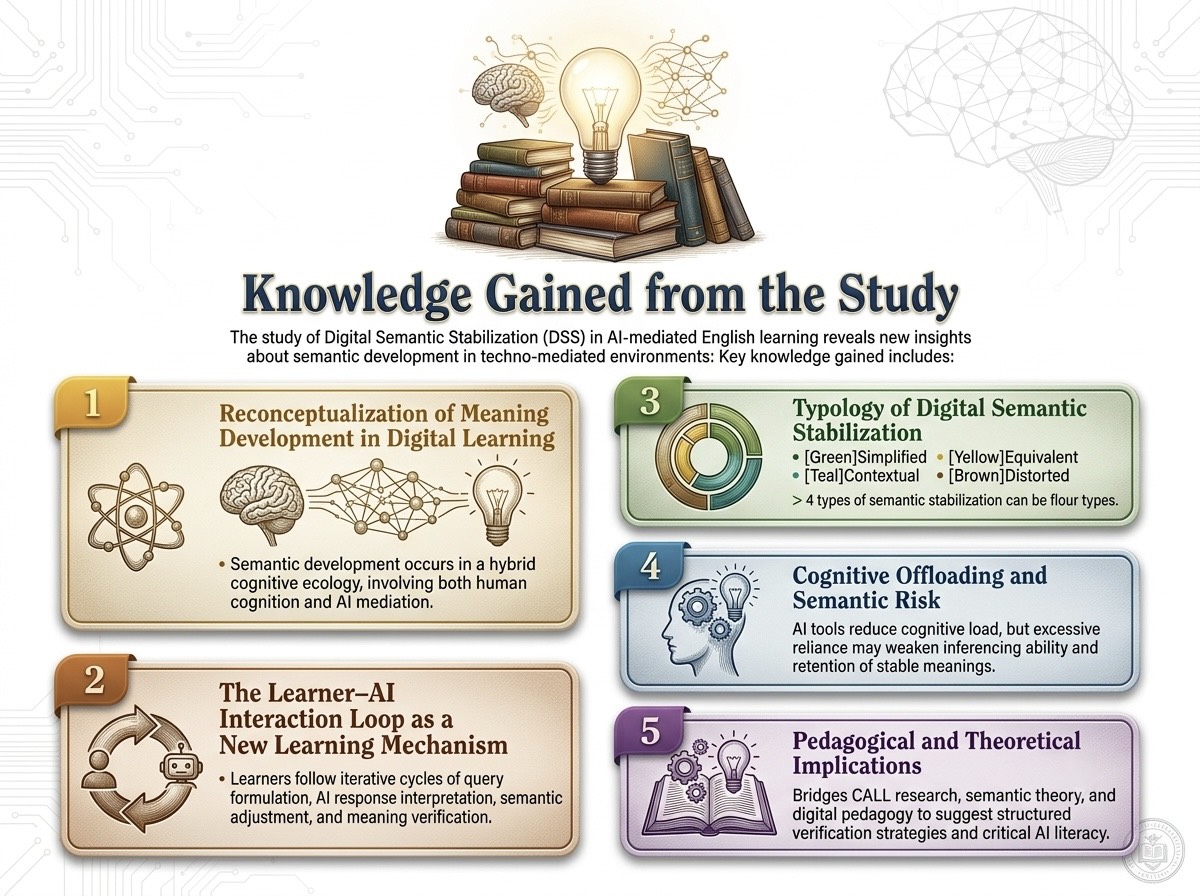
This paper examines how semantic meaning is constructed and stabilized in AI - mediated English learning environments. As artificial intelligence increasingly functions as a learning agent in language education, understanding the underlying cognitive and linguistic mechanisms of meaning development has become essential. However, existing studies have largely focused on performance outcomes and technology adoption, leaving the processes of semantic construction underexplored. To address this gap, this paper proposes the concept of Digital Semantic Stabilization (DSS) as a theoretical framework for explaining how learners construct, negotiate, and stabilize meaning through interaction with AI systems. The framework conceptualizes meaning development as a dynamic process shaped by iterative cycles of inquiry, AI - generated feedback, verification, and consolidation within a learner - AI interaction loop.
The DSS model identifies four possible patterns of semantic stabilization: simplified, equivalent, contextual, and distorted stabilization. These patterns reflect varying levels of cognitive engagement and semantic accuracy in AI - mediated English learning. While AI enhances accessibility, autonomy, and linguistic support, it also introduces risks related to cognitive offloading and superficial understanding. This paper contributes to applied linguistics and digital pedagogy by offering a new perspective on semantic development in AI - mediated learning and by highlighting the importance of critical AI literacy and structured meaning verification in contemporary English education.
Downloads
เอกสารอ้างอิง
Chen, M. R. A. (2024). The AI Chatbot Interaction for Semantic Learning: A Collaborative Note - Taking Approach with EFL Students. Language Learning & Technology, 28(1), 1 - 25. https://www.lltjournal.org/item/10125-73586/
Godwin Jones, R. (2022). Emerging Technologies: Intelligent Language Tutoring Systems and AI - Mediated Language Learning. Language Learning & Technology, 26(2), 5 - 17. https://www.researchgate.net/publication/394699192_Partnering_with_AI_Intelligent_writing_assistance_and_instructed_language_learning
Jarvis, S., & Pavlenko, A. (2021). Crosslinguistic Influence in Language and cognition (2nd ed.). Routledge.
Kohnke, L., Moorhouse, B. L., & Zou, D. (2023). ChatGPT for Language Teaching and Learning. RELC Journal, 54(2), 537 - 550. https://www.researchgate.net/publication/369743021_ChatGPT_for_Language_Teaching_and_Learning
Nizzolino, S. (2024). Artificial Intelligence in Language Teaching: Using ChatGPT to Assist Teachers of English as a Foreign Language. Form@re - Open Journal per la Formazione in Rete, 24(1), 242 - 261. https://www.researchgate.net/publication/383449993_Artificial_Intelligence_in_Language_Teaching_Using_ChatGPT_to_assist_teachers_of_English_as_a_Foreign_Language
Li, T. (2024). The investigation related to the Role of ChatGPT in English language teaching. Proceedings of the 1st International Conference on Data Science and Engineering (ICDSE 2024) (pp. 429 - 433). SciTePress. https://doi.org/10.5220/0012807900004547
Ranalli, J., Link, S., & Chukharev-Hudilainen, E. (2021). Automated Writing Evaluation for Formative Assessment of Second Language Writing. Language Teaching Research, 25(4), 620 - 643. https://www.researchgate.net/publication/292782878_Automated_writing_evaluation_for_formative_assessment_of_second_language_writing_investigating_the_accuracy_and_usefulness_of_feedback_as_part_of_argument-based_validation
Risko, E. F., & Gilbert, S. J. (2021). Cognitive Offloading. Trends in Cognitive Sciences, 25(9), 737 - 748. https://www.researchgate.net/publication/306352756_Cognitive_Offloading
Saarela, M., Samarasinghe Gunasekara, S. V. & Kumarage, P. M. (2026). A Meta - Analysis of Generative AI Effects on Learning Performance and Perception. Humanities and Social Sciences Communications, 13(1), 1 - 12. https://www.researchgate.net/publication/401167083_A_meta-analysis_of_generative_AI_effects_on_language_proficiency_and_affective-cognitive_outcomes_in_language_learning
Torres, P. J., & Kahveci, Y. E. (2025). Effectiveness of Artificial Intelligence in Language Teaching: A Multilevel Meta-Analysis. Computers and Education: Artificial Intelligence, 6, 100522. https://www.researchgate.net/publication/398197960_Effectiveness_of_Artificial_Intelligence_AI_in_Language_Teaching
Tsai, S. C. (2022). Using Google Translate in EFL Contexts: Implications for Reading Comprehension and Learner Cognition. Computer Assisted Language Learning, 35(1 - 2), 67 - 90. https://www.researchgate.net/publication/331099165_Using_google_translate_in_EFL_drafts_a_preliminary_investigation
Webb, S. (2020). Incidental Vocabulary Learning Through Reading and Listening. Annual Review of Applied Linguistics, 40, 102 - 120. https://www.researchgate.net/publication/377955870_Incidental_vocabulary_learning_from_listening_reading_and_viewing_captioned_videos_frequency_and_prior_vocabulary_knowledge
Gonzalez Lloret, M. & Ziegler, N. (2022). Technology - Mediated Task - Based Interaction and Negotiation of Meaning. Language Teaching Research, 26(1), 45 - 65. https://www.researchgate.net/publication/367165192_Technology-Mediated_Task-Based_Language_Teaching
ดาวน์โหลด
เผยแพร่แล้ว
รูปแบบการอ้างอิง
ฉบับ
ประเภทบทความ
สัญญาอนุญาต
ลิขสิทธิ์ (c) 2026 วารสารพุทธนวัตกรรมการศึกษา

อนุญาตภายใต้เงื่อนไข Creative Commons Attribution-NonCommercial-NoDerivatives 4.0 International License.
บทความนี้ได้รับการเผยแพร่ภายใต้สัญญาอนุญาต Creative Commons Attribution-NonCommercial-NoDerivatives 4.0 International (CC BY-NC-ND 4.0) ซึ่งอนุญาตให้ผู้อื่นสามารถแชร์บทความได้โดยให้เครดิตผู้เขียนและห้ามนำไปใช้เพื่อการค้าหรือดัดแปลง หากต้องการใช้งานซ้ำในลักษณะอื่น ๆ หรือการเผยแพร่ซ้ำ จำเป็นต้องได้รับอนุญาตจากวารสาร