
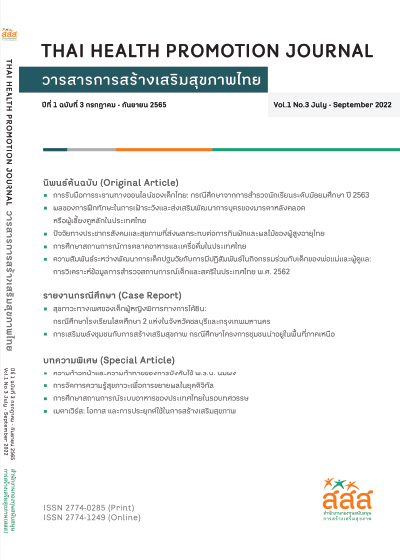
ความสัมพันธ์ระหว่างพัฒนาการเด็กปฐมวัยกับการมีปฏิสัมพันธ์ในกิจกรรมร่วมกับเด็กของพ่อแม่และผู้ดูแล: การวิเคราะห์ข้อมูลการสำารวจสถานการณ์เด็กและสตรีใน ประเทศไทย พ.ศ. 2562
บทคัดย่อ
ฐิติกร โตโพธิ์ไทย
สำนักงานพัฒนานโยบายสุขภาพระหว่างประเทศ กระทรวงสาธารณสุข จังหวัดนนทบุรี
ชมพูนุท โตโพธิ์ไทย
สำนักงานพัฒนานโยบายสุขภาพระหว่างประเทศ กระทรวงสาธารณสุข จังหวัดนนทบุรี
บทคัดย่อ
ช่วงขวบวัยตอนต้นของชีวิตส่งผลสำคัญต่อพัฒนาการในอนาคตของเด็ก พ่อแม่และผู้ดูแลสามารถช่วยให้เด็กเติบโตได้เต็มศักยภาพผ่านการมีปฏิสัมพันธ์ในกิจกรรมการเล่นกับเด็ก อย่างไรก็ตามการศึกษาในด้านความสัมพันธ์ระหว่างการมีปฏิสัมพันธ์ในกิจกรรมร่วมกับเด็กของผู้ใหญ่ในครอบครัวกับพัฒนาการเด็กยังมีจำกัด การศึกษานี้ มีวัตถุประสงค์เพื่อค้นหาระดับการมีปฏิสัมพันธ์ในกิจกรรมร่วมกับเด็กของพ่อแม่และบุคคลอื่นในครอบครัว และความสัมพันธ์ระหว่างการมีปฏิสัมพันธ์ดังกล่าวกับพัฒนาการสมวัยของเด็กปฐมวัยไทยอายุสามถึงสี่ปี ระเบียบวิธีวิจัยเป็นการศึกษาภาคตัดขวางโดยใช้ข้อมูลจากการสำรวจสถานการณ์เด็กและสตรีในประเทศไทย พ.ศ. 2562 การสำรวจใช้วิธีสัมภาษณ์แม่หรือผู้ปกครองเด็กปฐมวัยอายุ 3 ถึง 4 ปี จำนวน 5,787 คน ผลการศึกษาพบว่าเด็กปฐมวัยมีปฏิสัมพันธ์ในกิจกรรมการเล่นอย่างน้อย 4 กิจกรรมร่วมกับพ่อน้อยที่สุด (ร้อยละ 31) รองลงมาคือปฏิสัมพันธ์กับบุคคลในครอบครัว (ร้อยละ 53) และแม่ (ร้อยละ 58) นอกจากนี้การมีปฏิสัมพันธ์ในกิจกรรมการเล่นอย่างน้อย 4 กิจกรรมร่วมกับพ่อ ส่งผลต่อการมีพัฒนาการสมวัยสูงที่สุด จากการวิเคราะห์ถดถอยเอกนาม (crude odds ratio = 1.50, 95% confidence interval 1.19-1.87, p<0.001) ในขณะที่การมีปฏิสัมพันธ์ในกิจกรรมการเล่นอย่างน้อย 4 กิจกรรมร่วมกับบุคคลอื่นในครอบครัว ส่งผลต่อการมีพัฒนาการสมวัยสูงที่สุด จากการวิเคราะห์ถดถอยพหุนาม (adjusted odds ratio = 1.50, 95% confidence interval 1.19-1.87, p<0.001) การศึกษานี้แสดงให้เห็นว่าการมีปฏิสัมพันธ์ในกิจกรรมร่วมกับเด็กของพ่อแม่และบุคคลอื่นในครอบครัวมีระดับต่ำ โดยเฉพาะการปฏิสัมพันธ์ร่วมกับพ่อ ทั้งที่พบว่าส่งผลดีต่อพัฒนาการด้านสติปัญญา การศึกษานี้ยังแสดงความสัมพันธ์ระหว่างการมีปฏิสัมพันธ์ในกิจกรรมของผู้ใหญ่ ไม่ว่าจะเป็นพ่อแม่หรือบุคคลในครอบครัว กับพัฒนาการสมวัยของเด็ก การศึกษานี้มีข้อเสนอแนะ คือ ควรมีนโยบายและการสนับสนุนการมีปฏิสัมพันธ์ของผู้ใหญ่กับเด็กปฐมวัย
คำสำคัญ: เด็กปฐมวัย; พัฒนาการ; สติปัญญา; ผู้ปกครอง; ปฏิสััมพัันธ์์; ประเทศไทย MICS
เอกสารอ้างอิง
Black MM, Trude ACB. Conceptualizations of child development benefit from inclusion of the nurturing careframework. J Nutr 2019;149(8):1307-8.
Black MM, Walker SP, Fernald LCH, Andersen CT, DiGirolamo AM, Lu C, et al. Early childhood development coming of age: science through the life course. Lancet 2017;389(10064):77-90.
Shonkoff JP. Science, policy, and practice: three cultures in search of a shared mission. Child Dev 2000;71(1):181-7.
Chan M, Lake A, Hansen K. The early years: silent emergency or unique opportunity? Lancet 2017;389(10064):11-3.
Grantham-McGregor S, International Child Development Committee. Early child development in developing countries. Lancet 2007;369(9564):824.
United Nations Children’s Fund. The development status of children varies widely among countries New York: United Nations Children’s Fund [Internet]. 2022 [cited 2022 April 28]. Available from: https://data.unicef.org/topic/early-childhood-development/development-status/
Cabrera NJ, Roggman L. Father Play: is it special? Infant Ment Health J 2017;38(6):706-8.
Milteer RM, Ginsburg KR, Council on Communications and Media, Committee on Psychosocial Aspects of Child and Family Health. The importance of play in promoting healthy child development and maintaining strong parent-child bond: focus on children in poverty. Pediatrics 2012;129(1):e204-13.
Wright LG. The Mommy and Me Play Program: a pilot play intervention for low-income, African American preschool families. J Evid Inf Soc Work 2015;12(4):349-68.
Ginsburg KR, American Academy of Pediatrics Committee On Communications, American Academy of Pediatrics Committee on Psychosocial Aspects of Child and Family Health. The Importance of Play in Promoting Healthy Child Development and Maintaining Strong Parent-Child Bonds. American Academy of Pediatrics 2007;119(1):182-91.
Scott HK, Cogburn M. Peer play. Treasure Island, FL. StatPearls Publishing; 2021.
United Nations Children’s Fund. Home environment - early stimulation and responsive care. New York: United Nations Children’s Fund [Internet]. 2022 [cited 2022 April 28]. Available from: https://data.unicef.org/topic/early-childhood-development/home-environment/
Yogman MW, Kindlon D, Earls F. Father involvement and cognitive/behavioral outcomes of preterm infants. J Am Acad Child Adolesc Psychiatry 1995;34(1):58-66.
Menashe-Grinberg A, Atzaba-Poria N. Mother-child and father-child play interaction: the importance of parental playfulness as a moderator of the links between parental behavior and child negativity. Infant Ment Health J 2017;38(6):772-84.
Topothai T, Suphanchaimat R, Topothai C, Tangcharoensathien V, Cetthakrikul N, Waleewong O. Self-reported parental interactions through play with young children in Thailand: an analysis of the 2019 Multiple Indicator Cluster Survey (MICS). Int J Environ Res Public Health 2022;19(6):3418.
Topothai T, Suphanchaimat R, Topothai C, Tangcharoensathien V, Cetthakrikul N, Waleewong O. Thailand achievement of SDG Indicator 4.2.1 on Early child development: an analysis of the 2019 Multiple Indicator Cluster Survey. International Journal of Environmental Research and Public Health 2022;19(13):7599.
National Statistical Office, United Nations Children’s Fund. Thailand survey findings report: Multiple Indicator Cluster Survey 2019. Bangkok: National Statistical Office; 2019.
United Nations Children’s Fund. MICS6 tabulation plan: United Nations Children’s Fund [Internet]. 2021 [cited 2022 Feb 14]. Available from: https://mics.unicef.org/tools#analysis
Frongillo E, Basnet S. SDG indicator 4.2.3: Measurement of positive and stimulating home environments. Technical Cooperation Group Fifth Meeting; 15-16 Nov 2018; Mexico City, Mexico [Internet]. [cited 2022 Feb 14]. Available from: https://tcg.uis.unesco.org/wp-content/uploads/sites/4/2019/01/TCG5-REF-2-indicator-4.2.3.pdf
Shaheen S. How child’s play impacts executive function--related behaviors. Appl Neuropsychol Child 2014;3(3):182-7.
Yogman M, Garner A, Hutchinson J, Hirsh-Pasek K, Golinkoff RM, Committee On Psychosocial Aspects of Child and Family Health, et al. The power of play: a pediatric role in enhancing development in young children. Pediatrics. 2018;142(3).
Robinson EL, StGeorge J, Freeman EE. A systematic review of father-child play interactions and the impacts on child development. Children 2021;8(5):389.
Popp JM, Thomsen BS. A commentary on the importance of father-child play and children’s development. infant Ment Health J 2017;38(6):785-8.
MajdandzIc M. Commentary on fathers’ play: measurement, conceptualization, culture, and connections with child development. Infant Ment Health J 2017;38(6):789-94.
Black MM, Hurley KM. Early child development programmes: further evidence for action. Lancet Glob Health 2016;4(8):e505-6.
Tandon PS, Saelens BE, Christakis DA. Active play opportunities at child care. Pediatrics 2015;135(6):e1425-31.
Latkin CA, Edwards C, Davey-Rothwell MA, Tobin KE. The relationship between social desirability bias and self-reports of health, substance use, and social network factors among urban substance users in Baltimore, Maryland. Addict Behav 2017;73:133-6.
ดาวน์โหลด
เผยแพร่แล้ว
รูปแบบการอ้างอิง
ฉบับ
ประเภทบทความ
สัญญาอนุญาต

อนุญาตภายใต้เงื่อนไข Creative Commons Attribution-NonCommercial-NoDerivatives 4.0 International License.
บทความนี้ได้รับการเผยแพร่ภายใต้สัญญาอนุญาต Creative Commons Attribution-NonCommercial-NoDerivatives 4.0 International (CC BY-NC-ND 4.0) ซึ่งอนุญาตให้ผู้อื่นสามารถแชร์บทความได้โดยให้เครดิตผู้เขียนและห้ามนำไปใช้เพื่อการค้าหรือดัดแปลง หากต้องการใช้งานซ้ำในลักษณะอื่น ๆ หรือการเผยแพร่ซ้ำ จำเป็นต้องได้รับอนุญาตจากวารสาร


