
Enhancing Entrepreneurial Competencies through Work-Integrated Learning and yPAR: A Community-Based Black Glutinous Rice Project
Keywords:
Work-Integrated Learning, Youth Participatory Action Research, Black Glutinous Rice, Entrepreneurial CompetenciesAbstract
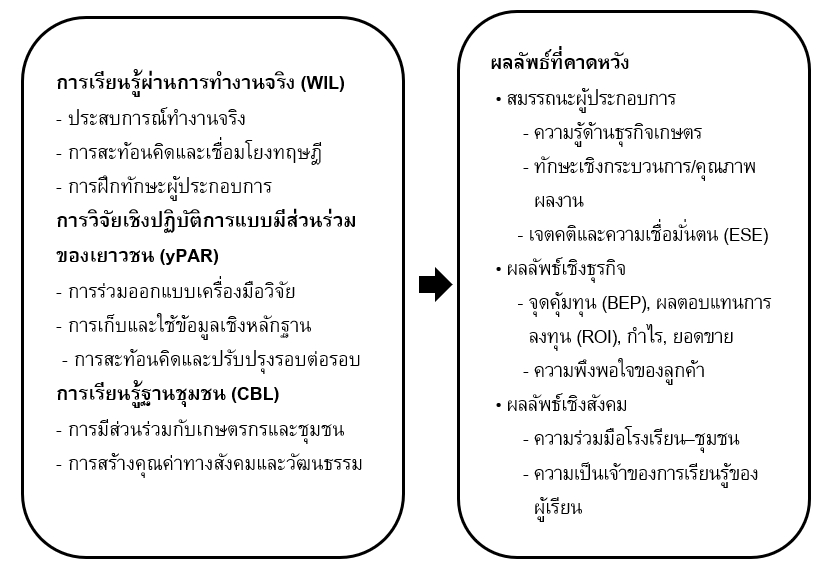
This research aimed to develop and evaluate a Work-Integrated Learning (WIL) unit integrated with Youth Participatory Action Research (yPAR) within a Community-Based Learning (CBL) context. The sample group consisted of 25 lower secondary students (Grades 7–9) from Ban Haet Municipal School, selected through purposive sampling, along with 12 community members contributing as key informants. The participants engaged in the "cultivation–processing–marketing" cycle of black glutinous rice. A mixed-methods approach was employed. Research instruments included 1) learning management plans, 2) an agribusiness knowledge test,
3) entrepreneurial self-efficacy and attitude scales, 4) a performance assessment form using an analytic rubric, and 5) a customer satisfaction questionnaire. Data were analyzed using mean, standard deviation, t-test for dependent samples, and content analysis. The findings indicated that: 1) Students' post-test scores in agribusiness knowledge, entrepreneurial self-efficacy, and entrepreneurial attitudes were significantly higher than pre-test scores (p<.001). 2) Performance competency scores met the criteria at an excellent level. 3) Regarding business outcomes, the project achieved a 15.8% return on investment (ROI) and attained a high level of customer satisfaction (Mean = 4.34). 4) Qualitative analysis revealed three key themes: student ownership of learning, cross-disciplinary knowledge integration in authentic contexts, and school–community collaboration yielding social value. These findings align with experiential learning frameworks and offer guidelines for enhancing student competencies in community contexts.
Downloads
References
He, J., & Giusti, M. M. (2010). Anthocyanins: Natural colorants with health-promoting properties. Annual Review of Food Science and Technology, 1(1), 163–187. https://doi.org/10.1146/annurev.food.080708.100754
Sompong, R., Siebenhandl-Ehn, S., Linsberger-Martin, G., & Berghofer, E. (2011). Physicochemical and antioxidative properties of Thai pigmented rice varieties. Food Chemistry, 124(1), 132–140.
https://doi.org/10.1016/j.foodchem.2010.05.115
Yodmanee, S., Karrila, T. T., & Pakdeechanuan, P. (2011). Physical, chemical and antioxidant properties of black glutinous rice. International Food Research Journal, 18(2), 421–431.
Shao, Y., & Bao, J. (2015). Polyphenols in whole rice and their health effects. Food Chemistry, 172, 40–49. https://doi.org/10.1016/j.foodchem.2014.08.116
Kolb, D. A. (1984). Experiential learning: Experience as the source of learning and development. Prentice-Hall.
Patrick, C.-J., Peach, D., Pocknee, C., Webb, F., Fletcher, M., & Pretto, G. (2008). The WIL report: A national scoping study. Queensland University of Technology. https://eprints.qut.edu.au/
Smith, C., Ferns, S., & Russell, L. (2014). Assessing the impact of WIL on student work-readiness. Asia-Pacific Journal of Cooperative Education, 15(4), 291–300.
Jackson, D. (2015). Employability skill development in work-integrated learning: Barriers and best practice. Asia-Pacific Journal of Cooperative Education, 16(3), 209–223.
Cammarota, J., & Fine, M. (2008). Revolutionizing education: Youth participatory action research in motion. Routledge.
Ozer, E. J. (2017). Youth-led participatory action research: Overview and potential for youth and community development. Adolescent Research Review, 2, 1–15 https://doi.org/10.1007/s40894-017-0057-2
Chen, C. C., Greene, P. G., & Crick, A. (1998). Does entrepreneurial self-efficacy distinguish entrepreneurs from managers?. Journal of Business Venturing, 13(4), 295–316.
Ajzen, I. (1991). The theory of planned behavior. Organizational Behavior and Human Decision Processes, 50(2), 179–211.
Bacigalupo, M., Kampylis, P., Punie, Y., & Van den Brande, G. (2016). EntreComp: The entrepreneurship competence framework. Publications Office of the European Union. https://data.europa.eu/doi/10.2791/593884
Bringle, R. G., & Hatcher, J. A. (1996). Implementing service-learning in higher education. Journal of Higher Education, 67(2), 221–239.
Nonedang, J & Techaatik, S. (2019). Implementation and Problems of Organic Brown Rice Group, Tum bon Nong Saeng, Ban Haet District, Khon Kaen Province. The 20th National Graduate Research Conference. March 15, 2019 at Khon Kaen University.
Hattie, J., & Timperley, H. (2007). The power of feedback. Review of Educational Research, 77(1), 81–112. https://doi.org/10.3102/003465430298487
Siemens, G., & Long, P. (2011). Penetrating the fog: Analytics in learning and education. EDUCAUSE Review, 46(1), 30–40. https://er.educause.edu/articles/2011/9/penetrating-the-fog-analytics-in-learning-and-education
Downloads
Published
How to Cite
Issue
Section
License
Copyright (c) 2025 Journal of Research and Innovation in Industrial Education

This work is licensed under a Creative Commons Attribution-NonCommercial-NoDerivatives 4.0 International License.
This article is published under a Creative Commons Attribution-NonCommercial-NoDerivatives 4.0 International License (CC BY-NC-ND 4.0), which allows others to share the article with proper attribution to the authors and prohibits commercial use or modification. For any other reuse or republication, permission from the journal and the authors is required.